Florida regulates roofing more tightly than almost any state in the country, and for good reason: the roof is the single component that decides whether a Florida building survives a hurricane. Wind does not usually destroy a house by pushing it over. It lifts the roof covering, gets inside, pressurises the structure and takes the walls with it. Every layer of Florida’s roofing regime — state contractor licensing, product approvals, the High-Velocity Hurricane Zone, secondary water barriers, mandatory re-nailing at replacement — exists because of that failure sequence.
This directory lists roofing and waterproofing companies working across Florida: tile and metal specialists in South Florida, shingle re-roofers across Central Florida and the Gulf coast, low-slope and commercial membrane contractors on the state’s enormous inventory of flat-roofed retail, hospitality and institutional buildings, and waterproofing firms handling the balcony, plaza-deck and building-envelope work that Florida’s coastal high-rises consume continuously.
Licensing is mandatory and verifiable
Roofing contractors in Florida must be licensed through the Department of Business and Professional Regulation under the Construction Industry Licensing Board. The roofing classification is a certified roofing contractor (CCC prefix), valid statewide, or a registered roofing contractor, valid only in the local jurisdiction that issued the underlying competency card. Both carry the same core obligation: the licensee must qualify the business, carry general liability and property damage coverage at the statutory minimums, and either carry workers’ compensation or hold a valid exemption.
Every license is searchable on the DBPR public license portal by name or license number, and checking it takes under a minute. In Florida this is not optional diligence — unlicensed contracting is a criminal offence here, it escalates to a felony during a declared state of emergency, and a homeowner who hires an unlicensed roofer generally has no recourse to the state’s recovery fund and may find the work uninsurable and unpermittable.
The High-Velocity Hurricane Zone
Miami-Dade and Broward counties operate under the High-Velocity Hurricane Zone provisions of the Florida Building Code — the most stringent wind-resistance standard in the United States. In the HVHZ, every roofing component must carry a Miami-Dade Notice of Acceptance or a Florida Product Approval demonstrating it was tested as a system to HVHZ protocols: TAS 100 for wind driven rain, TAS 105 and 107 for uplift, TAS 125 for tile. Components cannot be mixed across systems. A tile, an underlayment and a fastener that each carry an NOA individually are not an approved assembly unless they were tested together.
Outside the HVHZ, the rest of the state still works to Florida Product Approval, and design wind speeds vary sharply by county and by distance from the coast. A roofer quoting the same assembly in Naples and in Ocala is not reading the code.
The 25 percent rule and secondary water barriers
Two Florida-specific rules dominate re-roofing conversations. The first is the repair-versus-replace threshold, commonly called the 25 percent rule: when more than a quarter of a roof section is repaired or replaced within a twelve-month period, the entire section generally must be brought into compliance with current code, not patched. Florida has since carved out relief where the existing roof was built to the 2007 Florida Building Code or later and is demonstrably compliant, but the default remains that large repairs trigger full compliance.
The second is the secondary water barrier. At replacement, Florida requires the roof deck to be re-nailed to current fastening standards and a sealed secondary water barrier installed — a taped or self-adhered layer over the deck seams that keeps water out even if the primary covering blows off. This is the single most effective mitigation measure in Florida residential construction, and it is also the line item most often missing from an underpriced bid.
Insurance, mitigation and the wind mitigation inspection
Florida’s property insurance market has been volatile, and roof age and condition are the primary underwriting variables. Carriers routinely refuse or non-renew coverage on older roofs, and Florida law protects a roof less than 15 years old from being denied coverage solely on age where an inspection shows five or more years of remaining life. That makes the wind mitigation inspection form the most valuable piece of paper a Florida homeowner holds. It documents roof covering compliance, deck attachment, roof-to-wall connections (clips, single wraps, double wraps), roof geometry and the presence of a secondary water barrier — and each line generates a premium credit.
A competent Florida roofer will build the mitigation credits into the scope: upgraded roof-to-wall connections during a re-roof cost a fraction of what they cost as standalone work, and the premium savings are permanent.
Assemblies that work in Florida
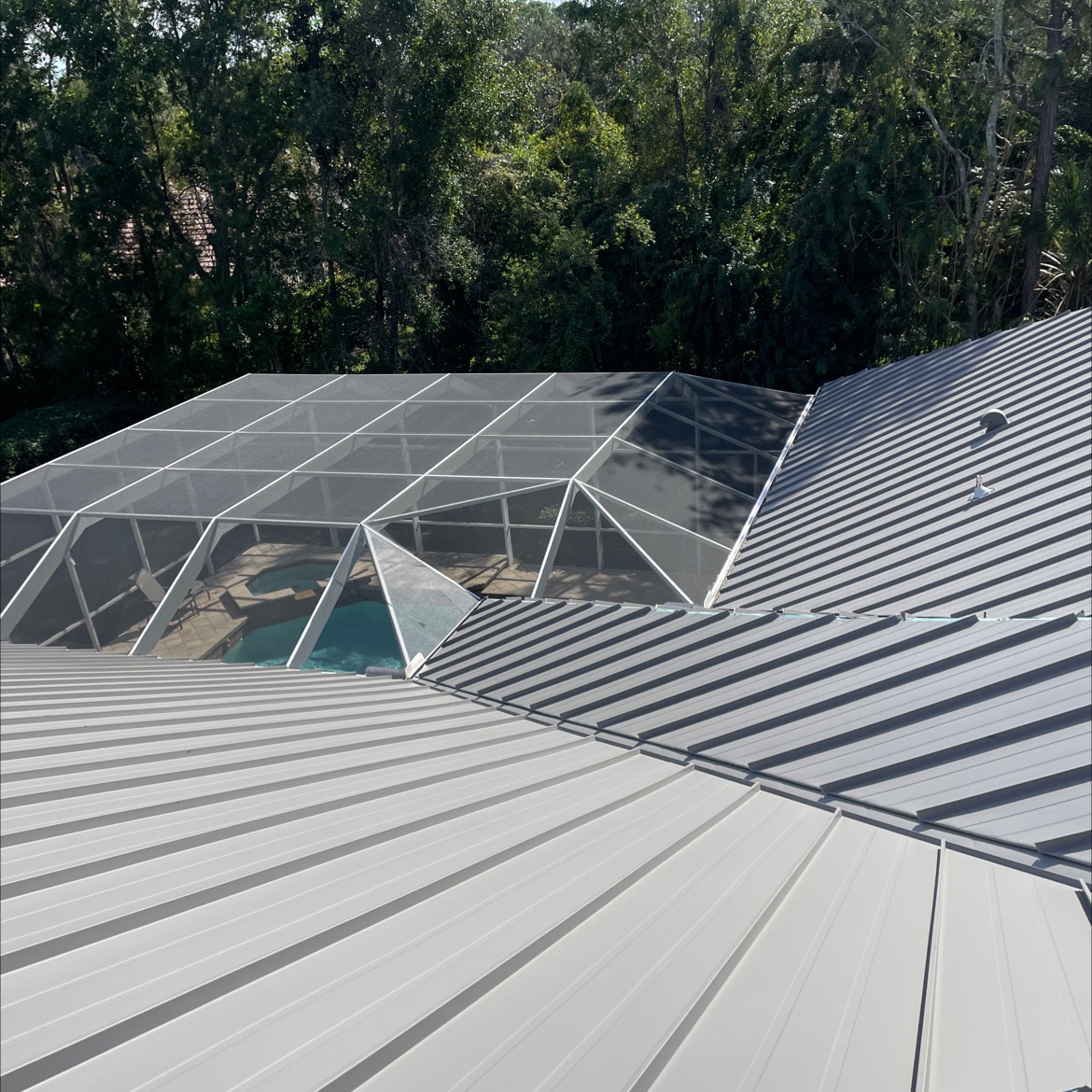
Concrete and clay tile dominate South Florida for wind performance, longevity and heat rejection, and mortar-set versus foam-set versus mechanically fastened is a real engineering decision, not a preference. Metal has grown rapidly statewide — standing seam handles uplift well, sheds rain fast, and reflects the solar gain that drives Florida cooling loads. Architectural shingles remain the volume product in Central and North Florida, where design wind speeds are lower. On the low-slope side, TPO and modified bitumen carry most of the commercial and multifamily stock, and reflective membranes are effectively standard given the cooling climate.
Whatever the covering, ventilation and moisture control matter more here than almost anywhere. Florida’s combination of heat and humidity turns an unvented or poorly detailed attic into a condensation and mould problem. Ridge and soffit balance, correctly sealed penetrations, and underlayment appropriate to the covering are what separate a fifteen-year roof from a thirty-year one.
Choosing a Florida roofer
Verify the DBPR license number online before signing. Confirm general liability and workers’ compensation, and confirm the contractor pulls the permit in their own name — a contractor asking the homeowner to pull an owner-builder permit is transferring liability, not saving money. Ask for the Product Approval or NOA numbers for the specific assembly proposed. Ask explicitly how the secondary water barrier and deck re-nailing are being handled. And get the wind mitigation inspection done after completion; the credits are worth real money every year the roof stands.
Roofing & Waterproofing contractors in other regions: Arizona, California, Colorado, Georgia, Illinois, Indiana, Louisiana, Massachusetts, Michigan, Minnesota, Missouri, New York, North Carolina, Ohio, Oklahoma, Ontario, Pennsylvania, South Carolina, Tennessee, Texas, Utah, Virginia, Washington.
Other trades in Florida: Demolition & Disposal, General Contracting, HVAC, Mechanical, Renovation & Remodeling.
Jump to licence verification sources for Roofing & Waterproofing in Florida, or back to all roofing & waterproofing contractors on Exchange.