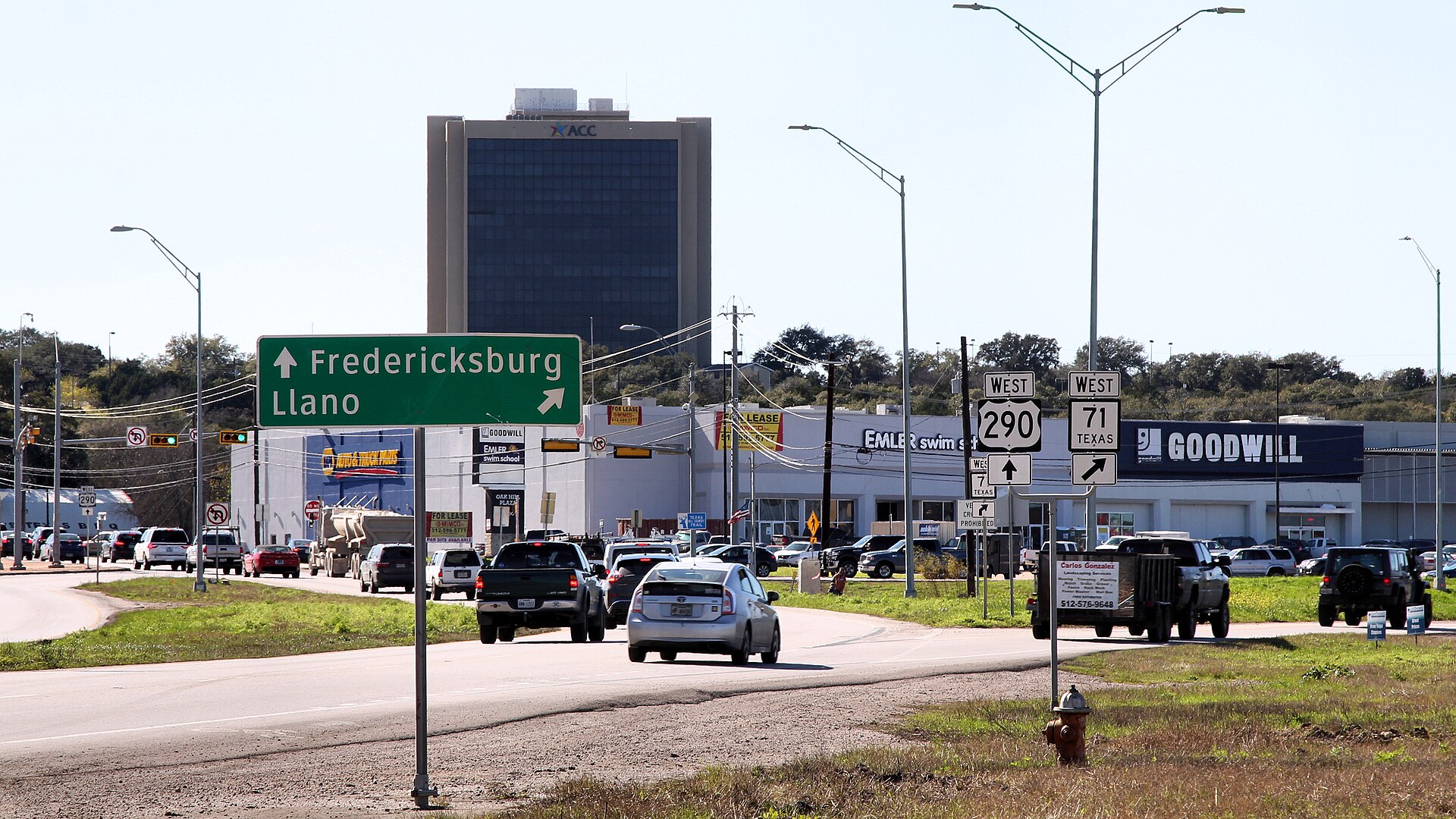
The Oak Hill Parkway in southwest Austin is open, about three decades after TxDOT says the US 290 and SH 71 junction hit capacity. The $677 million design-build job replaced the old Oak Hill “Y,” where two highways squeezed through one signalized split, with a single-point urban interchange, direct-connect flyovers and nonstop mainlanes.
Colorado River Constructors, a joint venture of Fluor and Balfour Beatty, reached substantial completion on July 20, 2026, and held the grand opening Sept. 24. Landscaping, paving and striping run through year-end.
Project Scope
The corridor covers about seven miles: US 290 from near Circle Drive to Loop 1, and SH 71 from US 290 to Silvermine Drive. US 290 went from two mainlanes to three in each direction, with frontage roads alongside, and now passes over William Cannon Drive instead of stopping at it. New intersections went in at Convict Hill Road, RM 1826, Scenic Brook Drive and Circle Drive. Past Scenic Brook, SH 71 becomes a five-lane rural section with U-turns in place of signals.
AECOM was lead engineer, with P.E. Structural Consultants, Rios Engineering, SE3 and Terracon as design subconsultants. Raba Kistner handled independent quality, Hicks & Company the environmental work and Bartlett Tree Experts the trees.
The site was harder than the map suggests. It sits on the Edwards Aquifer recharge zone, so the team mapped karst and built water quality ponds along the corridor, plus an offsite detention pond of about 67 acre-feet with its own dam and spillway. Instead of stacking bridges, crews built down, cutting as deep as 25 feet into limestone on the west end. Two lanes each way stayed open during the day, and protected oaks got their own contract terms and a project arborist.
The finished corridor carries 14 miles of shared-use path and 1.5 miles of sidewalk. It won the National Association of Environmental Professionals’ 2026 award for public involvement and education.
Why It Matters
Oak Hill is a clean test of the Texas Clear Lanes program, which targets the state’s worst chokepoints. The pitch here was simple: fix one bad interchange and the cut-through traffic in the surrounding neighborhoods goes with it.
The schedule slipped, but not much. Fluor’s 2020 award announcement targeted 2025, a 2022 trade-press update said early 2026, and substantial completion landed in July 2026. For a five-year build over karst with traffic running, that’s respectable.
The price moved a little too. Earlier coverage put the job at $674 million, and this fall’s opening coverage says $677 million. Nobody has published a reconciliation, and a $3 million drift on a contract this size barely registers.
Whether the parkway fixes the Oak Hill commute depends on what sits at either end of it. A faster interchange tends to move a queue, not erase it, and Loop 1 has queues of its own.
Related coverage & projects
Project Team & Details
| Owner / Client | Texas Department of Transportation |
|---|
| Consultants | AECOM (Lead Engineer)
P.E. Structural Consultants (Design Subconsultant)
Rios Engineering (Design Subconsultant)
SE3 (Design Subconsultant)
Terracon (Design Subconsultant)
Raba Kistner (Lead Independent Quality Firm)
Hicks & Company (Environmental)
Bartlett Tree Experts (Tree Services)
The Whiddon Group (Utility Coordination)
Property Acquisition Services (Right-of-Way Acquisition) |
|---|
| General Contractor | Colorado River Constructors (Fluor Enterprises and Balfour Beatty joint venture) |
|---|
| Status | Completed |
|---|
| Delivery Method | Design-Build |
|---|
| Funding Source | Public (State) |
|---|