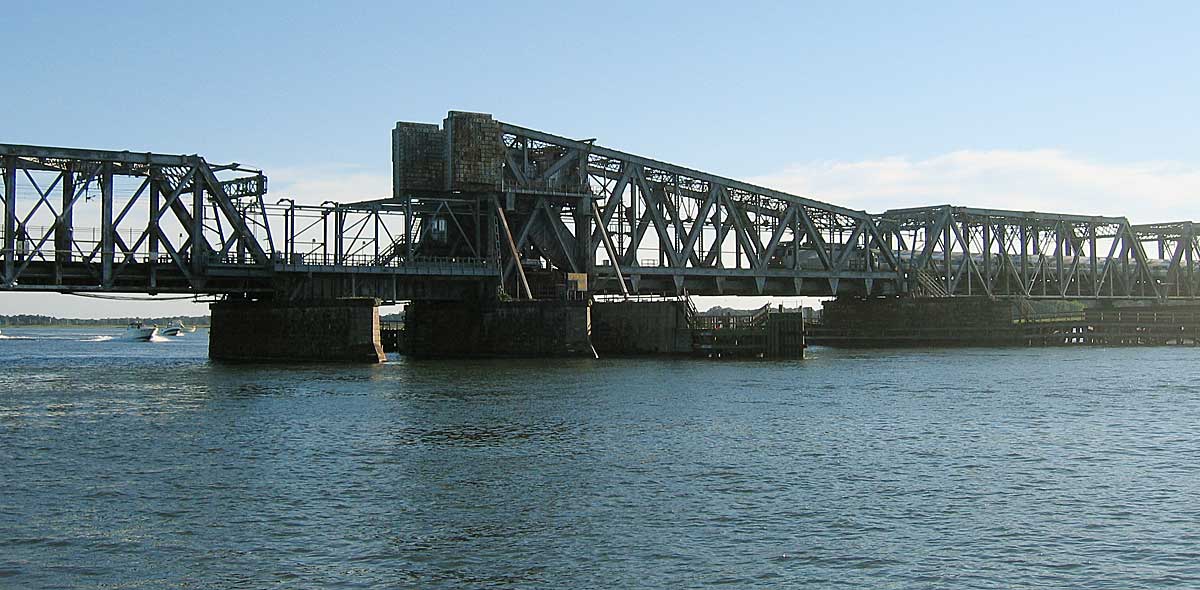
The bridge Amtrak is replacing opened the year Ford started building the Model T. Its successor is going up about 50 feet to the south, which is the whole point: trains keep running on the old structure while crews build the new one alongside, then the tie-ins happen at the ends.
Amtrak awarded the construction contract to a joint venture of O&G Industries and Tutor Perini in June 2024. The Federal Railroad Administration is carrying $826.64 million of the roughly $1.3 billion cost through a Bipartisan Infrastructure Law grant. STV handled design engineering.
Project Scope
The replacement is a two-track, electrified trunnion bascule bridge carrying the Northeast Corridor across the Connecticut River between Old Saybrook and Old Lyme at milepost 106.89. Track tie-ins run 1,000 to 1,500 feet off each approach. The 1907 bridge it replaces is a movable structure with a 45 mph speed restriction; the new span is designed for 70 mph, a 55 percent increase across one of the slowest segments between New York and Boston.
Building offline and shifting the alignment avoids the outage windows that make in-place rail bridge replacement so expensive. It also means the new structure gets built to modern seismic and scour standards without the compromises that come with reusing century-old substructure.
Why It Matters
The Northeast Corridor’s movable bridges are the corridor’s real speed ceiling. Amtrak has been working through them one at a time — Portal North, Dock Bridge, Susquehanna, now the Connecticut River — and each one buys back minutes that no amount of rolling stock investment can recover. A 45-to-70 mph jump on a two-mile stretch sounds small until you multiply it by the roughly 40 trains a day that cross it.
There’s a second argument that’s easier to miss. The 1907 bridge opens for marine traffic, and every opening is an unplanned delay for a passenger railroad trying to sell on-time performance. Federal money is flowing to these structures because the maintenance bill on 120-year-old movable machinery keeps rising while reliability keeps falling. Replacement is the cheaper answer, eventually.
Project Team & Details
| Developer | Amtrak |
|---|
| Owner / Client | Amtrak (National Railroad Passenger Corporation) |
|---|
| Consultants | STV Inc. (Design Engineering) |
|---|
| General Contractor | O&G Industries / Tutor Perini Joint Venture |
|---|
| Status | Under Construction |
|---|
| Delivery Method | Design-Bid-Build |
|---|
| Funding Source | Public (Federal) |
|---|