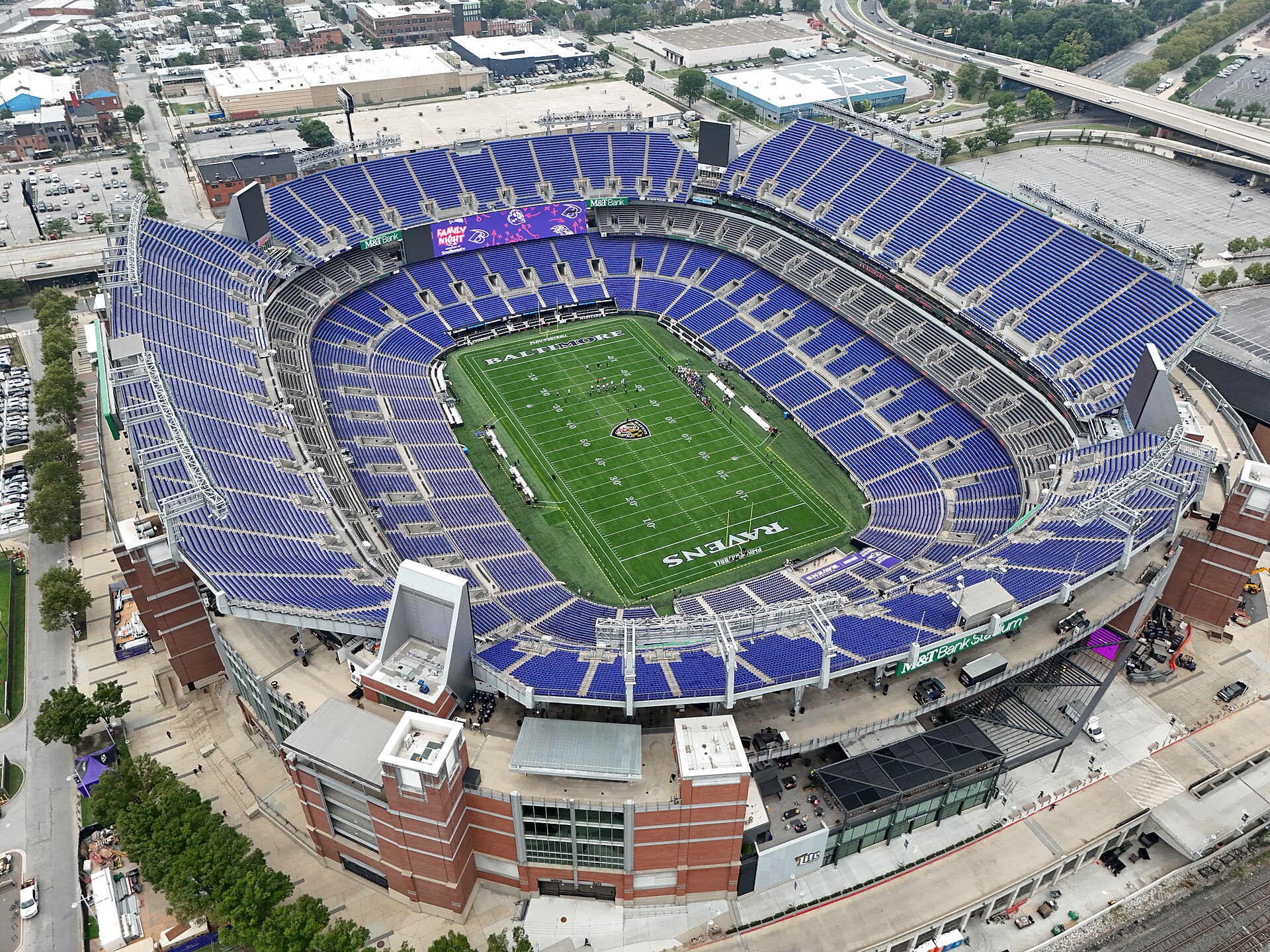
The M&T Bank Stadium renovation in Baltimore wrapped in August 2026, three offseasons and $489 million after it started. The Ravens debuted the last phase at their preseason opener against the Philadelphia Eagles, and the Maryland Stadium Authority now owns a 1998 building that’s been reworked from the service level up without giving up a home game.
That last part is the story. Gilbane Building Company, the construction manager at-risk, never had the stadium to itself for more than about six months at a stretch.
Project Scope
Gensler designed the program and Gilbane delivered it in three annual phases, each one due before kickoff. Phase one opened in August 2024 with new field-level seating, The Blackwing suites and club, and the Miller Lite Gatehouse, a two-level beer hall with a rooftop deck. ENR, which gave that phase an Award of Merit, put it at 200,000 square feet of new and renovated space built around structural expansions at the north gate. Crews worked seven days a week to make the date.
Phase two followed in August 2025: field-level suites that Gilbane says required heavy excavation, the Champions Club, more premium suites, and two retail stores including a year-round team shop. Phase three, finished this summer, added an open-air music stage the team calls The Talon, an indoor sports bar, a hospitality expansion of more than 7,000 square feet on the upper level, and 30 percent more restroom fixtures in the upper deck. The Ravens say they’ve added more than 12,800 square feet of video display since 2025.
The engineering bench on phase one included A&F Engineers on structure, SSR on MEP and RK&K on civil. Trade contractors named by ENR include Crystal Steel Fabricators, Keller North America, Nicholson Construction, Henry J. Knott Masonry and W.G. Tomko. Gilbane says the job peaked above 400 tradespeople, with Corenic Construction as its minority business partner.
Why It Matters
Public money paid for this. When ENR reported Gilbane’s selection in December 2023, the figure was $430 million, drawn from $600 million in state bond capacity set aside for the stadium. The Ravens now describe a $489 million program carried out with the authority. Neither party has published a reconciliation of the two numbers, and readers should treat them as snapshots taken nearly three years apart.
What the state bought isn’t more seats. It’s a venue meant to earn on the 350-odd days a year without football, and the early evidence is decent: the stadium hosted a D.C. United match in March 2026, a Morgan Wallen concert in July and BTS shows in August that the team says drew more than 140,000 people.
The Ravens’ lease runs through at least the 2037 season. That gives Maryland 11 seasons to learn whether a beer hall and a music stage were the cheaper alternative to a replacement stadium.
Related coverage & projects
Project Team & Details
| Developer | Baltimore Ravens |
|---|
| Owner / Client | Maryland Stadium Authority |
|---|
| Architect | Gensler |
|---|
| Consultants | A&F Engineers (Structural, Phase 1)
SSR (MEP, Phase 1)
RK&K (Civil, Phase 1) |
|---|
| General Contractor | Gilbane Building Company |
|---|
| Major Subcontractors | Corenic Construction (MBE partner)
Crystal Steel Fabricators (Steel)
Reedbird Steel (Steel)
Henry J. Knott Masonry (Masonry)
Keller North America (Geotechnical)
Nicholson Construction (Geotechnical)
W.G. Tomko (Mechanical) |
|---|
| Status | Completed |
|---|
| Delivery Method | CMAR |
|---|
| Funding Source | Public (State) |
|---|