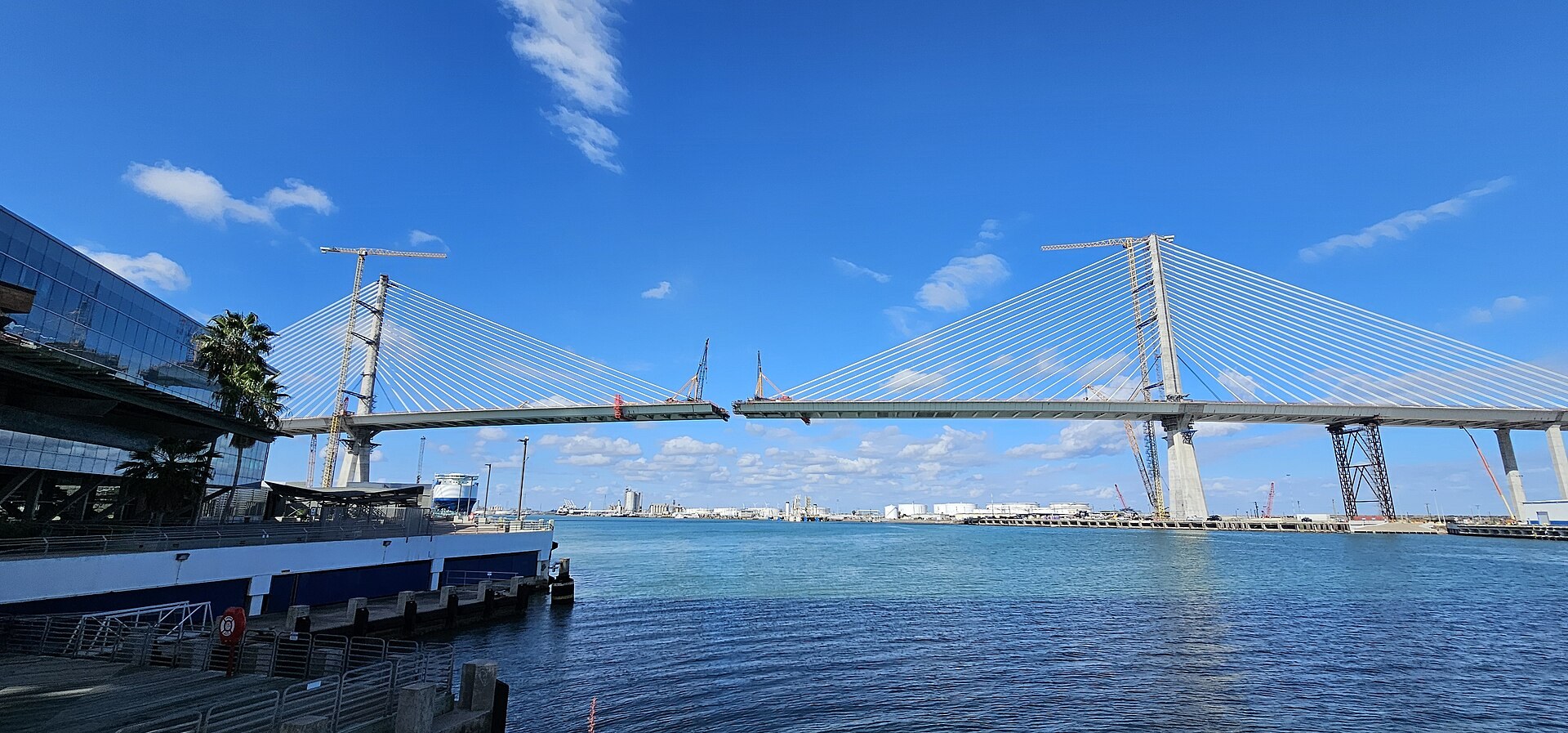
The span is the record. The contract is the case study.
TxDOT’s replacement for the 1959 US 181 Harbor Bridge carries a 1,661-foot cable-stayed main span, the longest concrete segmental cable-stayed span in North America. It opened to traffic in June 2025, more than five years past the original spring 2020 target, after an independent structural review, a work stoppage and a settlement worth roughly $400 million.
Both halves of that sentence are why the job matters.
Project Scope
Flatiron/Dragados LLC, a joint venture of Flatiron Construction Corp. and Dragados USA, holds the design-build contract. Twin towers rise 538 feet. The deck is 134 feet wide, carries six lanes of US 181 plus a shared-use bicycle and pedestrian path, and clears the ship channel by 205 feet. Total structure length with approaches is 10,820 feet.
The wider scope dwarfs the signature span: 6.44 miles of bridge and connecting roadway, 18 additional non-cable-stayed bridges and ramps, about 1.6 miles of rebuilt I-37 and a mile of the Crosstown Expressway. Precast prestressed concrete box girder segments were set with a delta frame lifting system and are specified for a 170-year design life.
Reported cost sits between $1.2 billion and $1.3 billion depending on the source. The 2015 design-build contract was about $803 million, and the 2023 settlement added roughly $400 million on top of it.
The commercial history is unusual. FIGG Bridge Engineers was removed as design engineer in 2020 and replaced by Arup as engineer of record. TxDOT then halted construction in 2022 over structural design concerns raised by an independent review, and the 2023 settlement resolved the dispute and restarted the work.
Taking the old bridge down is its own heavy-civil exercise. Mammoet engineered removal of the 1959 structure’s 2,300-tonne center span in a single lift, using four 900-tonne strand jacks and 54 strand wires to lower it about 50 meters onto a barge, which was towed 10 nautical miles for breakup.
Why It Matters
Owners and contractors cite Harbor Bridge when they argue about design-build risk allocation, specifically what happens when the engineer of record gets replaced mid-build and nobody’s contract anticipated it. The 2022 stand-down and the settlement that followed have already changed how Texas and other state DOTs write independent-review provisions into design-build agreements.
The construction record stands on its own. Segmental delta-frame erection at this span length, and a single-lift truss removal over a live deep-draft ship channel, are both benchmark operations that few crews in the country have done.
There is a third thread here for anyone working public infrastructure. The new alignment pulls the old bridge’s ramps out of the Hillcrest and Washington-Coles neighborhoods, and the mitigation package attached to that relocation was central to how the project got approved.
Project Team & Details
| Owner / Client | Texas Department of Transportation (TxDOT) |
|---|
| Consultants | Arup (Engineer of Record from 2020, as Arup-CFC)
FIGG Bridge Engineers (original design engineer, replaced in 2020) |
|---|
| General Contractor | Flatiron/Dragados LLC (joint venture of Flatiron Construction Corp. and Dragados USA) |
|---|
| Major Subcontractors | Mammoet (heavy-lift engineering for removal of the old bridge center span) |
|---|
| Status | Completed |
|---|
| Delivery Method | Design-Build |
|---|
| Funding Source | Public (State) |
|---|