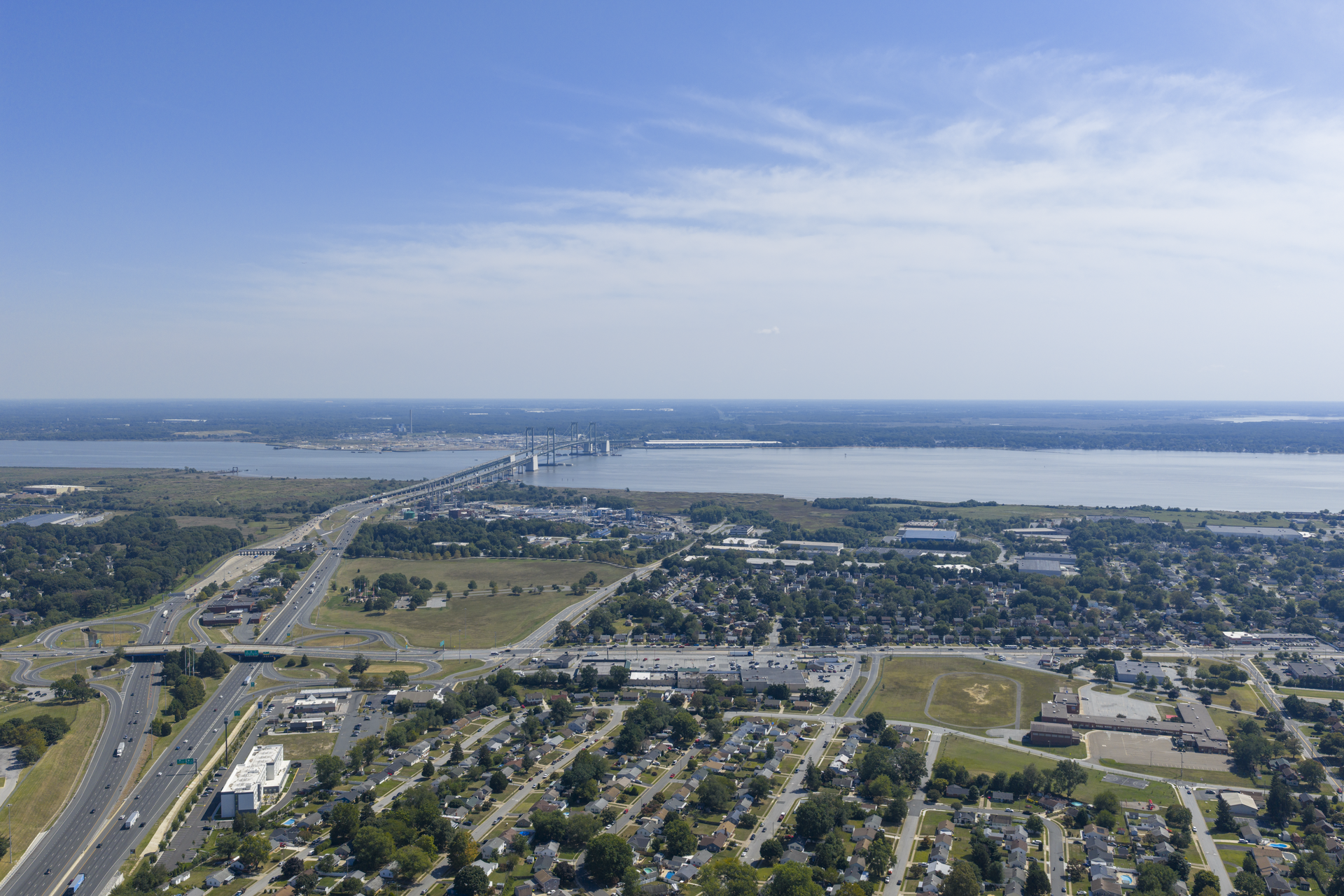
The Delaware River and Bay Authority started this job fourteen months before a container ship took down the Francis Scott Key Bridge. By the time the industry was asking what pier protection actually costs, the answer was already being driven into the riverbed outside Wilmington.
The DRBA marked completion of the Delaware Memorial Bridge ship collision protection system on August 12, 2026, alongside the 75th anniversary of the first span. Eight solid-fill dolphin cells now stand around the piers carrying the twin suspension bridges’ 440-ft towers, four per tower pair. The contract ran $93 million and closed out near $89 million.
Project Scope
R.E. Pierson Construction Company built each cell from 150 interlocked sheet piles, 115 ft long, driven 45 ft through silty clay into dense sand below. The cells measure 80 ft in diameter, get filled with sand, stone and riprap, and carry a concrete collar at the outer face. Modjeski and Masters designed the protection system for both spans, with Pennoni providing engineering support.
The design case is a 120,000-DWT Neopanamax vessel striking at roughly 7 knots. For scale, the M/V Dali that destroyed Baltimore’s Key Bridge in March 2024 displaced about 116,000 DWT.
Two constraints shaped everything. The cells had to sit at least 443 ft off the edge of an 800-ft-wide, 50-ft-deep federal navigation channel, so the Coast Guard stayed in the loop continuously and shipping kept moving. And a fishery restriction bans pile driving in the Delaware River from March 1 through June 30 every year, which set the entire construction sequence around a nine-month annual window.
Why It Matters
What the bridge had before was the original channel-side fender system from the 1950s and 60s spans. Those same fenders were struck by the tanker Regent Liverpool in July 1969, causing roughly $1 million in damage, about $7 million today.
The job has since become a reference case. DRBA says other bridge owners have requested the plans and toured the site. NTSB’s March 2025 vulnerability guidance faulted the Key Bridge’s four 28-ft rubber-fendered dolphins as both undersized and badly located, which is precisely the failure mode eight 80-ft cells are built to avoid.
The bridge carries more than 100,000 vehicles a day on the I-95 corridor. Funding came from DRBA toll revenue plus a $22.25 million USDOT BUILD grant.
Related coverage & projects
Project Team & Details
| Owner / Client | Delaware River and Bay Authority |
|---|
| Consultants | Modjeski and Masters (Vessel Collision Protection Design)
Pennoni (Engineering Support) |
|---|
| General Contractor | R.E. Pierson Construction Company |
|---|
| Status | Completed |
|---|
| Delivery Method | Design-Bid-Build |
|---|
| Funding Source | Mixed |
|---|