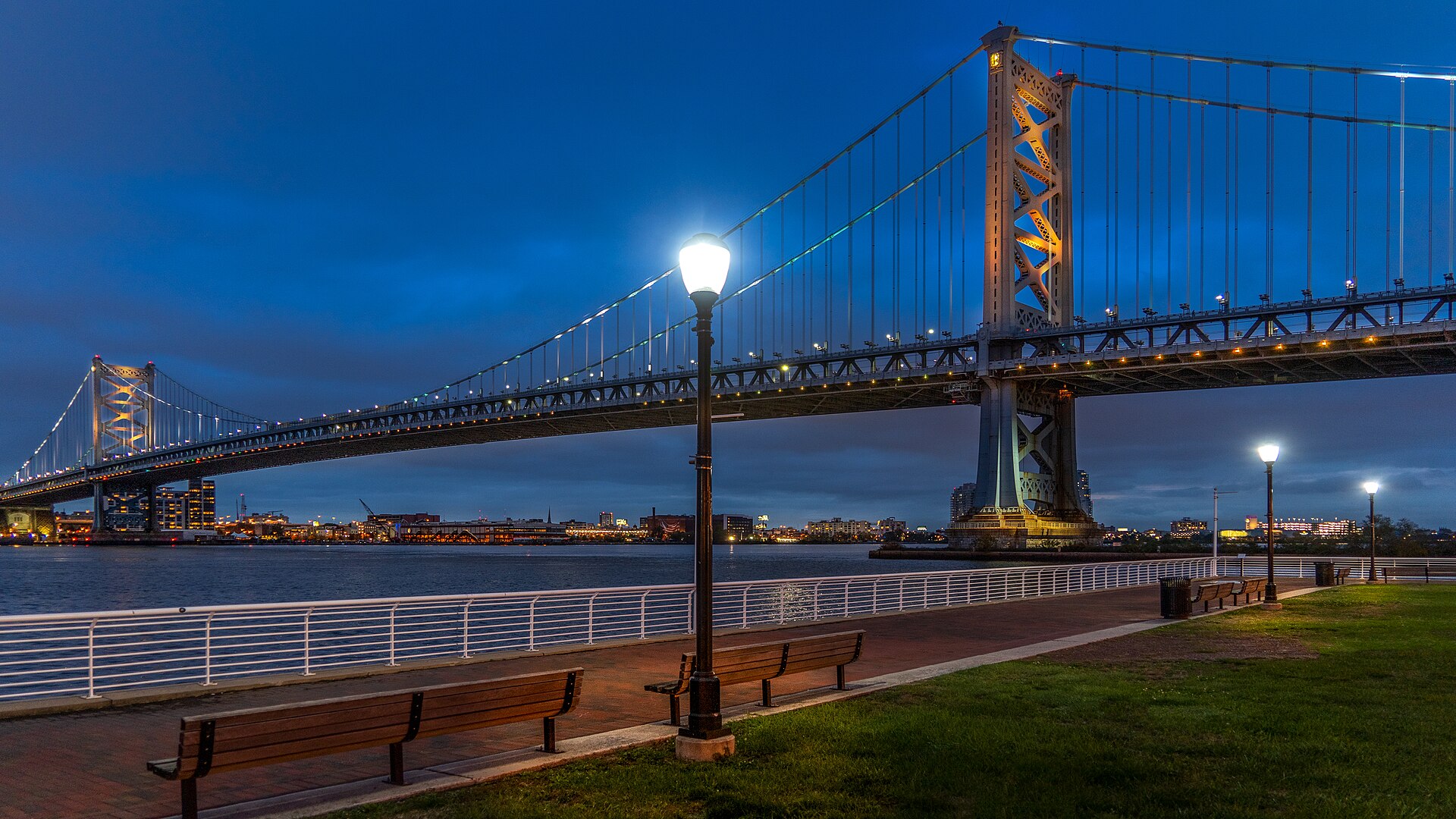
The Ben Franklin Bridge rehabilitation did something most drivers crossing the Delaware never saw: it turned the main cables of a 1926 suspension bridge into a climate-controlled space. The Delaware River Port Authority bundled five separate jobs into one $216.9 million program on the suspension span and its anchorages, and now lists the work as complete.
Skanska held the construction contract, which the company valued at $195 million when it booked the order in 2020. Work started that February with a planned finish at the end of 2024.
The bridge is not a forgiving place to work. It carries seven lanes of I-676 and US 30 plus two PATCO rail tracks between Philadelphia and Camden, and it stayed open throughout.
Project Scope
The headline item was main cable dehumidification. Crews built an enclosure inside the Philadelphia anchorage to house a plant that pushes dry air through the cables, holding relative humidity at 40 percent or below. Skanska’s scope description also covers elastomeric wrapping of the cables, which seals the system so the dry air stays where it’s needed.
The riskier structural work sat at the towers and anchorages. Pin-and-link assemblies, the components that tie the suspended structure back to its supports, were replaced using temporary bracing and jacking. Wind lock assemblies were replaced too, and the lateral bracing repaired.
Then came the long list. Maintenance painting and steel repairs ran the length of the suspended spans from underbridge platforms that doubled as paint containment. Inside the anchorages, crews repaired reinforced concrete and steel members and repainted. Both walkways were rehabilitated, the north walkway was widened on the Camden side, and the decorative lighting was replaced.
Why It Matters
Ralph Modjeski’s bridge had the longest suspension span in the world when it opened on July 1, 1926, at 1,750 feet. A century on, its cables can’t be swapped out the way a deck can. Corrosion inside a wire bundle is slow, hidden and very expensive to reverse, which is why owners of older suspension bridges have been retrofitting dry-air systems instead of waiting for wire breaks.
DRPA had already done a main cable investigation and dehumidification design on the Walt Whitman Bridge downstream. The Ben Franklin job is the bigger and older test.
It also isn’t the end of the spending. The authority’s current five-year capital program still carries $133.6 million for the bridge between 2026 and 2030, and a separate rehabilitation of the century-old masonry is under way. Suspension cables that stay dry buy time. They don’t buy an exit from maintenance.
Related coverage & projects
Project Team & Details
| Owner / Client | Delaware River Port Authority (DRPA) |
|---|
| General Contractor | Skanska |
|---|
| Status | Completed |
|---|