Most American transit tunnels get built twice: bore two tubes, then cut and cover a box for each station. VTA is trying something else in San Jose.
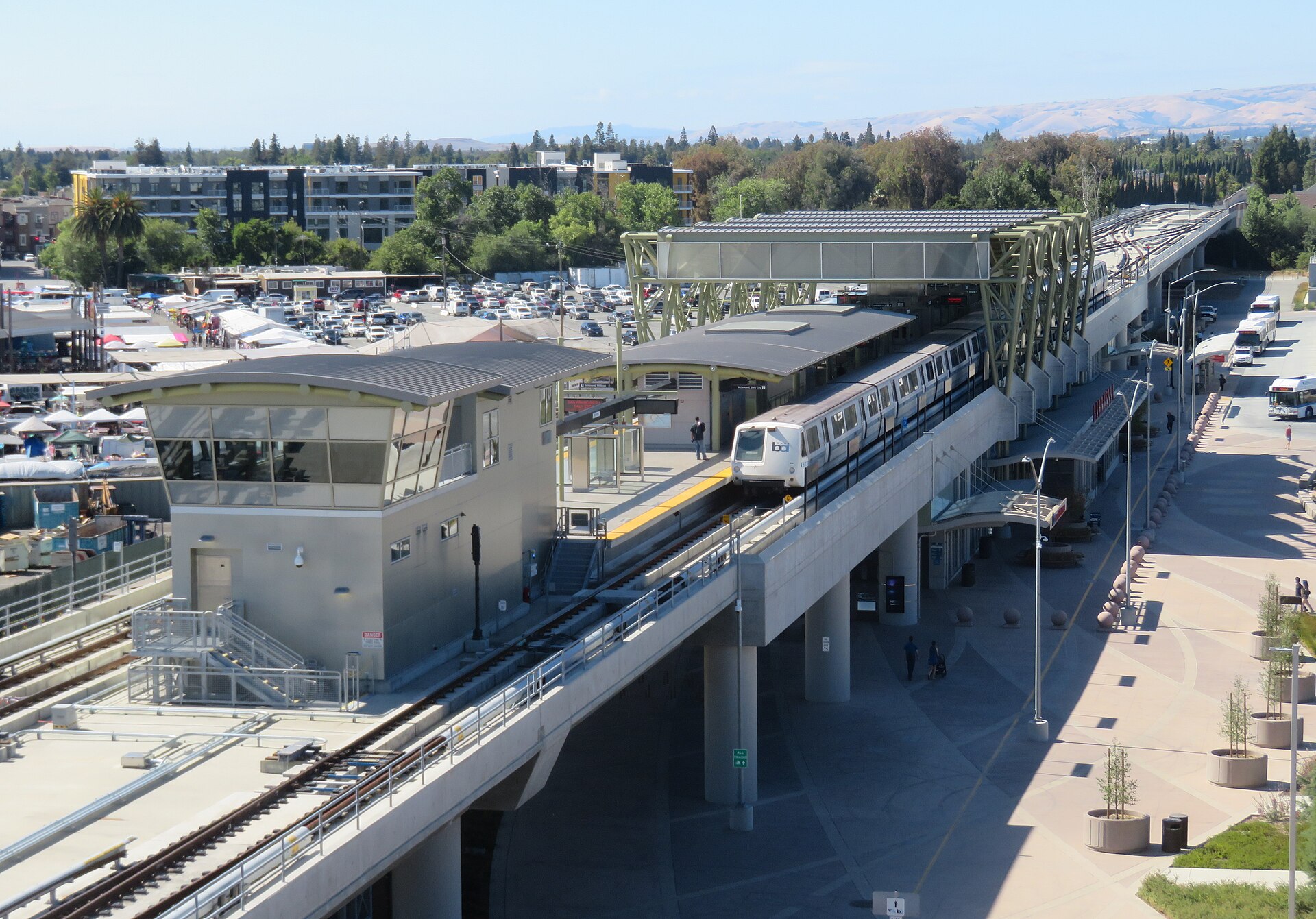
The BART Silicon Valley Phase II Extension runs six miles from the existing Berryessa terminus southwest under Santa Clara Street to a new maintenance yard in Santa Clara. Five of those miles are a single bore roughly 43 feet in internal diameter, big enough that the platforms at Downtown San Jose and Diridon sit inside the tunnel itself rather than in separate excavated boxes. It’s the first application of the method to urban transit in the United States, and VTA calls the project California’s largest infrastructure job.
Project Scope
The capital cost was rebaselined at $12.7 billion in 2024, though VTA’s more recent monitoring reports cite roughly $12.2 billion, and both figures are still circulating. Four contract packages split the work. Kiewit Shea Traylor Joint Venture holds CP2, the tunnel and trackwork, under a progressive design-build agreement; the systems, yard, and underground station packages run design-bid-build. Bechtel Infrastructure holds a $490 million construction management contract through June 2034. Mott MacDonald and PGH Wong Engineering serve as general engineering consultant.
Construction began with early works in spring 2024. By January 2026 more than 70 percent of the tunnel launch structure walls at Newhall Yard were complete, including the deepest section of the launch shaft. Six months later crews had finished the launch structure walls, roughly three quarters of the excavation, and about a third of the concrete ramp. Tunnel design is at 100 percent, the custom TBM is in manufacture, and boring is targeted for 2027. Four new stations and a 500-space garage at Santa Clara round out the program, with passenger service anticipated in 2036.
Why It Matters
Single-bore is a schedule and disruption argument more than a cost argument. Building platforms inside the tunnel keeps Santa Clara Street open and avoids the years of cut-and-cover that made the Central Subway and Second Avenue Subway so unpopular with the businesses above them. The trade is a much larger, more expensive machine and a station design problem nobody in the U.S. has solved at this scale before.
The funding stack matters too: a $1.735 billion FTA Capital Investment Grant application sits alongside 2016 Measure B county sales tax revenue and $100 million in state grants secured in 2025. A ten-year federal commitment on a twelve-year build is its own kind of engineering.
Related coverage & projects
Project Team & Details
| Developer | Santa Clara Valley Transportation Authority (VTA) |
|---|
| Owner / Client | Santa Clara Valley Transportation Authority (VTA); operated by BART |
|---|
| Consultants | Mott MacDonald / PGH Wong Engineering JV (General Engineering Consultant)
Bechtel Infrastructure Corporation (Construction Management) |
|---|
| General Contractor | Kiewit Shea Traylor Joint Venture |
|---|
| Status | Under Construction |
|---|
| Delivery Method | Design-Build |
|---|
| Funding Source | Mixed |
|---|