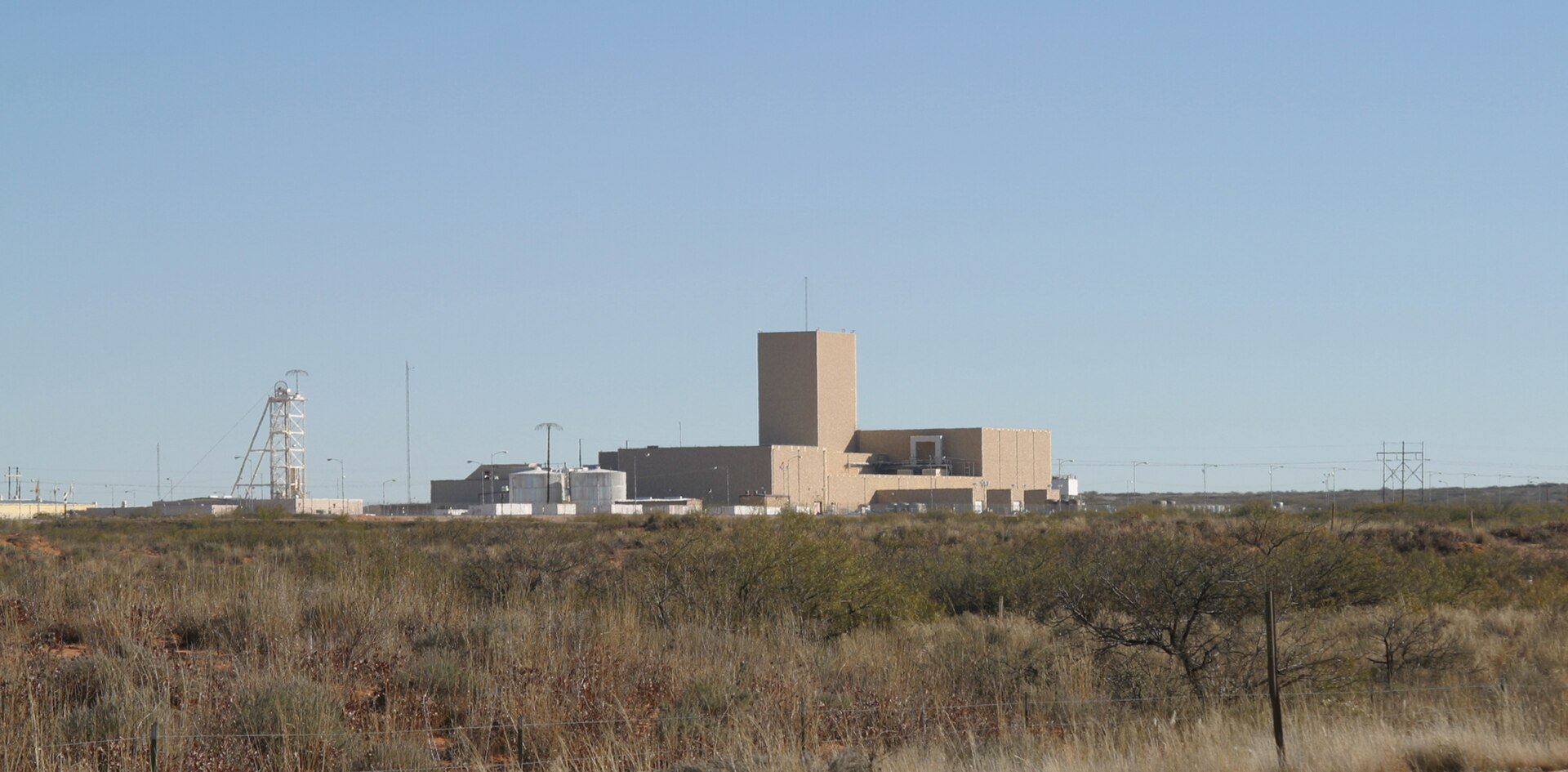
The WIPP ventilation system near Carlsbad triples the air a nuclear waste repository can push through rooms mined 2,150 feet underground. It took nearly $500 million and two construction contractors to build. The Department of Energy declared commissioning complete in March 2025.
The baseline, set in May 2018, was $288 million and a November 2022 finish.
Project Scope
The Waste Isolation Pilot Plant disposes of transuranic defense waste in a salt bed 26 miles east of Carlsbad, New Mexico. A February 2014 radiological release contaminated part of the underground and shut the site for about three years. Since then the mine has run on 170,000 cubic feet per minute of filtered air. That’s too little to mine salt, emplace waste and do maintenance at the same time.
The Safety Significant Confinement Ventilation System raises the figure to as much as 540,000 cfm. It’s two buildings. The Salt Reduction Building strips salt dust from exhaust air coming up from the repository. The New Filter Building holds six 1,000-horsepower fans and 22 HEPA filter units, and it discharges through a 125-foot stack.
The Industrial Company, a Kiewit subsidiary, built it under a $163 million subcontract awarded in 2021, after the first builder’s contract was terminated in August 2020. Construction finished in June 2024. Salado Isolation Mining Contractors, the Bechtel-led firm that runs WIPP for DOE, took the system through commissioning.
A companion project supplies the intake air. The utility shaft is WIPP’s fifth and its largest, at 26 feet in finished diameter. Harrison Western of Colorado and South Africa’s Shaft Sinkers sank it, and it reached station depth in July 2023.
Why It Matters
The Government Accountability Office laid out the numbers in 2024, as summarized by World Construction Network and Nuclear Engineering International. The ventilation system stood at $494 million against its $288 million baseline. The utility shaft stood at $288 million, which is $91 million over its own. Both were running three to four years late.
GAO’s findings went past the usual complaints. It said DOE knew the site’s managing contractor was inexperienced with capital projects when it handed over the work, and that the contractor’s earned value management system later lost its certification. The lesson isn’t subtle. A firm hired to operate a mine was asked to manage a half-billion-dollar building program, and the owner knew the gap going in.
Commissioning isn’t operation, either. DOE’s March 2025 announcement listed integration assessments, startup authorization and the tie-in to the underground as work still ahead. Its target for full operation has read 2025 in one document and 2026 in another. GAO’s 2024 schedule had the ventilation project closing out in June 2026 and the shaft in November 2026.
Until both are in service, WIPP keeps working on a third of the airflow it paid for.
Related coverage & projects
Project Team & Details
| Owner / Client | U.S. Department of Energy, Office of Environmental Management (Carlsbad Field Office) |
|---|
| Consultants | Salado Isolation Mining Contractors (Management and Operations Contractor, Commissioning) |
|---|
| General Contractor | The Industrial Company (TIC), a Kiewit subsidiary |
|---|
| Major Subcontractors | Harrison Western (Companion Utility Shaft Sinking)
Shaft Sinkers (Companion Utility Shaft Sinking) |
|---|
| Status | Completed |
|---|
| Funding Source | Public (Federal) |
|---|