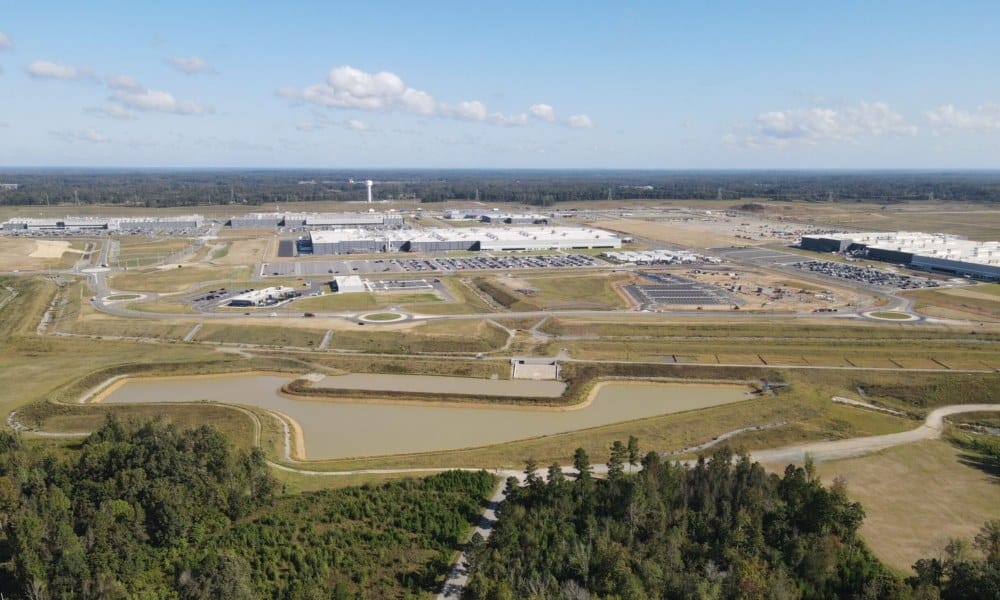
Toyota spent decades resisting the all-electric rush. Its biggest U.S. construction bet says the hedge is over. The company’s battery plant in Liberty, North Carolina is its largest in the world, a roughly $13.9 billion campus that began shipping cells in June 2025.
Project Scope
The plant sits on 1,850 acres of the Greensboro-Randolph megasite and packs about 7 million square feet of manufacturing space. Michigan-based Aristeo Construction led the build, which broke ground in 2021 and ramped through the back half of the decade. When fully online, the facility will run 14 production lines turning out cells for hybrids, plug-in hybrids and full battery-electric vehicles, with line launches staged through 2030 toward more than 30 GWh of annual capacity. Toyota has also pledged up to $10 billion in additional U.S. investment over five years, and the project supports more than 5,000 jobs.
Why It Matters
This is supply-chain construction. North America is racing to build battery capacity close to its assembly lines, and a 7-million-square-foot plant in the Carolinas is a large piece of that map. It joins the cluster of electric-vehicle plants reshaping the Southeast, from Hyundai’s Metaplant in Georgia to Ford’s BlueOval City in Tennessee. Toyota’s hedge-heavy strategy, leaning on hybrids as much as pure EVs, also shapes the building itself: a plant designed to flex across battery chemistries and vehicle types rather than bet everything on one. For a region courting advanced manufacturing, the campus is proof the bet landed.
Project Team & Details
| Developer | Toyota Motor North America |
|---|
| Owner / Client | Toyota Battery Manufacturing North Carolina |
|---|
| General Contractor | Aristeo Construction |
|---|
| Status | Completed |
|---|
| Funding Source | Private |
|---|