
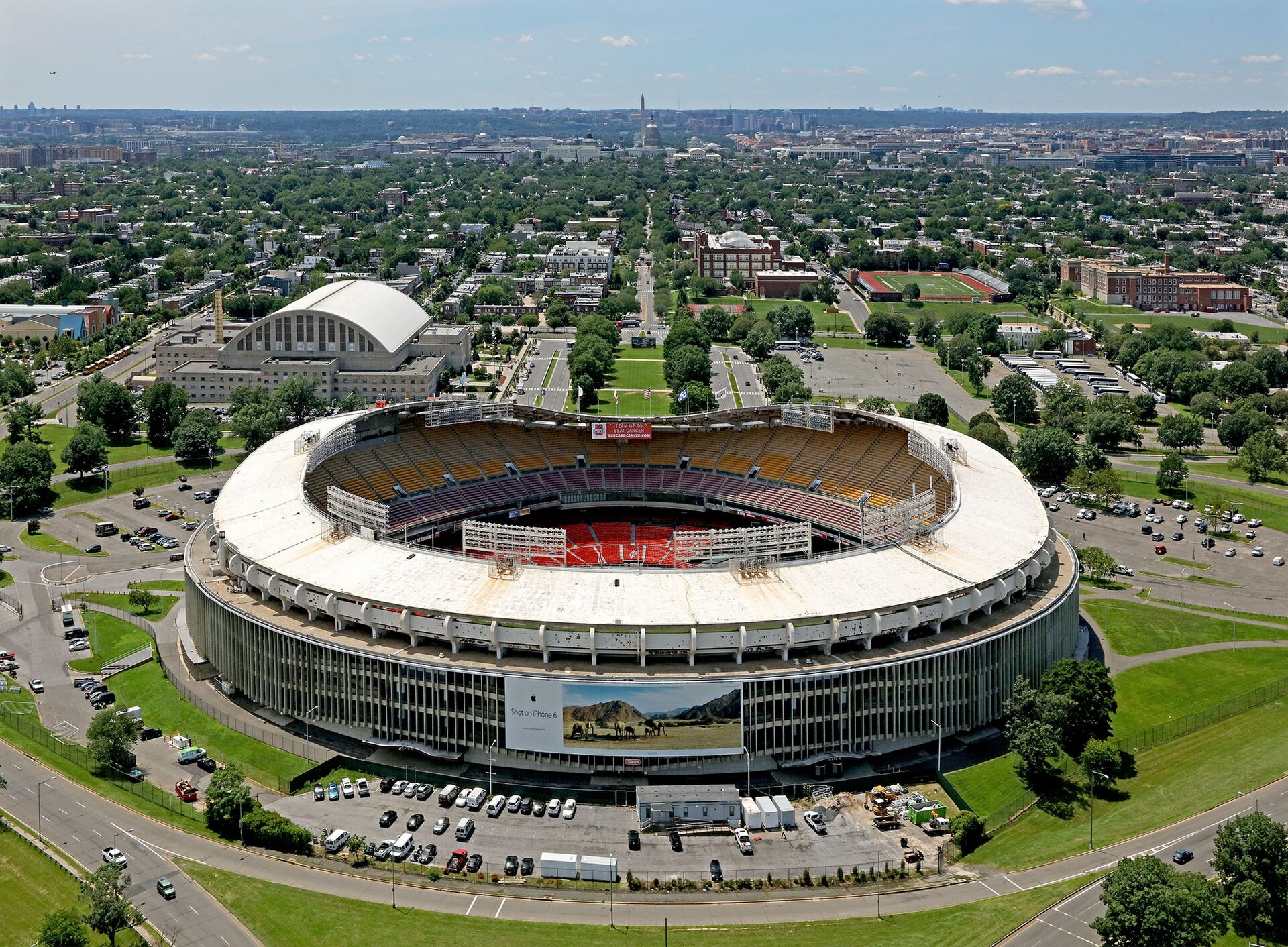
The RFK site has been an argument for decades. On August 11 it became a construction contract.
The Washington Commanders named Clark | Mortenson | SmootDC, A Joint Venture, to build their new stadium on the Anacostia River site where RFK Stadium stood. ENR puts the estimated cost at $3.8 billion, with HKS as architect; the team’s own release names neither figure.
What’s getting built
The venue is roughly 65,000 seats, enclosed and climate-controlled, at about 1.8 million square feet. It anchors a 180-acre campus redevelopment. Enabling work started in June 2026. Vertical construction begins in spring 2027, with completion targeted for spring 2030 so the team can open the 2030 season there.
The joint venture is a deliberate combination. Clark Construction Group built Nationals Park and Capital One Arena and is headquartered in the metro. Mortenson brings Allegiant Stadium and U.S. Bank Stadium, which is the enclosed-venue experience this project needs. Smoot Construction Company of Washington, DC brings a local, minority-owned partner into the prime position rather than a subcontract, which on a District project of this profile is a political requirement as much as a commercial one.
Matt Haas, the team’s head of construction, Lee DeLong of Clark, Logan Gerken of Mortenson Sports + Entertainment and Smoot president and CEO Mark S. Cain all appear in the announcement. The venue is being programmed for more than 200 events a year, which is the underwriting assumption that justifies enclosing it.
The enclosure decision drives everything
An enclosed stadium in a climate like Washington’s is a different building from an open bowl. Long-span roof structure, a fully conditioned volume of that size, and the mechanical plant to serve it push both cost and schedule well past a conventional NFL stadium. It also changes the erection sequence: the roof structure has to be planned from the first foundation, and the crane picks for it constrain everything underneath.
The 200-events-a-year target is why they’re doing it. An open stadium in the mid-Atlantic hosts football and a handful of summer concerts. An enclosed one competes for the year-round touring and convention calendar, which is a materially different revenue model.
Design review isn’t finished
Federal design review is still open. The Commission of Fine Arts is scheduled to take a final vote in mid-September. That’s a real gate on a federally sited project, and a contractor mobilizing enabling work ahead of it is carrying schedule risk the announcement doesn’t mention.
Civic megaprojects with long political histories tend to work this way. Paris spent about twenty years fighting over Tour Triangle before it topped out this April, and the shape of the building that finally got built was determined as much by the objections as by the architect. RFK has run a similar course, and the design that goes to the Commission next month is the one that survived the argument.
For the regional trade base, the practical news is a three-year vertical build starting spring 2027 in a market already tight on concrete and structural steel labor. Subcontractor prequalification for a job of this size typically opens six to nine months before the first packages go out, which puts it around the end of this year.