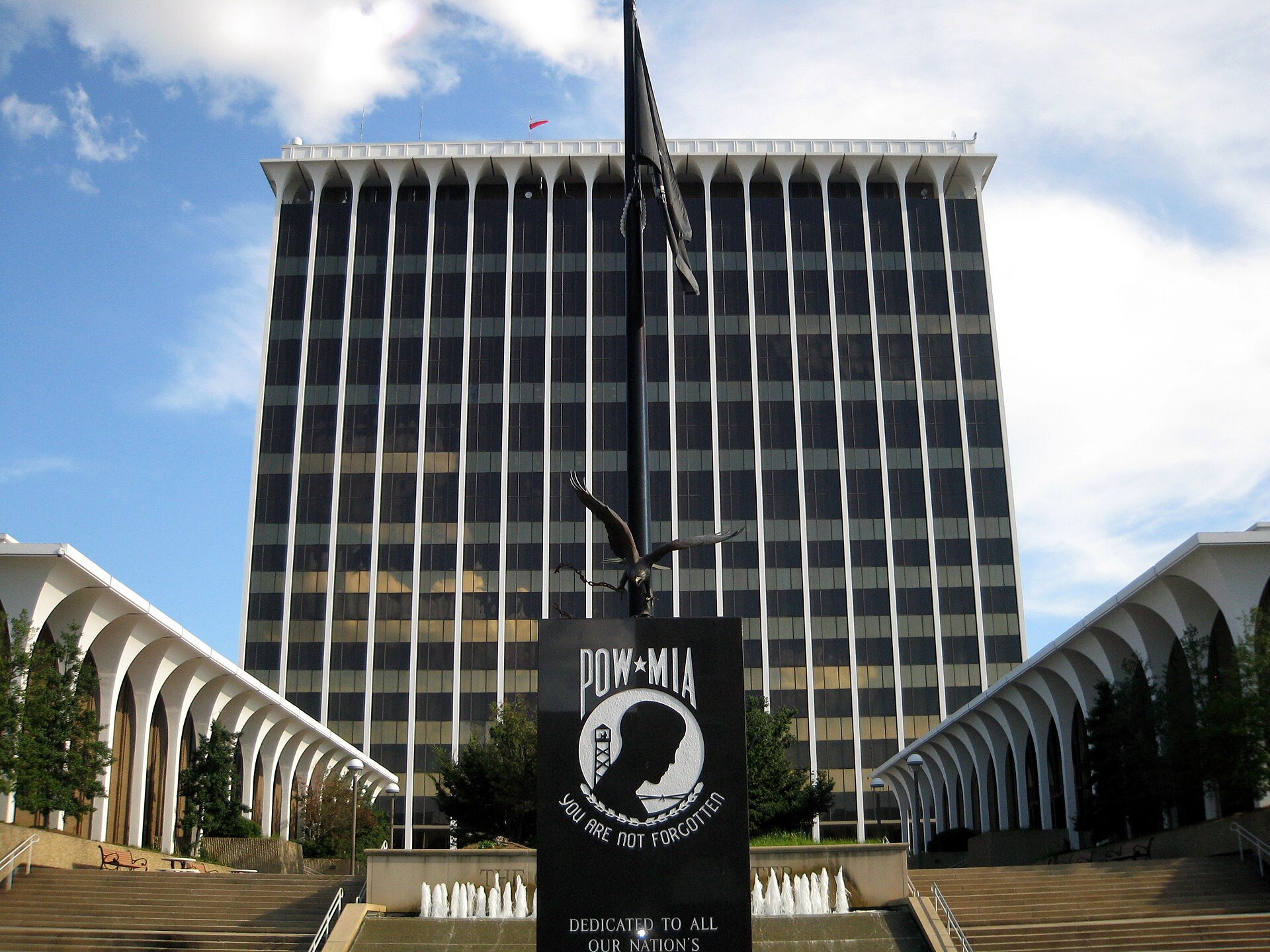
Columbus, Ga., cut the ribbon Oct. 30, 2026, on the $207.5 million John D. Allen Judicial Center, a 342,000-square-foot courts complex that city inspections director Ryan Pruett has called probably the largest project the city has ever built. It replaces the 1970s-era Columbus Government Center tower, which flooded from burst pipes and couldn’t keep up with how courts now run.
The building almost looked very different. The first scheme cleared the whole block between First and Second avenues and Ninth and 10th streets. When materials inflation pushed estimates roughly $50 million over budget, the design team reworked it to keep the existing three-story east and west wings and the parking deck under them, and to put a new eight-story tower along 10th Street.
Project Scope
The finished complex pairs that new court tower with fully renovated wings and a basement level with underground employee parking. It houses 13 courtrooms, with shell space for four more that can be finished without moving anyone out. Muscogee County’s Municipal, Magistrate, Superior, State, Probate and Juvenile courts all move in, along with the Chattahoochee Judicial Circuit district attorney’s office.
Circulation was the main fix. In the old tower, judges, staff and the public often rode the same elevators, and holding space was tight enough that only about six inmates could be on site at once. The new building has nine elevators and separate entrances and paths for the public, staff and detainees. Courtrooms carry juror evidence monitors, livestream-capable cameras for remote hearings and digital docket displays tied to the court management system. The Superior and State Court clerks get 16 service windows.
The SLAM Collaborative and Barnes Gibson Partners shared architecture. Gilbane Building Co. and Freeman & Associates led construction, which began in December 2023. Voters approved a 1% special purpose local option sales tax in 2021 that covers $200 million, and the city’s general fund picked up the remaining $7.5 million.
Why It Matters
Mid-size counties across the Southeast are sitting on courthouses built in the 1960s and ’70s, and most are wrestling with the same problems Columbus had: shared circulation, no room for video hearings and no growth space. Columbus shows one answer. Keeping the wings and the underground deck saved enough money to stay near the referendum number, and the shelled courtrooms buy capacity without another bond.
It wasn’t painless. Judges pushed back on space during design, and the 1871 Springer Opera House across 10th Street raised concerns about construction impacts. The old tower comes down once relocation finishes, and that site becomes surface parking for now.
Related coverage & projects
Project Team & Details
| Owner / Client | Columbus Consolidated Government |
|---|
| Architect | The SLAM Collaborative
Barnes Gibson Partners |
|---|
| General Contractor | Gilbane Building Company
Freeman & Associates |
|---|
| Status | Completed |
|---|
| Funding Source | Public (Municipal) |
|---|