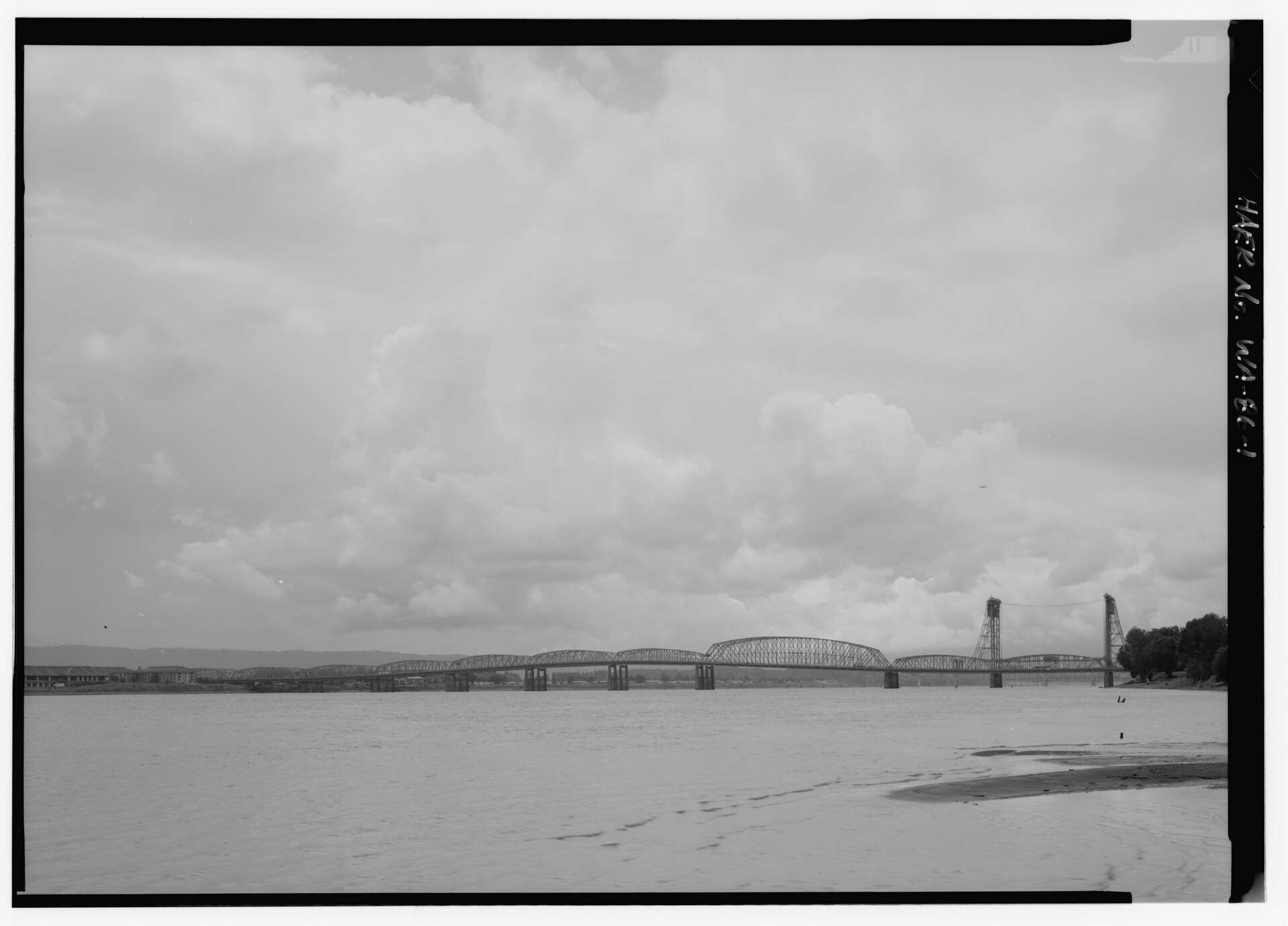
Six lanes of Interstate 5 cross the Columbia River on decks 38 and 39 feet wide with no shoulders, on two truss bridges that open for river traffic. The northbound span opened on 14 February 1917. The southbound one followed on 1 July 1958. Both sit on the Cascadia subduction zone and were built long before anyone wrote a modern seismic code for them. The Interstate Bridge Replacement Program is Oregon and Washington’s joint answer, now estimated at $13.5 to $15.2 billion with $14.4 billion used for planning.
Project Scope
The existing structures run 3,538 feet with a 531-foot longest span, and each carries a 279-foot vertical lift that raises 136 feet. Clearance is 72 feet at the humped span and 176 feet with the lift up. The replacement drops the movable span entirely: two new single-level fixed bridges at 116 feet of navigation clearance, three through lanes plus an auxiliary lane each way with full shoulders, a shared-use path, and deck width reserved for light rail running from Portland to Vancouver with three new stations. The North Portland Harbor Bridge gets replaced too, along with rebuilt interchanges at Marine Drive, Hayden Island, SR 14, Mill Plain, Fourth Plain and SR 500, plus a local-traffic bridge tying Hayden Island to Marine Drive. The existing bridges come out. WSP USA holds the general engineering consultant role, with Parametrix leading community, agency and tribal coordination. The RFQ for a progressive design-builder on the Columbia River Bridge Replacement package went out in August 2026, an RFP follows in November, a builder comes aboard in mid-2027 and construction starts in 2028.
Why It Matters
The Coast Guard settled the central question on 16 January 2026 by approving a fixed span at 116 feet, which still serves better than 99 percent of river traffic and ends the bridge lifts that have throttled I-5 for decades. Because that clearance constrains four upriver marine businesses, the programme negotiated $140 million in compensation payable only if the fixed span was allowed and construction begins. The cost history is sobering: construction costs are up 58 percent since the 2022 estimate, the estimate moved from the 60th to the 70th percentile to satisfy FHWA, and programme completion slipped from 2034 to 2045 after a two-year federal environmental delay. About $5.69 billion is committed against a $7.09 billion core scope. Tolling could start as early as 2028, at rates studied between $1.55 and $4.70 a trip.
Related coverage & projects
Project Team & Details
| Developer | Interstate Bridge Replacement Program Office |
|---|
| Owner / Client | Oregon Department of Transportation and Washington State Department of Transportation |
|---|
| Consultants | WSP USA (General Engineering Consultant)
Parametrix (Community, Agency and Tribal Coordination) |
|---|
| Status | Planned |
|---|
| Delivery Method | Design-Build |
|---|
| Funding Source | Mixed |
|---|