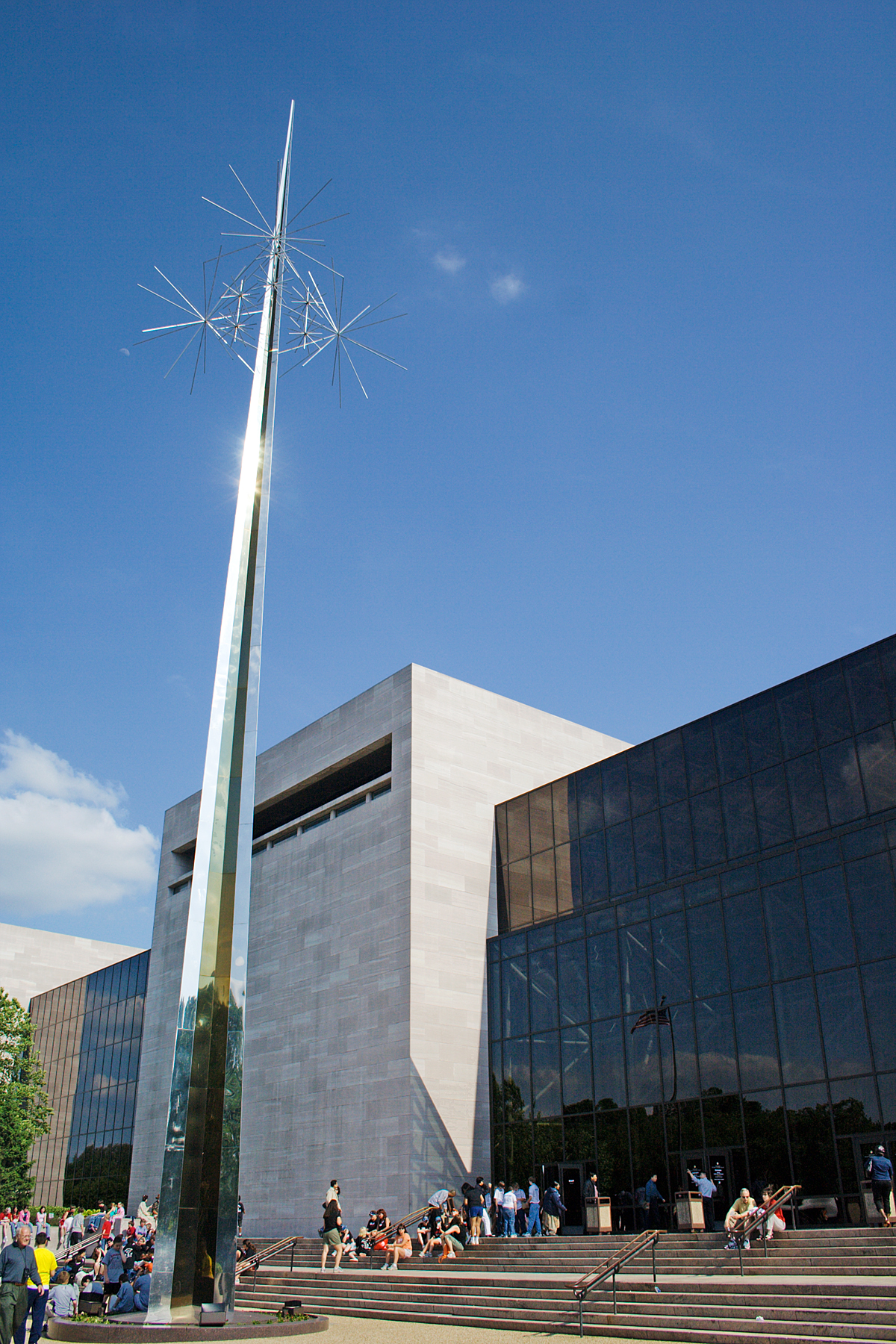
The second-most-visited museum on earth spans four city blocks of the National Mall, and it has been rebuilt around its own visitors for eight years.
The Smithsonian’s roughly $1 billion revitalization of the National Air and Space Museum covers 603,700 sq ft: complete replacement of the exterior cladding, replacement of aging mechanical systems, extensive structural work, and all 23 galleries reimagined. The last two galleries open in fall 2026, timed to the building’s 50th anniversary.
Project Scope
Clark Construction Group delivered the work as construction manager at risk, with Quinn Evans leading design across more than a decade on the project and Mueller Associates handling MEP engineering.
Nearly 2,000 artifacts came out of the historic collection to be protected, stored and reinstalled. Clark used 3D photogrammetry to record existing conditions before artifact removal and laser scanning to fix the exact geometry of the atrium trusses so future artifact supports would land correctly.
The hardest single problem was behind the walls, not on them. Original joint compound backing the historic murals contained asbestos. Ceiling demolition had to come first. Then the murals were cut from the walls with a scalpel, sealed, trucked off-site to a pressurized chamber for abatement, resealed, wiped and tested. They came back four months ahead of schedule.
A new entrance vestibule gives security screening a sheltered, climate-controlled space it never had, its geometry drawn from Leonardo da Vinci’s flying-machine studies.
Why It Matters
Phased reopening is the whole story here. Eight galleries came back in October 2022, five more in July 2025, five on July 1, 2026, and the final two this fall. The museum never fully closed, which means every phase was a separate occupancy problem with its own life-safety strategy, its own dust and noise limits, and its own set of artifacts that couldn’t be exposed.
That’s increasingly the standard condition for institutional renovation. Owners won’t dark a revenue-generating or mission-critical building for four years, so the contractor absorbs the sequencing cost instead.
The job has taken a 2025 NAIOP DC/Maryland award for best institutional facility and a 2023 ABC Metro Washington Excellence in Construction award in the mega-projects category. Funding blends federal appropriation with Smithsonian philanthropy.
Related coverage & projects
Project Team & Details
| Owner / Client | Smithsonian Institution |
|---|
| Architect | Quinn Evans |
|---|
| Consultants | Mueller Associates (MEP) |
|---|
| General Contractor | Clark Construction Group |
|---|
| Status | Under Construction |
|---|
| Delivery Method | CMAR |
|---|
| Funding Source | Mixed |
|---|