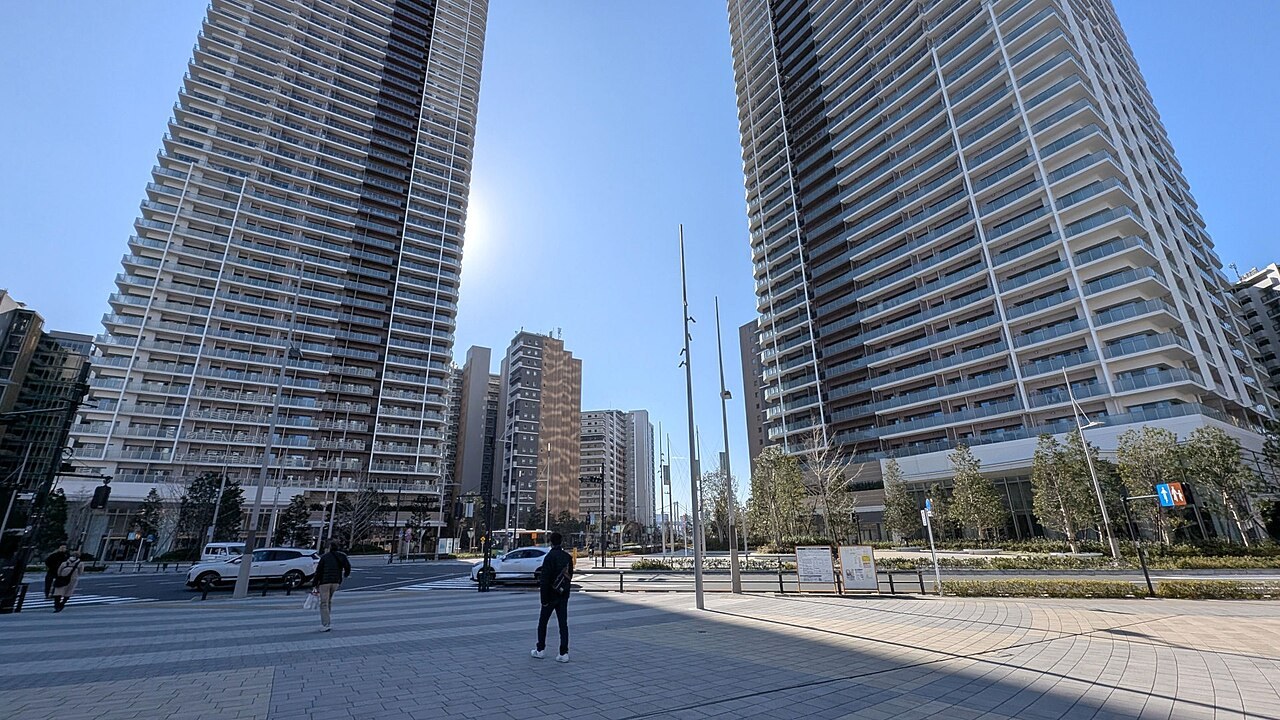
Most Olympic villages are planned backward from the Games. Harumi Flag was planned backward from the apartments. The Tokyo 2020 athletes’ village in Harumi, Chuo Ward, was built by private developers as housing from day one, lent out for the postponed 2021 Games, then fitted out as homes. With 5,632 units in 24 buildings about 2.5 kilometres from Ginza, it’s now the largest condominium complex in Japan.
Residents began moving in on 19 January 2024. The last piece, the twin 50-storey Sky Duo towers, was completed in September 2025.
Project Scope
The Tokyo Metropolitan Government launched the Harumi 5-chome West District Urban Redevelopment Project in March 2015 on the former Tokyo International Trade Fair grounds. The city built the roads and infrastructure. The buildings were financed and built by ten developers led by Mitsui Fudosan Residential, a group that includes Mitsubishi Estate Residence, Nomura Real Estate Development, Sumitomo Realty & Development and Tokyu Land, under a special developer system that let private capital build on the government’s behalf.
The village blocks, mostly 14 to 18 storeys, went up from 2017 to December 2019. After the Games their interiors were finished as apartments, a year behind the original plan because of the postponement. The district is split into four villages. Port Village holds 1,487 rental units, including senior housing and nursing care, while Sea, Sun and Park Villages carry the 4,145 for-sale homes.
The towers came last because the Games didn’t need them. Sun Village’s tower was designed by Mitsubishi Jisho Sekkei with Maeda Corporation, which also built it. Park Village’s was designed by Nikken Sekkei with Sumitomo Mitsui Construction, its builder. Between them the towers hold 1,455 units on a hybrid structure that pairs base isolation with damping devices.
Why It Matters
Harumi Flag doubles as an energy test bed. Since 29 March 2024, Tokyo Gas has piped hydrogen from an ENEOS fuelling station through about a kilometre of pipeline to fuel cells serving the condominiums and shared commercial facilities, the first pipeline hydrogen supply for homes and businesses in Japan.
It hasn’t been free of controversy. A group of Tokyo residents sued over the price of the land sale to the developers, and the Tokyo District Court dismissed the suit in December 2021. In May 2024, an NHK investigation found that close to 20% of 2,690 units it reviewed were being used for investment, rented out or resold, despite purchase restrictions.
At full occupancy the district is expected to house about 12,000 people, which makes it one of the clearest cases yet of an Olympic village that was never meant to be temporary.
Project Team & Details
| Developer | Mitsui Fudosan Residential (lead) and nine co-developers |
|---|
| Owner / Client | Tokyo Metropolitan Government (redevelopment implementer); developer consortium |
|---|
| Architect | Sky Duo: Mitsubishi Jisho Sekkei / Maeda (Sun Village); Nikken Sekkei / Sumitomo Mitsui (Park Village) |
|---|
| General Contractor | Sky Duo: Maeda Corporation (Sun Village tower); Sumitomo Mitsui Construction (Park Village tower) |
|---|
| Major Subcontractors | Tokyo Gas (Hydrogen Pipeline Supply)
ENEOS (Hydrogen Station) |
|---|
| Status | Completed |
|---|
| Funding Source | Mixed |
|---|