
Sagrada Família
A construction project located in Barcelona.

A Bit About Sagrada Família
The world’s longest-running active construction project crossed its tallest milestone on February 20, 2026. The upper arm of the four-pointed cross atop the Tower of Jesus Christ was hoisted into place on the 100th anniversary of Antoni Gaudí’s death, bringing the central tower to its final height of 172.5 meters and making the Sagrada Família the tallest church building in the world.
The basilica has been under construction since 1882. The new milestone closes the external geometry of the central tower, the highest of 18 planned spires, but leaves the church short of true completion. Interior work, the principal façade, and several of the smaller tower elements remain on the schedule through 2027 and 2028, with the entire program now realistically targeting full structural and decorative completion sometime in the early 2030s.
Project Scope
The completed external works on the Tower of Jesus Christ include the 138-meter shaft, a 21-meter cross terminus, and a four-meter Agnus Dei sculpture by Italian artist Andrea Mastrovito installed inside the upper arm at the highest interior point. The cross itself was fabricated in seven separate steel-reinforced stone components (a lower arm, a central core, four lateral arms, and the upper arm) and hoisted into position with a 250-tonne crawler crane positioned in the central nave with a custom temporary support frame.
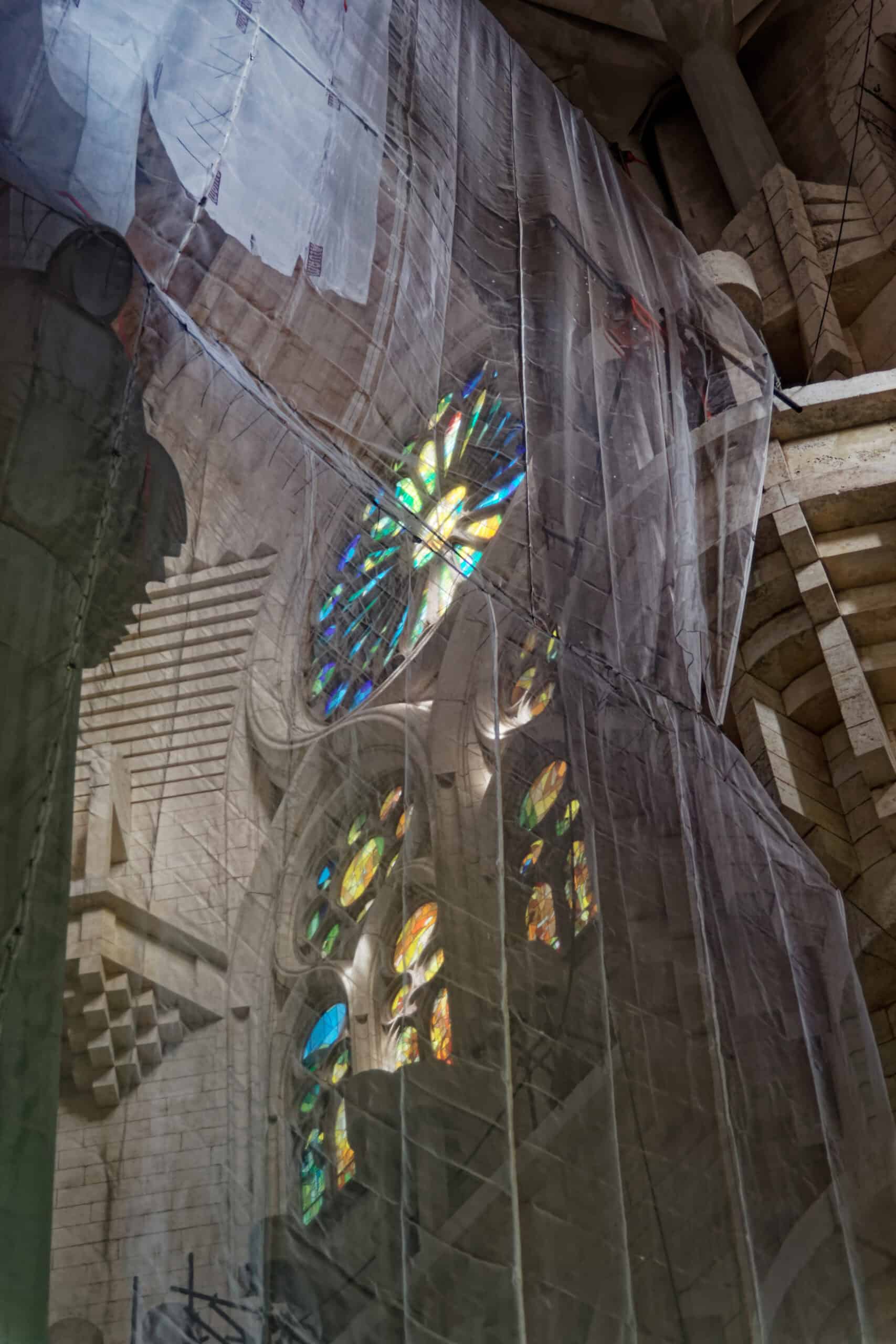
The basilica’s broader structural system is unlike anything else built in the modern era. The central nave columns are double-twisted hyperboloid forms whose geometry derives from Gaudí’s hanging chain models. Granite, basalt, sandstone, and porphyry are deployed differently across the structure based on each stone’s compressive strength and weathering characteristics. The current construction team, operating under the in-house contractor entity Construïm el Temple, uses CNC stone-cutting at a facility in Galera, Tarragona that produces components to tolerances tighter than anything available when Gaudí was alive.
The principal façade, the Glory Façade, is the major remaining external program. Its design includes the entry under a soaring narthex and the demolition of approximately 60 housing units across the Carrer de Mallorca that block the basilica’s southern frontage, a politically charged element that the Junta Constructora and the Barcelona city council have been negotiating in formal terms since 2016.
The current coordinating architect, Jordi Faulí, took over in 2012 from Jordi Bonet. Faulí works from Gaudí’s surviving plans, photographs of the demolished plaster models destroyed in the 1936 anarchist fire at the basilica’s workshop, and the long oral tradition of architects who studied directly under Gaudí. The construction continues to be funded entirely from private donations and ticket sales from the basilica’s roughly 4.7 million annual visitors, making it one of the few major monuments in the world built without public subsidy.
Why It Matters
The Sagrada Família is the rare construction project that has produced its own engineering canon. Hanging-chain geometric form-finding, parametric stone-block design, and the fusion of CAD-CAM stone cutting with hand-finishing techniques all advanced as solutions to specific problems on this building. Catalan modernisme construction practice and the international rationalist tradition that followed it both have direct roots in solutions developed on this site.
The completion of the Tower of Jesus Christ is also a cultural moment that crosses out of architecture into geopolitics. Catalonia’s regional government, the Spanish state, the Vatican, and the descendants of Gaudí’s original team have all taken slightly different positions on what “completion” means and on how the demolition of the Mallorca housing block should be handled. The Junta Constructora has been clear that finishing the building is the only acceptable outcome. The compromises required to get there will define the basilica’s next decade as much as the stones do.
For visitors, the central tower is now visible from almost everywhere in Barcelona, including from neighborhoods that haven’t had a Sagrada Família sightline in their entire lifetime. The next focus is the Glory Façade and the completion of the four central spires of the Evangelists. The earliest formal opening of the completed building is now penciled into the Junta’s plan for 2034, though the basilica’s history is, if nothing else, a study in why those dates move.
Project Team & Details
| Developer | Junta Constructora del Temple Expiatori de la Sagrada Família |
|---|---|
| Owner / Client | Junta Constructora del Temple Expiatori de la Sagrada Família |
| Architect | Antoni Gaudí (Original) / Jordi Faulí (Coordinating Architect since 2012) |
| Consultants | BAC Engineering Consultancy Group (Structural) FAES Consultoria (Stone Masonry Engineering) |
| General Contractor | Construïm el Temple (In-house Construction Team) |
| Major Subcontractors | Galera (Stone Cutting and CNC Carving) VERINSA (Specialty Glass) |
| Status | Under Construction |
| Delivery Method | Design-Build |
| Funding Source | Private |
Where to find this project
Sorry, no records were found. Please adjust your search criteria and try again.
Sorry, unable to load the Maps API.
More images from Sagrada Família


Project Team & Details
| Developer | Junta Constructora del Temple Expiatori de la Sagrada Família |
|---|---|
| Owner / Client | Junta Constructora del Temple Expiatori de la Sagrada Família |
| Architect | Antoni Gaudí (Original) / Jordi Faulí (Coordinating Architect since 2012) |
| Consultants | BAC Engineering Consultancy Group (Structural) FAES Consultoria (Stone Masonry Engineering) |
| General Contractor | Construïm el Temple (In-house Construction Team) |
| Major Subcontractors | Galera (Stone Cutting and CNC Carving) VERINSA (Specialty Glass) |
| Status | Under Construction |
| Delivery Method | Design-Build |
| Funding Source | Private |