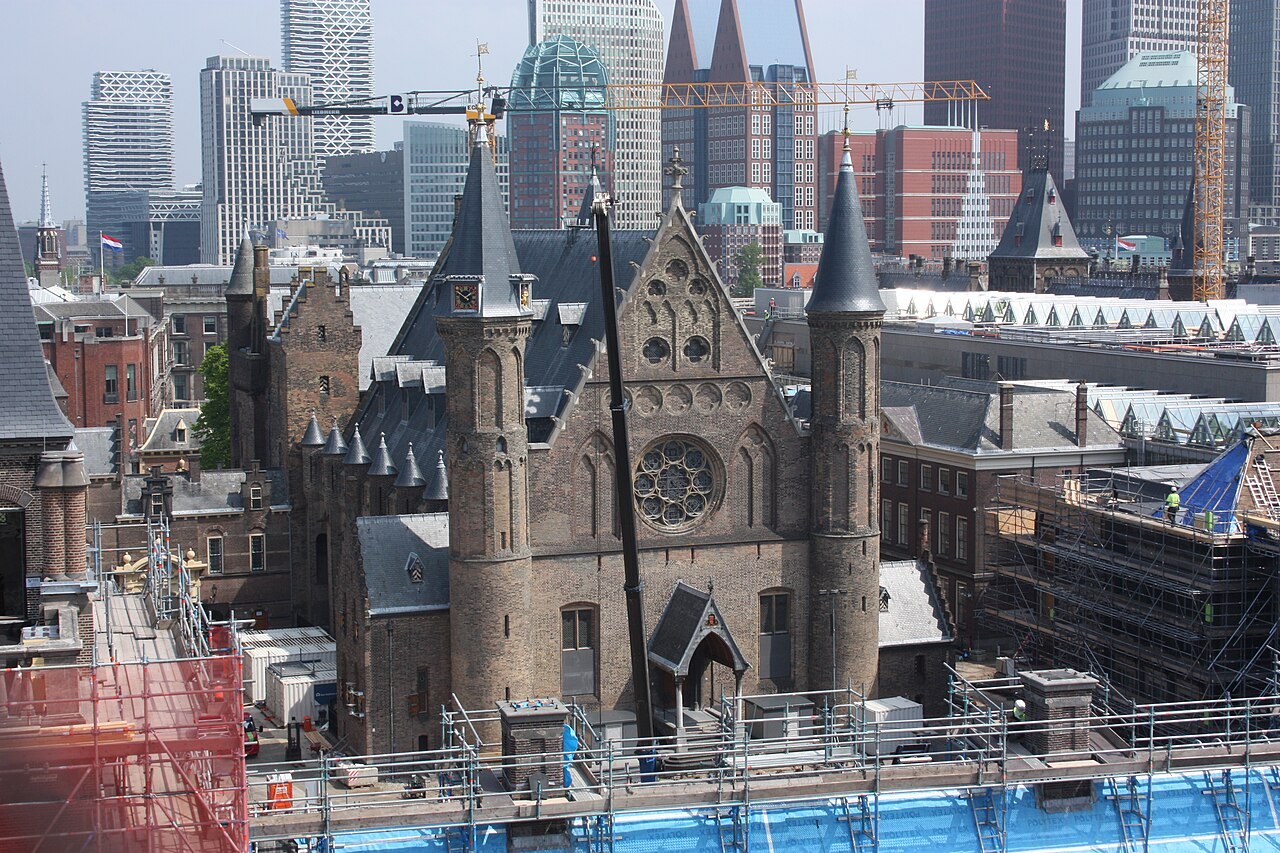
The Binnenhof renovation was sold to Dutch lawmakers at €475 million and about five and a half years. In November 2025, outgoing housing minister Mona Keijzer put the cost at a minimum of €2.7 billion and pushed completion to summer 2031. Reporting by de Volkskrant in May 2026 put the likely final figure nearer €3 billion.
It’s the seat of the Dutch parliament, a cluster of buildings in The Hague that has grown around the 13th-century Ridderzaal for roughly 800 years. The Senate and the House of Representatives moved out in 2021 so the work could start.
Project Scope
The scope takes in 20 monuments and 65 buildings, more than 90,000 m² in all, with over 4,000 rooms, halls, attics, basements and corridors. The original brief was fire safety, asbestos and worn-out building services. Then the walls came open.
The government’s November 2025 update listed what crews had found. Water from the Hofvijver pond leaking into cellars. A loose roof on the Senate building. More than half the load-bearing timber beams rotten, with about 400 still awaiting repair, plus wood ant damage in others. Roofing alone is expected to take another four years.
The state real estate agency, the Rijksvastgoedbedrijf, owns the complex and runs the program, with Pi de Bruijn as coordinating architect. Five contractor teams split the buildings: Heijmans with Burgy, TBI companies J.P. van Eesteren, Croonwolter&dros and Nico de Bont, Combinatie De Kroon (Hanab and Koninklijke Woudenberg), Van Hattum en Blankevoort, and SPIE on technical installations. More than 1,000 workers are assigned to the site.
Archaeology keeps adding to the clock. In April 2025, excavations between the Mauritstoren and the Stadhouderspoort exposed traces of a building nearly 800 years old, showing the medieval court complex was bigger than historians had thought.
Why It Matters
One person involved told de Volkskrant the job was approached “as if it were a normal 21st-century building,” and called that the structural flaw. That’s a fair diagnosis for a lot of heritage work. Medieval gateways too narrow for modern trucks, a shortage of specialist roofers, and a late decision to add a basement IT facility for cybersecurity have all stacked on top of the rot.
The lesson for public owners is about surveys, not ambition. Opening up 4,000 rooms before fixing a budget would have cost time and money up front. Skipping it has so far cost more than €2 billion over the original number. The first institutions are due back in early 2031.
Project Team & Details
| Owner / Client | Rijksvastgoedbedrijf (Central Government Real Estate Agency) |
|---|
| Architect | Pi de Bruijn (coordinating architect) |
|---|
| General Contractor | Heijmans & Burgy / TBI / Combinatie De Kroon / Van Hattum en Blankevoort (by package) |
|---|
| Major Subcontractors | SPIE (Building Services) |
|---|
| Status | Under Construction |
|---|
| Funding Source | Public (Federal) |
|---|