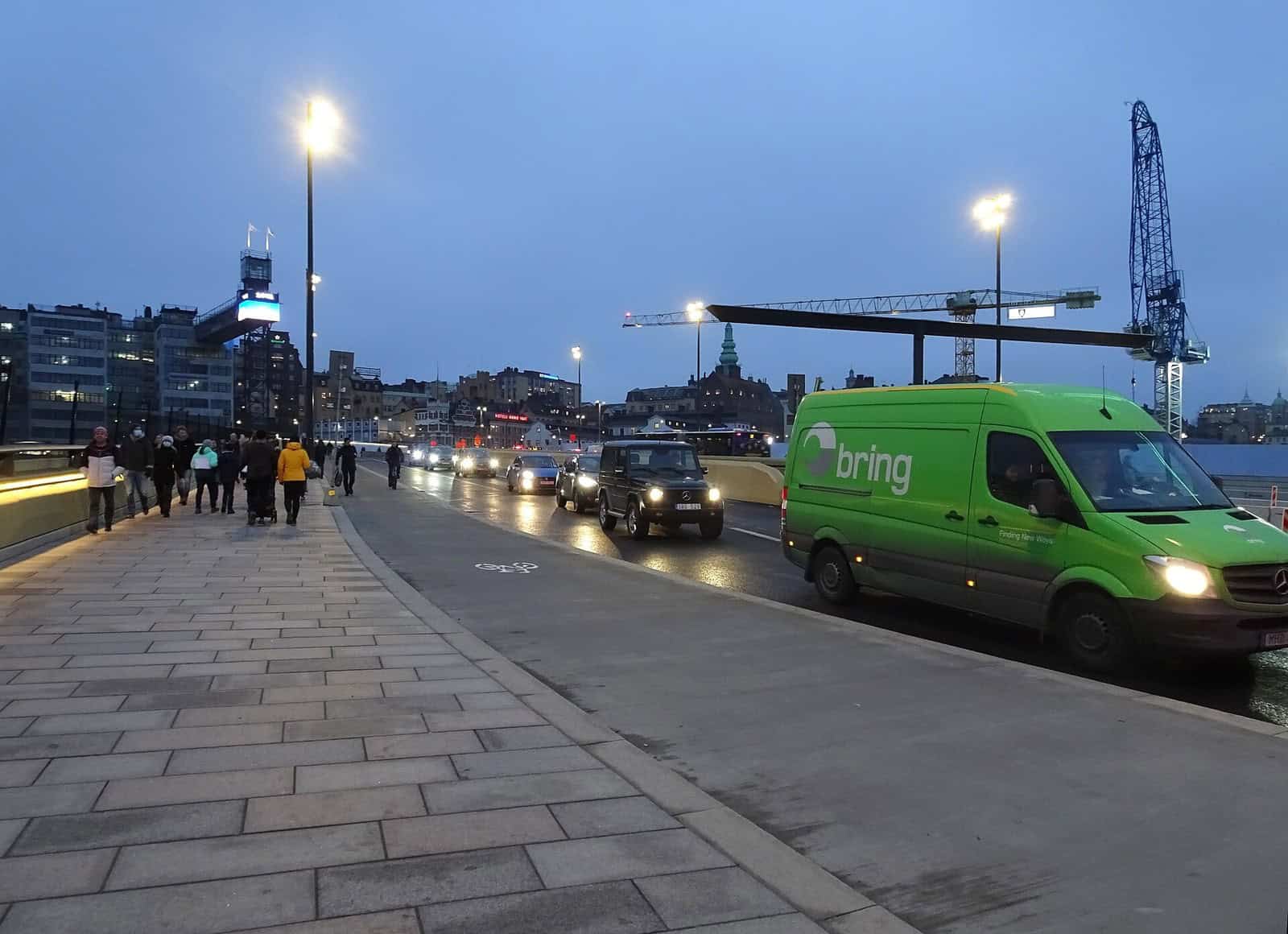
Stockholm has been rebuilding the hinge of its own city for ten years, and the work is finally close to done. Slussen is the point where Lake Malaren meets the Baltic and where road, metro, commuter rail, bus and ferry all cross in a few hundred metres. The 1935 functionalist cloverleaf that handled it, designed by Gosta Lundborg and Sven Markelius, had been taking de-icing salt since the 1940s and was corroding from the inside. The City of Stockholm is replacing it outright.
Project Scope
Foster + Partners, with Berg Arkitektkontor, won the design competition in 2007. The scheme was approved in 2011 and ground was broken in 2016. It delivers a new lock and two discharge channels that roughly quintuple Lake Malaren’s outflow capacity, eight new bridges and decks, a bus terminal mined into the Katarinaberget rock mass, and a new water-level public square at Vattentorget. The centrepiece is Slussbron, known locally as Guldbron. It was fabricated in China, shipped to Stockholm in March 2020 and opened to traffic that October at a bridge cost of SEK 198 million. Ramboll engineered it. Skanska Sverige has carried several of the largest packages, including the SEK 2 billion area reconstruction let in 2015, roughly SEK 620 million of structural works for the bus terminal, and a further SEK 2 billion overdecking of Stadsgardsleden awarded in 2024. The old Nils Ericson lock was converted into a fish migration channel, completed in 2024. Saltsjobanan’s Slussen terminus stays closed for the duration, with Henriksdal as the interim end of the line. Buses have run from a temporary terminal at Stadsgardsterminalen since August 2024.
Why It Matters
The flood-control case is the one that gets least attention and matters most. Lake Malaren is the drinking water source for about two million people, and the old outflow capacity was not enough for the rainfall the city now plans around. Everything else at Slussen sits on top of that. The project also shows what a twenty-five-year-old cost estimate is worth: original completion was 2022, then 2025, and the traffic solution is now due in 2027 with finishing works running into 2028. Stockholm has argued about the loss of the 1935 structure the entire time, and the argument isn’t settled. Note that the city quotes two different figures depending on what’s being counted, a net project cost near SEK 12.6 billion and a total investment cost closer to SEK 21 billion.
Project Team & Details
| Owner / Client | City of Stockholm (Stockholms stad) |
|---|
| Architect | Foster + Partners with Berg Arkitektkontor |
|---|
| Consultants | Ramboll (Bridge Engineering) |
|---|
| General Contractor | Skanska Sverige |
|---|
| Status | Under Construction |
|---|
| Funding Source | Mixed |
|---|