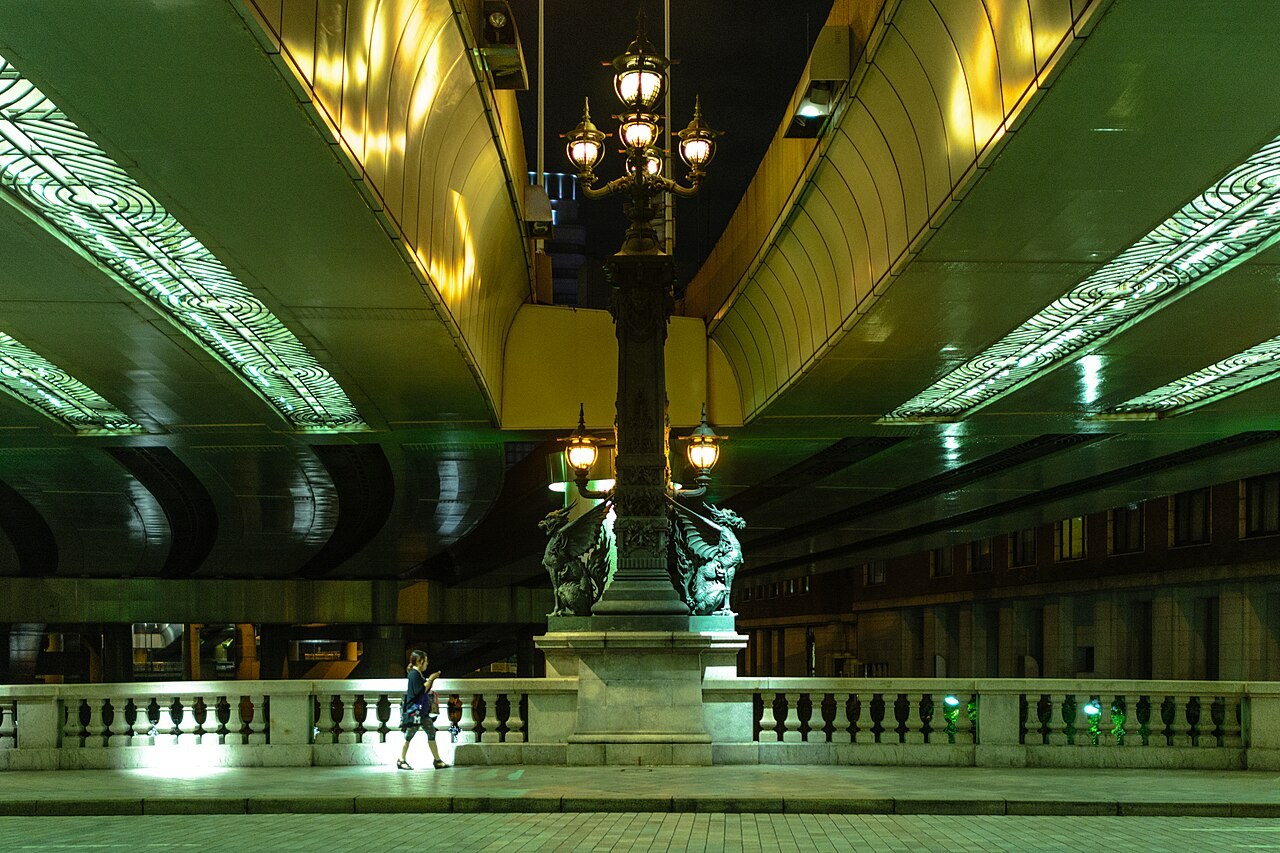
Tokyo put an elevated expressway over its most famous bridge in the rush to get ready for the 1964 Olympics, and it has spent six decades wishing it hadn’t. The Nihonbashi expressway undergrounding project is the fix. Metropolitan Expressway Co. (Shutoko) is moving a 1.8-kilometer stretch of the Inner Circular Route below ground between the Kandabashi and Edobashi junctions, then taking down the viaduct that has sat on top of the 1911 Nihonbashi bridge ever since.
The budget is about ¥320 billion. The tunnel is due to open in 2035. The old deck is scheduled to be gone by 2040.
Project Scope
The plan was approved in May 2020. Work began on May 10, 2021, when Shutoko permanently closed the Edobashi and Gofukubashi ramps, and those ramp viaducts were removed by March 2024.
The core of the job is a shield tunnel. Taisei Corporation signed that contract in March 2024 at ¥76.12 billion including tax, covering roughly 550 m of shield tunnel and about 110 m of cut-and-cover. The launch shaft sits near Edobashi, the only spot with room for a site yard. Shutoko’s plan has the machine drive to a shaft near Ichikokubashi, turn around and bore back, so one TBM does both drives. Cover is shallow, curves and grades are steep, and new towers will sit right on top. The lining uses composite segments rated for up to 200 kN/m² of overburden, with heavy fire-resistant concrete providing the dead weight to resist uplift in place of a secondary lining.
Where the new route ties into the existing Yaesu tunnel, it goes open-cut directly under the Nihonbashi River. Crews will install a false riverbed of boards with double watertight joints so the river keeps flowing above the dig. A JFE Engineering, MMB, Kajima and Toa Construction joint venture holds the ¥44.2 billion package for piers and foundations at the Route 6 Mukojima connection. Toda Corporation, with Giken Seko as piling sub, is installing 120 tubular piles at Nihonbashi Hongoku-cho using Giken’s rotary-press Gyropress method.
Why It Matters
Freeway removal isn’t new. Seoul tore out the elevated road over Cheonggyecheon and reopened the stream in 2005. Tokyo’s version is harder because the expressway carries about 100,000 vehicles a day and can’t close, so the replacement has to be built and running before the old structure comes down.
It’s also a redevelopment deal as much as a road job. The tunnel is threaded beneath private towers going up along the river, and its design loads assume they’ll be there. Once the viaduct is gone, the bridge’s bronze kirin statues will stand under open sky for the first time since the early 1960s. Shutoko’s date for that is 2040.
Project Team & Details
| Owner / Client | Metropolitan Expressway Company Limited (Shutoko) |
|---|
| General Contractor | Taisei Corporation (shield tunnel) |
|---|
| Major Subcontractors | JFE Engineering / MMB / Kajima / Toa Construction JV (Route 6 connection)
Toda Corporation (foundation works)
Giken Seko (Piling) |
|---|
| Status | Under Construction |
|---|
| Funding Source | Mixed |
|---|