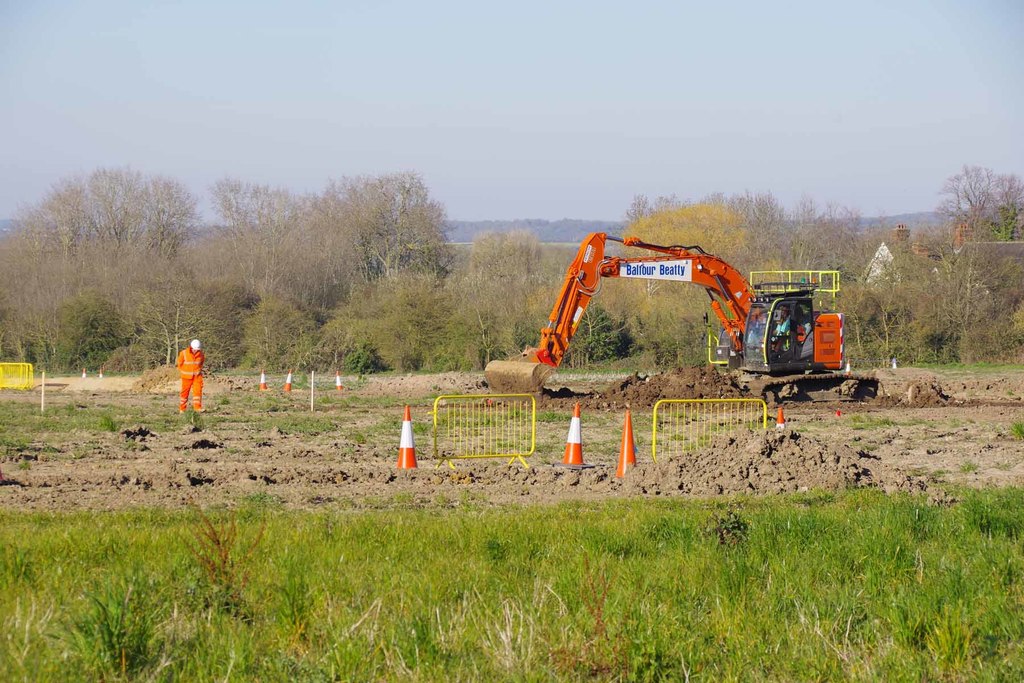
Britain hasn’t built a new road crossing east of London since 1991. The Lower Thames Crossing changes that, and the machine that will do the digging is the largest tunnel boring machine ever ordered in Europe.
National Highways began enabling works in March 2026 on a 14.3-mile route linking the A2 near Gravesend in Kent to the M25 near North Ockendon in Essex. At the centre sits a pair of 2.6-mile bored tunnels running as deep as 60 metres beneath the river, each carrying three lanes at 70 mph. At 16 metres internal width, the bores are more than twice the cross-section of the existing Dartford tunnels the scheme is meant to relieve.
Project Scope
The whole-life cost is roughly 9.2 billion pounds, about 12.4 billion US dollars, funded by UK central government with tolling planned once the road opens. Delivery is split across three main works packages rather than a single prime contractor: a Bouygues Travaux Publics and Murphy joint venture holds the 1.34 billion pound tunnels-and-approaches contract, Balfour Beatty Civil Engineering has the roads north of the Thames, and Skanska Construction UK has the Kent roads. Jacobs sits across all three as integration partner, with Turner and Townsend handling commercial assurance.
Herrenknecht was named TBM supplier on 13 July 2026. The machine will run 16.4 metres in diameter, 120 metres long, and weigh more than 5,000 tonnes. It’s a Variable Density TBM, the largest of that type ever built, sized to handle the clay and chalk sequence under the river. A single machine will drive both bores using a planned U-turn at the far portal, a decision made to cut both cost and embodied carbon. It arrives by sea in sections at the Port of Tilbury and starts boring in 2028.
Why It Matters
Around 80 percent of the route sits in tunnel, cutting, or behind embankment, which is an unusually high proportion for a scheme of this length and reflects how much of the budget went into keeping the road out of sight. National Highways has said it wants this to be the first major UK infrastructure project that’s carbon neutral in construction, and running the TBM on renewable electricity is part of that claim. Whether the number holds up is a question for the closeout report, not the press release.
For the wider market, the more interesting feature is the contracting model. Three separate main works contractors with an integrator layered over the top is a bet that programme-level coordination beats a single prime on a job this fragmented. Hinkley Point C and HS2 both offer cautionary precedent.
Related coverage & projects
Project Team & Details
| Developer | National Highways |
|---|
| Owner / Client | National Highways (UK Department for Transport) |
|---|
| Consultants | Jacobs (Integration Partner)
Turner & Townsend (Commercial Partner) |
|---|
| General Contractor | Bouygues Travaux Publics / Murphy JV (tunnels); Balfour Beatty Civil Engineering (Essex roads); Skanska Construction UK (Kent roads) |
|---|
| Major Subcontractors | Herrenknecht AG (Tunnel Boring Machine) |
|---|
| Status | Under Construction |
|---|
| Delivery Method | Design-Build |
|---|
| Funding Source | Public (Federal) |
|---|