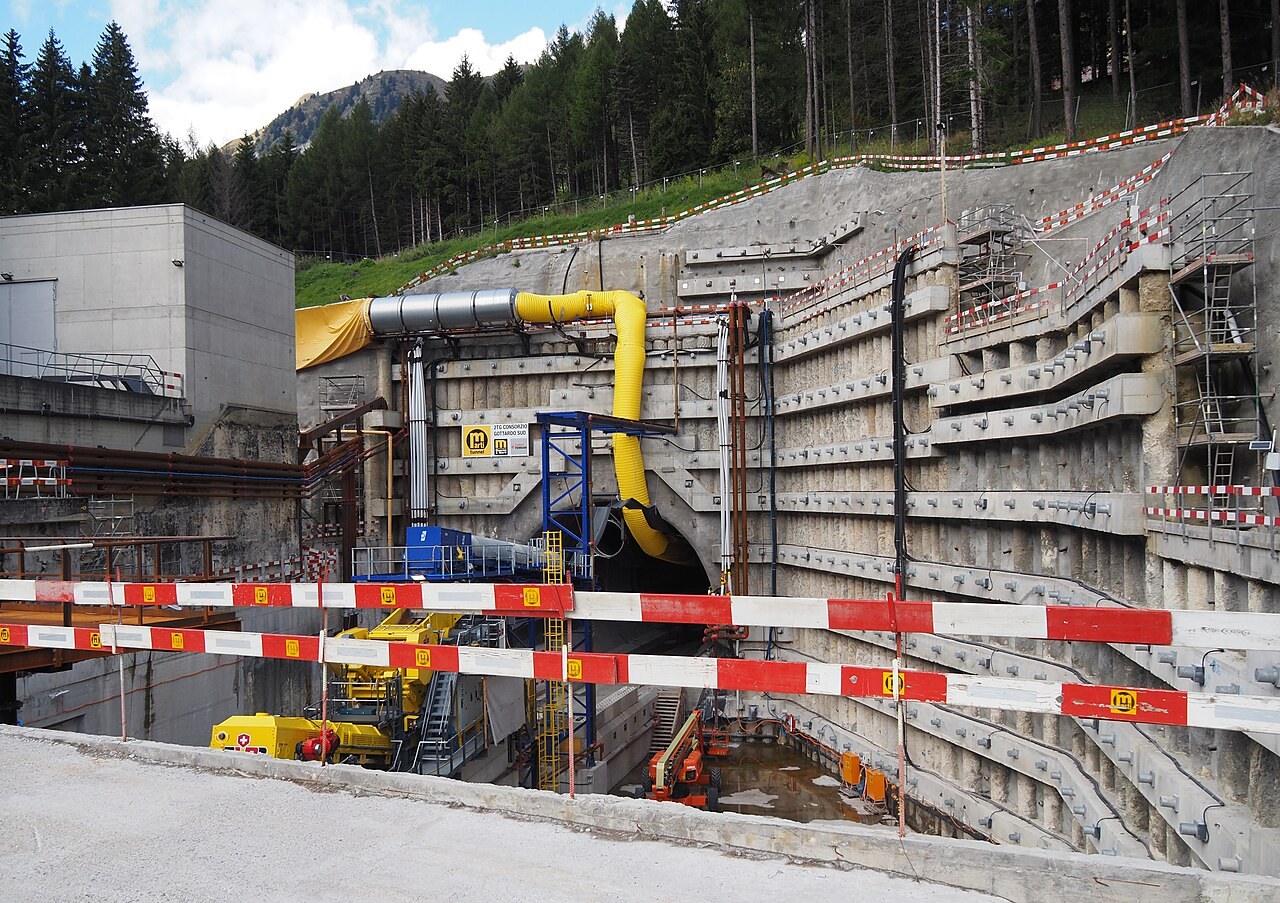
Switzerland is boring a second 16.9-kilometre road tunnel under the Gotthard, and it isn’t allowed to add a single lane of capacity. The Gotthard Road Tunnel second tube is a CHF 2.14 billion project from the Federal Roads Office (FEDRO, or ASTRA in German) whose real job is maintenance. Once the new bore opens, the original tunnel can close for a full refurbishment while A2 traffic keeps moving between Göschenen in Uri and Airolo in Ticino.
The old tunnel is a single bidirectional tube with one lane each way. It was the longest road tunnel in the world when it opened on 5 September 1980. After more than four decades of north-south freight, it needs a rebuild that can’t be done under traffic.
Project Scope
Voters approved the approach in a February 2016 referendum. The government had weighed sending traffic over the pass, loading vehicles onto trains at a new terminal, or closing the tunnel for months every year across a decade. A second tube won as the least disruptive option.
Site work began at both portals in 2020. The main drive is split into two lots, each bored by a single-shield Herrenknecht TBM of roughly 12.3 metres diameter. In the north, ARGE Secondo Tubo, an Implenia and Frutiger partnership, is driving about 6.9 kilometres from Göschenen with a machine named Alessandra. In the south, the Marti 2TG consortium of Marti Tunnel, Mancini & Marti and Ennio Ferrari is boring Lot 341, about 7.8 kilometres, from Airolo with a machine named Paulina. Both TBMs were launched on 14 February 2025.
On 29 April 2026, Alessandra broke into the cavern built across the northern fault zone after roughly 3.8 kilometres, with about 4 kilometres still to go. FEDRO’s schedule puts the main breakthrough in 2027, with operating and safety systems going in from 2028 and the new tube opening to traffic in 2030. The original tube then closes, and its refurbishment is due to finish in 2033. The dig moves about 7.4 million tonnes of rock in all, and at Airolo some of it is being used to cover about a kilometre of motorway and rebuild the valley floor under a 2017 agreement between the Confederation and Ticino.
Why It Matters
The constraint is constitutional. Article 84 of the Swiss Federal Constitution bars any increase in transit road capacity in the Alpine region, so when both tubes are open each will carry one lane in one direction. Northbound traffic gets the new bore. Southbound gets the renovated one.
That makes this one of Europe’s stranger tunnel jobs: more than two billion francs for zero new lanes. What the money buys is separation and redundancy. Opposing traffic will no longer share a tube in the tunnel where a two-truck collision and fire killed 11 people in October 2001, and the next major repair won’t mean choosing between a mountain pass and a train shuttle.
Switzerland is building itself a spare, and it’s 17 kilometres long.
Project Team & Details
| Owner / Client | Swiss Federal Roads Office (FEDRO/ASTRA) |
|---|
| Consultants | ARX / Bedrina JV (Construction Supervision, South Section) |
|---|
| General Contractor | ARGE Secondo Tubo (Implenia / Frutiger), north Lot 241; Consorzio Marti 2TG, south Lot 341 |
|---|
| Major Subcontractors | Herrenknecht (Tunnel Boring Machines)
Marti Tunnel / Mancini & Marti / Ennio Ferrari (Tunnelling, South Lot) |
|---|
| Status | Under Construction |
|---|
| Funding Source | Public (Federal) |
|---|