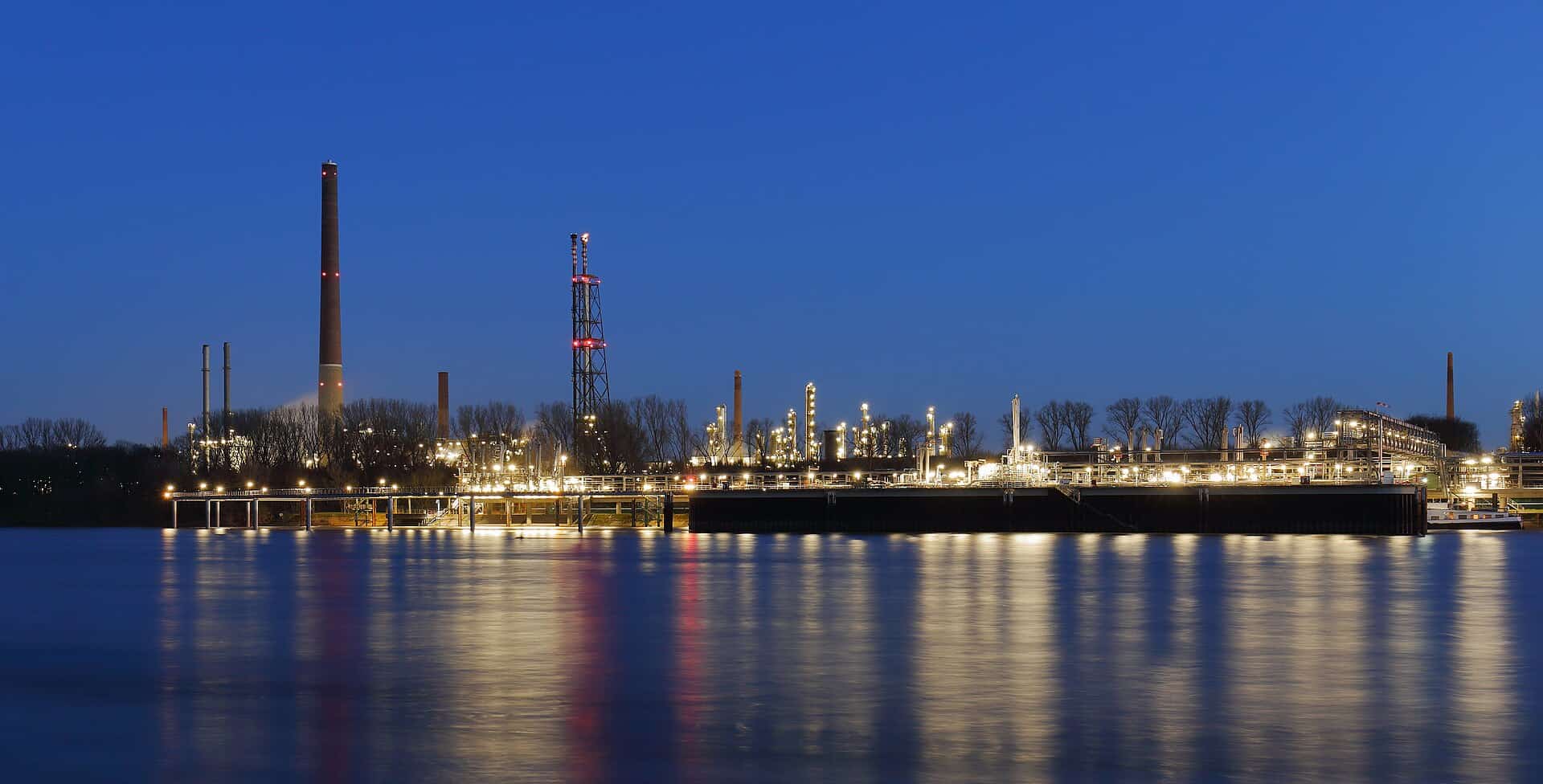
Wesseling has made motor and heating fuels since 1940, starting as a coal-to-liquids plant under Union Rheinische Braunkohlen Kraftstoff. In March 2025 the crude distillation unit shut permanently. Refining is over on that side of the site.
What replaces it is a conversion rather than a demolition. Shell Deutschland took a final investment decision in January 2024 to convert the existing Wesseling hydrocracker, plus a newly built Base Oil Distillation Unit, into a plant making API Group III base oils for premium lubricants, pharmaceutical and cosmetic white oils, and dielectric fluids. Godorf, the other half of the Shell Energy and Chemicals Park Rheinland, keeps running crude and feeds Wesseling vacuum gasoil through existing inter-site pipelines.
Project Scope
The unit is designed for about 300,000 tonnes a year, which Shell puts at roughly 9 percent of EU and 40 percent of German base-oil demand, making it Germany’s largest base oil plant. The new BODU carries a 54 m vacuum column and a 37 m secondary column on six piles of roughly 1 m diameter and 13 m depth. Its centrepiece is a renewable-powered electric process furnace, the E-Heater, which Shell and its contractor describe as the first of its kind at this duty in the petrochemical industry. Components for it were fabricated in Romania and delivered in September 2025.
Kraftanlagen Energies & Services, part of the Equans and Bouygues group, holds the general contract, with engineering and project management through its subsidiary ECM Ingenieur-Unternehmen. Groundbreaking followed the FID in August 2024, construction completion is targeted for 2027 and production from 2028.
Shell has never itemised the cost, describing it only as a high three-digit million euro amount. That is a corporate investment figure, not a construction contract value. The 620,000 tonnes a year of CO2 reduction Shell cites is its own Scope 1 and 2 projection covering the crude unit shutdown, retirements and electrification together, not the new plant alone. The co-located REFHYNE electrolysers are EU-funded; that funding does not apply here.
Why It Matters
Refinery conversions are usually framed as closures with a press release attached. This one keeps the hydrocracker, the site’s rail and pipeline connections and most of its workforce, and changes what comes out the other end.
The electric furnace is the part worth watching. Process heat at this duty has been the hardest thing to electrify in petrochemicals, and Wesseling will be the first place anyone finds out how it behaves at scale.
Project Team & Details
| Developer | Shell Deutschland GmbH |
|---|
| Owner / Client | Shell Deutschland GmbH |
|---|
| Consultants | ECM Ingenieur-Unternehmen (Engineering and Project Management) |
|---|
| General Contractor | Kraftanlagen Energies & Services SE (Equans / Bouygues) |
|---|
| Status | Under Construction |
|---|
| Delivery Method | Design-Build |
|---|
| Funding Source | Private |
|---|