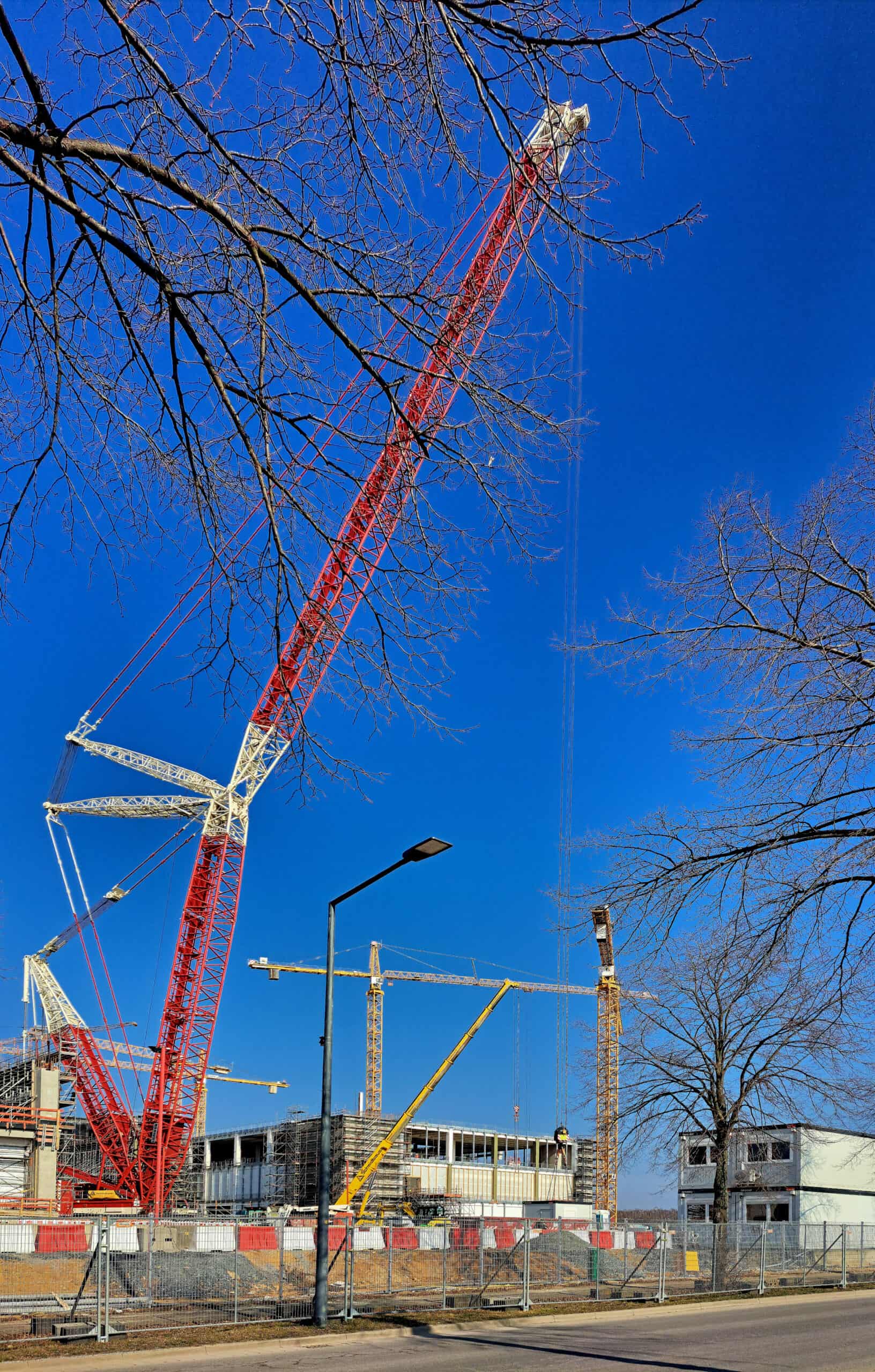
ESMC’s Dresden fab is the European Union’s biggest single industrial bet of the decade, and it’s now well past the symbolic-groundbreaking stage. The €10 billion-plus facility, a joint venture between TSMC, Bosch, Infineon, and NXP, finished its main structural build in late 2025 and entered fab-system installation in the first half of 2026, with equipment move-in scheduled for the second half of this year and production targeted for late 2027.
The development sits in Dresden’s Silicon Saxony cluster, on land prepared next to AMD’s former fab campus. Exyte (formerly M+W Group) is leading the cleanroom EPC work. Max Bögl carried the civil and structural package.
Project Scope
ESMC is a single-site, multi-process fab targeting 40,000 300-millimeter wafers per month at full operation. Process technology runs TSMC’s 28/22-nanometer planar CMOS and 16/12-nanometer FinFET nodes, deliberately positioned at mature trailing-edge geometries that European automotive and industrial customers actually buy in volume, not at the leading edge where TSMC’s Taiwan and Arizona capacity already dominates.
The site comprises roughly 1.1 million square feet of building footprint across the main fab, a central utility building, and back-of-house support buildings. Cleanroom space totals approximately 270,000 square feet of Class 1 / Class 10 environment.
- 40,000 wafers per month at full ramp on 300mm 28/22nm and 16/12nm
- ~1.1M sq ft total building footprint, ~270K sq ft cleanroom
- TSMC 70% / Bosch, Infineon, NXP 10% each, with guaranteed allocation for the European industrial partners
- ~2,000 direct high-tech jobs at full ramp
Why It Matters
ESMC is the EU Chips Act’s largest single proof point. The European Commission’s plan to bring 20% of global semiconductor capacity onshore by 2030 is essentially a single chart driven by a small number of fab projects, and ESMC is the largest of them after Intel’s cancellation of the Magdeburg site in late 2024 pushed the EU’s flagship project portfolio onto the Dresden fab.
The economic case has been carried by European Commission and German government subsidies covering roughly half the total capital. That ratio survived Brussels’ state-aid review in 2024 and continues to underwrite the project schedule. Politically, the fab has become the test of whether the EU’s industrial policy can actually deliver capacity on a calendar that matters, against a 28nm market that the world’s other foundries are also expanding into.
For European automotive supply chains, the timing matters more than the geometry. Bosch, Infineon, and NXP all consume large volumes of 28nm and 16nm parts (power management, microcontrollers, analog mixed-signal), and a Dresden source eliminates one Taiwan-Strait dependency at the most exposed point in the European auto bill of materials.
Project Team & Details
| Developer | European Semiconductor Manufacturing Company (ESMC) |
|---|
| Owner / Client | ESMC (TSMC 70% / Bosch 10% / Infineon 10% / NXP 10%) |
|---|
| Architect | M+W Group (Exyte) |
|---|
| Consultants | Drees & Sommer (Project Management)
HHP Berlin (Fire Engineering) |
|---|
| General Contractor | Exyte (Lead Cleanroom / EPC) |
|---|
| Major Subcontractors | Max Bögl (Civil / Structural)
Sächsische Bau (Site Works) |
|---|
| Status | Under Construction |
|---|
| Delivery Method | Design-Build |
|---|
| Funding Source | Public-Private Partnership (P3) |
|---|