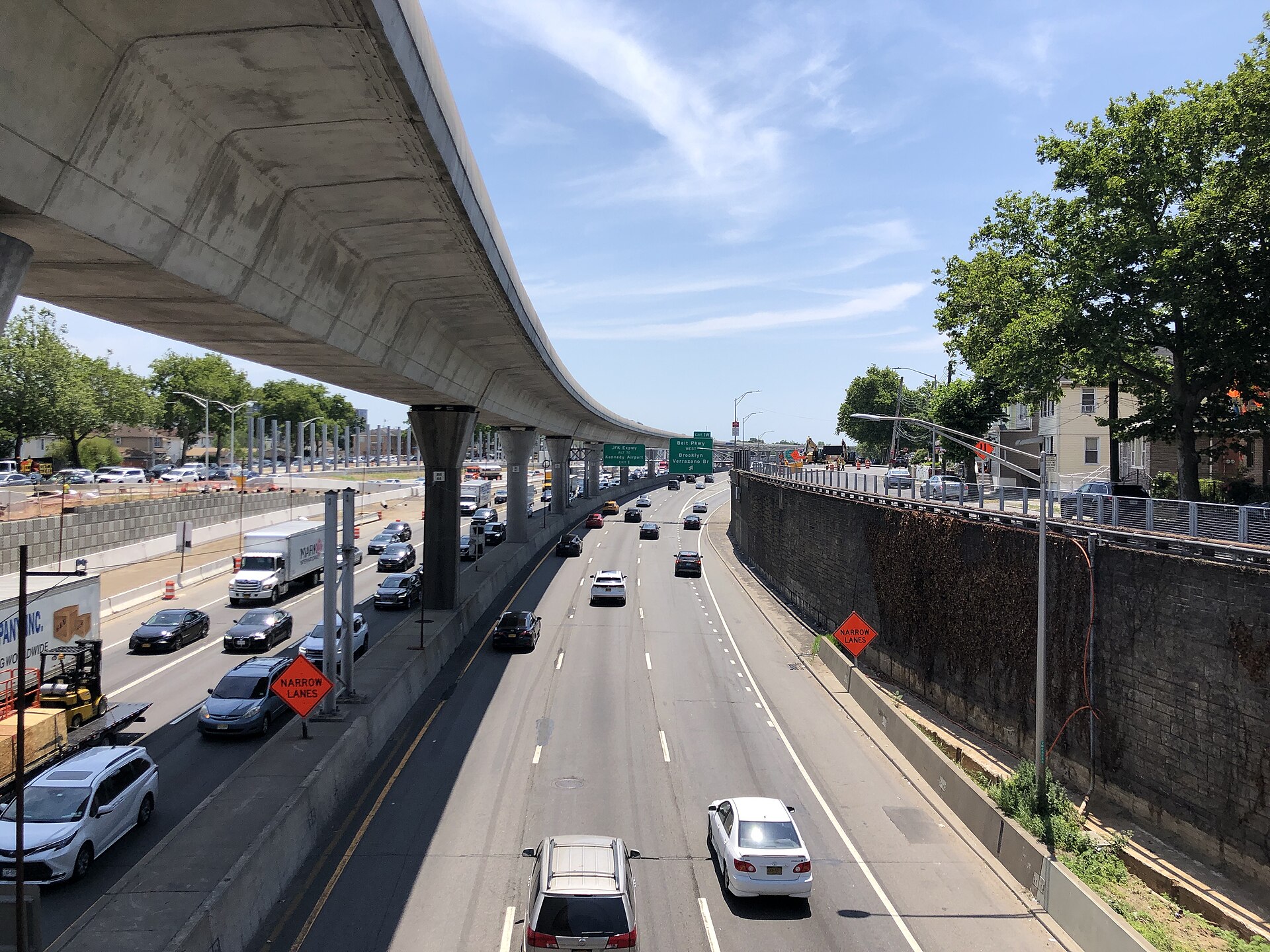
Anyone who’s crawled down the Van Wyck to catch a flight at JFK knows why this one took six years. The New York State Department of Transportation opened new managed-use lanes in both directions of the Van Wyck Expressway on Oct. 23, marking substantial completion of main-line work on a $1.4 billion program to rebuild the 4.3-mile corridor between the Kew Gardens Interchange and John F. Kennedy International Airport.
The new lanes run as HOV lanes, open to buses, taxis, for-hire vehicles and private cars carrying at least one passenger. Service-road rehabilitation is still going and is expected to wrap up later this year.
Project Scope
NYSDOT split the work into three design-build contracts, and between them the program rehabilitated or replaced 23 bridges. Everything had to be built inside a depressed, wall-lined highway with the AirTrain running down the median for much of the route.
The first contract, about $342 million, lengthened or replaced nine overpasses to create clearance for a future fourth lane. A Posillico/El Sol joint venture built it with Dewberry and Greenman-Pedersen on design, and it finished in 2023. The second, about $318 million, went to Halmar International as design-builder. It replaced and retrofitted the Long Island Rail Road bridges over the expressway near Jamaica Station, including the Atlantic Avenue bridge, with spans rolled in on self-propelled modular transporters during weekend outages.
The third and largest contract, about $804 million, built the managed-use lanes themselves. A Tully Construction and STV design-build team, with SJH Engineering designing several bridges, sign structures and lighting, replaced or rehabilitated 10 bridges over the Belt Parkway, the Conduit Avenues, Federal Circle and Main Street, added a new ramp bridge for the southbound lane, lengthened entrance and exit ramps to cut weaving, and upgraded drainage. A $135 million double-barrel sewer segment built with the city’s Department of Environmental Protection rides along to attack chronic flooding in southeast Queens.
Why It Matters
The Van Wyck carries most of the car and truck traffic into the busiest international gateway in the country, and it does it in a trench that leaves almost no room to work. Adding a lane meant rebuilding nearly every bridge that crosses it, often while trains and traffic kept moving overhead.
Splitting the job into three design-build packages let NYSDOT keep bridge work moving in parallel instead of staging one contractor down a 4-mile trench, and it’s a structure other urban DOTs with boxed-in airport corridors should study. Whether HOV enforcement actually keeps those lanes moving is the next question.
Project Team & Details
| Owner / Client | New York State Department of Transportation |
|---|
| Consultants | Dewberry (Design, Contract 1)
Greenman-Pedersen, Inc. (Design, Contract 1)
STV Inc. (Design, Contract 3 design-build team)
SJH Engineering (Structural, Civil and Lighting, Contract 3)
WSP (Environmental Impact Statement)
Hayduk Engineering (EIS Subconsultant) |
|---|
| General Contractor | Tully Construction Co. (Contract 3); Halmar International (Contract 2); Posillico/El Sol JV (Contract 1) |
|---|
| Status | Under Construction |
|---|
| Delivery Method | Design-Build |
|---|
| Funding Source | Public (State) |
|---|