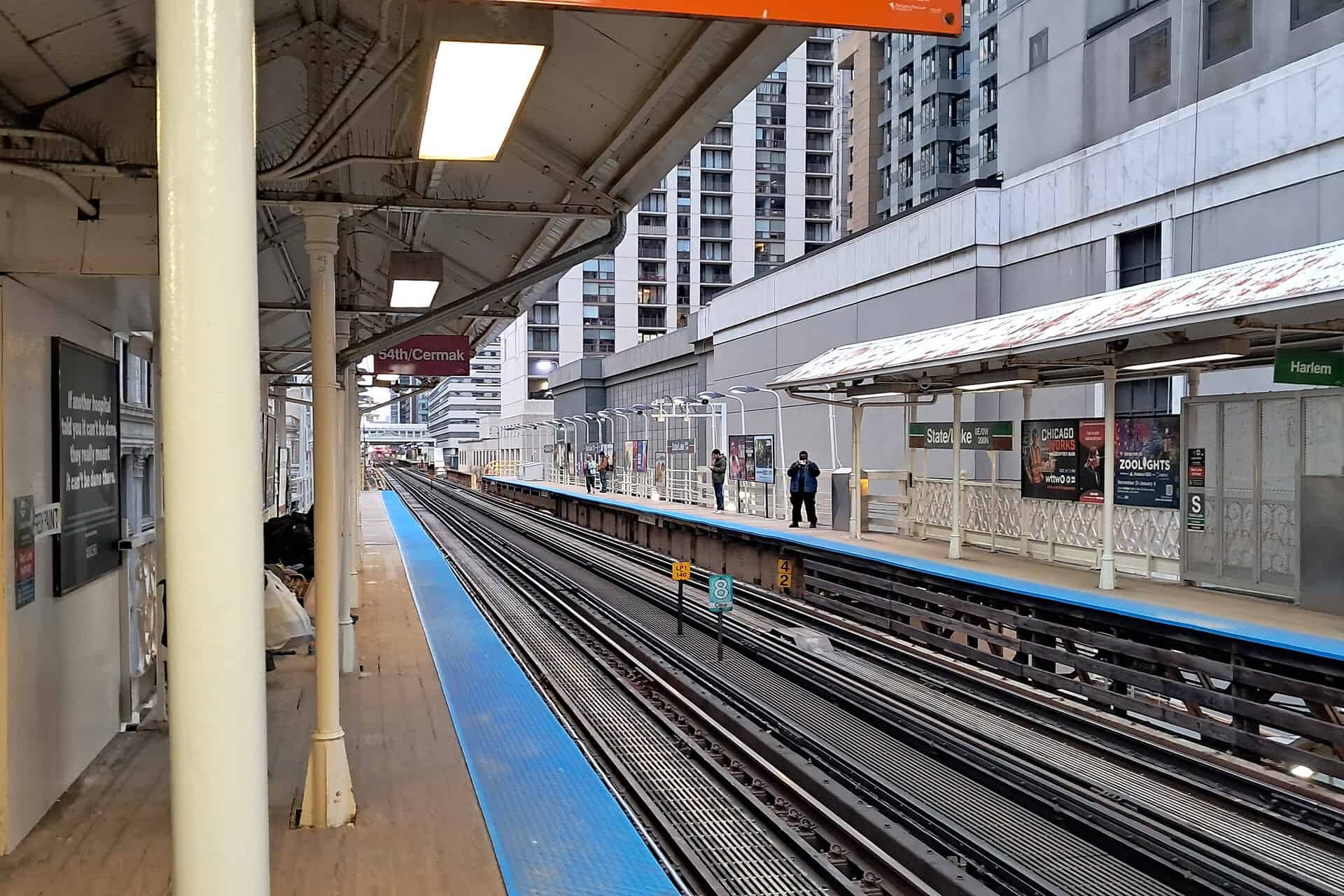
The State/Lake station reconstruction in Chicago carries a $444 million price for one elevated stop. In 2017 the city talked about $75 million. By 2021 the figure was $180 million. The contract F.H. Paschen holds today is nearly two and a half times that.
The station closed in early January 2026 after 130 years of service. It’s due back in 2029.
Project Scope
State/Lake opened in 1895. By the city’s 2021 count it’s the second-busiest stop on the Loop elevated, with more than 3.7 million entries in 2019, and Bisnow ranks it fifth in the whole CTA system. Five lines stop there. Its platforms are among the narrowest on the system, and it isn’t wheelchair accessible.
The Chicago Department of Transportation is delivering the job for the Chicago Transit Authority. TranSystems, which now operates as GFT after its merger with Gannett Fleming, and Skidmore, Owings & Merrill lead design. Railway Technology’s 2021 profile lists a long bench of subconsultants behind them, including HDR, Gannett Fleming, Milhouse Engineering, Ardmore Roderick, GSG Consultants and Rider Levett Bucknall.
The new station doubles the platform width and is laid out for eight-car trains. A glass canopy covers the full platform. Four elevators, one at each corner of the intersection, come with two escalators, and a flyover bridge joins the inner and outer platforms. Elevators will also connect to the Red Line subway below. ENR’s report on the advance work lists micropiles and drilled shafts for new foundations, along with track and signal modifications.
At street level, Bisnow reports, the rebuild takes columns out of the roadway, raises vehicle clearance under the structure and adds sidewalk bump-outs. Trains keep running through the site for the full three years. They just don’t stop.
Why It Matters
More than 90 percent of the money is federal, according to Bisnow, and the 2021 plan already had $119 million in Congestion Mitigation and Air Quality funds lined up for construction. That helps explain how a budget can grow nearly sixfold from its first estimate without killing the project.
It doesn’t explain the growth. Nothing in the published record accounts line by line for what moved between $180 million and $444 million. Four years of escalation is part of it. So is the basic problem of rebuilding a steel structure over two live downtown streets and under active track.
The schedule deserves the same skepticism. In 2021 the city expected construction to start that year and take about three. Utility relocation actually began in August 2025.
Still, the scope is hard to argue with. A transfer station at the center of the Loop that riders in wheelchairs can’t use is a liability the CTA has carried for decades. The fix costs $444 million and three years of trains that roll past without opening their doors.
Related coverage & projects
Project Team & Details
| Owner / Client | Chicago Transit Authority (delivered by Chicago Department of Transportation) |
|---|
| Architect | Skidmore, Owings & Merrill (SOM) |
|---|
| Consultants | TranSystems, now GFT (Design Team Lead, Engineering)
HDR (Design Subconsultant)
Gannett Fleming, now GFT (Design Subconsultant)
Milhouse Engineering (Design Subconsultant)
Ardmore Roderick (Design Subconsultant)
GSG Consultants (Design Subconsultant)
Garza Karhoff Engineering (Design Subconsultant)
Site Design Group (Design Subconsultant)
Rider Levett Bucknall (Cost Consultant) |
|---|
| General Contractor | F.H. Paschen |
|---|
| Status | Under Construction |
|---|
| Funding Source | Public (Federal) |
|---|