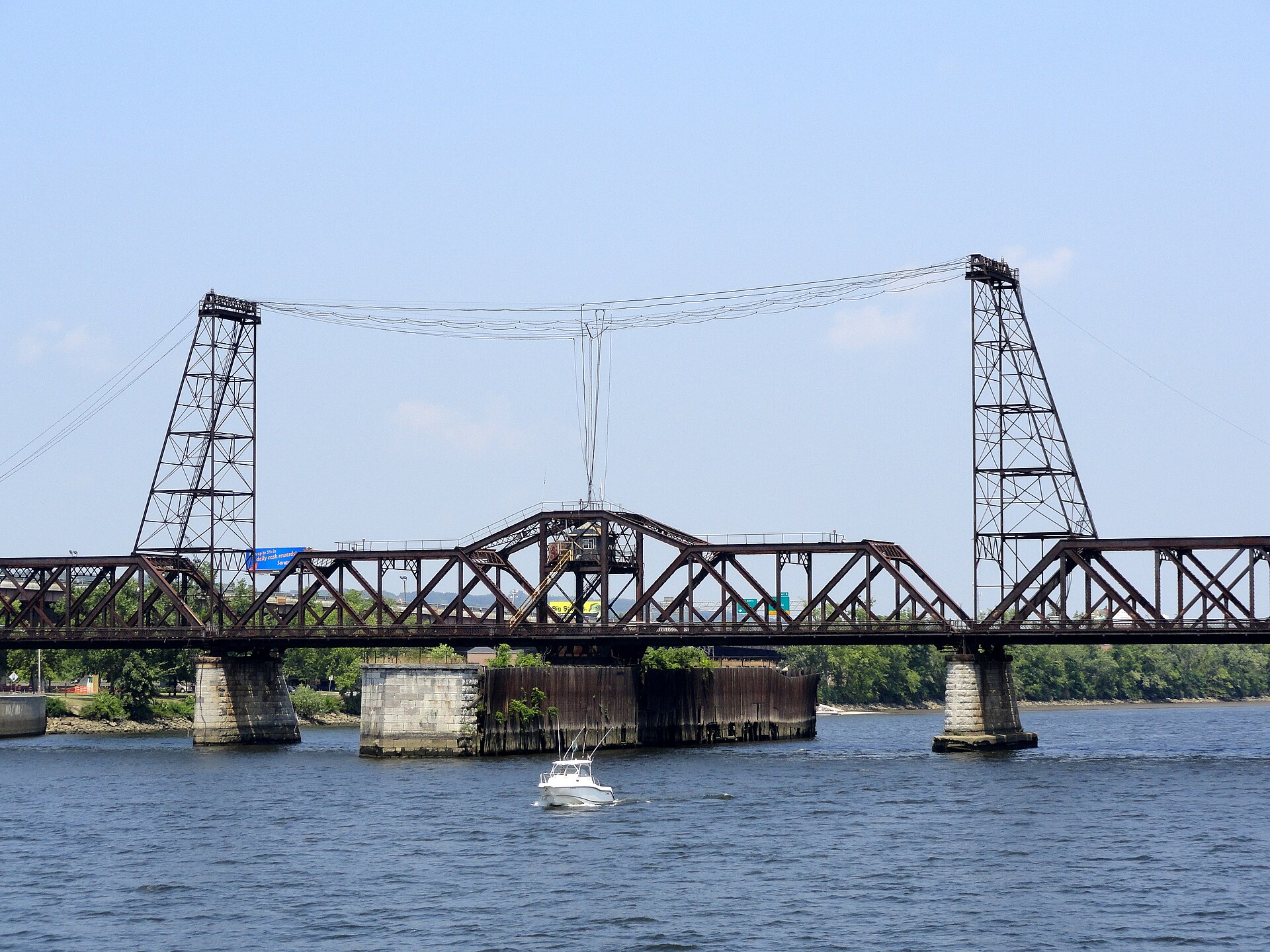
The Livingston Avenue Bridge replacement in Albany gets built twice. Skanska is assembling the steel trusses on land at the Port of Coeymans, 10 miles downriver, then floating them up the Hudson on barges and letting the tide help set them on their piers. The contractor says that saves about a year.
The crossing being replaced dates to the Civil War. Today’s swing bridge went up at the start of the 1900s on substructure from an 1860s bridge, and trains are held to 15 mph, one at a time.
Project Scope
New York State DOT awarded the $634.8 million design-build contract in July 2024 to Skanska Koch LAB JV, which pairs Skanska USA Civil with Skanska Koch. HNTB is the designer. Railway Technology’s project profile also lists LiRo Engineers and Creighton Manning Engineering among the consultants. CSX owns the bridge and leases it to Amtrak, which runs about a dozen passenger trains a day across it. Railway Age counted two to six daily freights as well.
The new structure is a seven-span, two-track vertical lift bridge set within 15 feet of the old one. Construction Equipment Guide, reporting in December 2025, described three main truss sections plus two lift towers and four girder spans. The lift span weighs roughly 4 million pounds. Six in-water piers sit on 6-foot-diameter caissons averaging 70 feet deep, and the team cut that pier count from eight during design. Quantities run to about 14,000 cubic yards of concrete and 15 million pounds of steel.
The shipping channel under the main span widens from 100 feet to 190, according to Railway Technology. A separated path for pedestrians and cyclists comes with the bridge, tying the Albany Skyway and the Empire State Trail to the Rensselaer waterfront.
Why It Matters
Two constraints drive the method. In-water work stops from March 1 to Oct. 1 to protect spawning Atlantic sturgeon, which leaves a winter river season and a need for icebreakers. And there’s no detour. Railway Age reported that routing trains around the crossing would add at least two and a half hours, so the old bridge has to keep working until the new one is ready.
That makes the cutover the number to watch. Skanska’s plan gives crews 58 hours after the float-in to finish the bridge and move rail traffic onto it. The float-ins are scheduled for 2027. The job stood at about 20 percent complete in December 2025, with piers due to be largely finished by the end of 2026.
Published completion dates don’t agree. Skanska’s award release says March 2028. The state said summer 2028 at the start and has since said only 2028. The state capital plan carries the cost, and New York has said it’s pursuing federal grants on top.
A 58-hour window at the end of a four-year job doesn’t leave much room. Building the trusses where cranes can reach them easily is how Skanska bought some.
Related coverage & projects
Project Team & Details
| Owner / Client | New York State Department of Transportation (sponsor); CSX (bridge owner, leased to Amtrak) |
|---|
| Consultants | HNTB (Lead Designer)
LiRo Engineers (Engineering Consultant)
Creighton Manning Engineering (Engineering Consultant) |
|---|
| General Contractor | Skanska Koch LAB JV (Skanska USA Civil and Skanska Koch) |
|---|
| Status | Under Construction |
|---|
| Delivery Method | Design-Build |
|---|
| Funding Source | Public (State) |
|---|