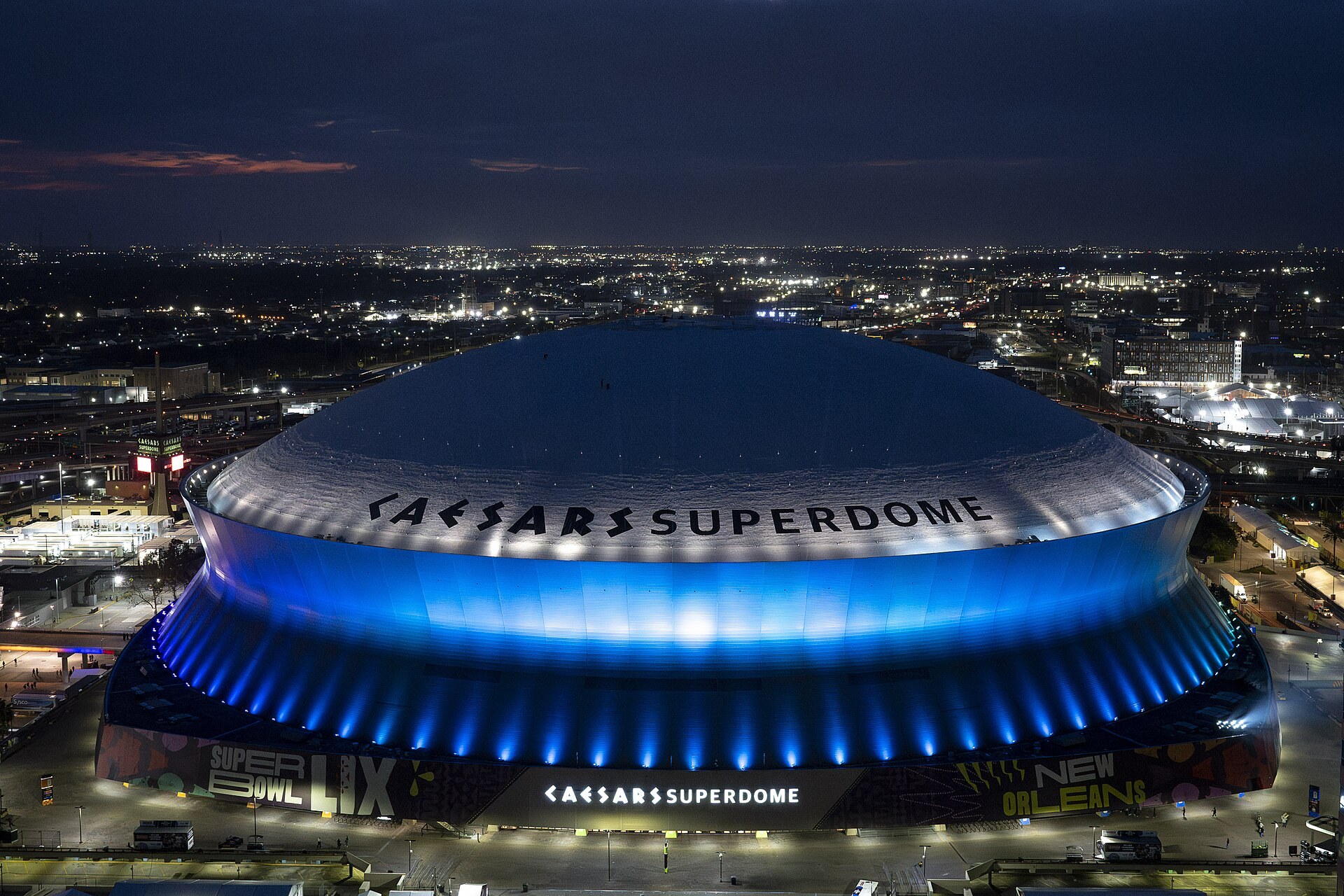
The Caesars Superdome renovation spent $560 million on a 1975 stadium without adding to its footprint. Rather than chase a replacement, the Louisiana Stadium and Exposition District and the New Orleans Saints rebuilt the dome’s circulation over five off-seasons and handed it back in August 2024, six months before Super Bowl LIX.
That’s the part worth studying. Recent NFL stadiums have been priced at $2 billion and up. New Orleans kept the roof, the seating bowl and the aluminum skin, and went after the things fans actually complained about: long walks up the ramps, tight concourses and too little accessible seating.
Project Scope
Trahan Architects of New Orleans led design, and Broadmoor LLC built the work in phases around the football calendar. Structure magazine counted 17 separate mini-projects across five construction seasons, each one squeezed into the window between a final home game and the next preseason opener. Design kept rolling while crews were already demolishing.
The headline move was taking out the spiral pedestrian ramps along the sidelines. In their place the team cut four corner atria through the building. Each opening measures about 40 feet by 90 feet and passes through four floor levels, and 40 existing trusses had to be reconfigured to make room. Escalators now run through those atria, and 16 new elevators improve access to every level.
Thornton Tomasetti was the structural engineer. Henderson Engineers, the Lenexa, Kansas firm that documented the dome’s damage after Hurricane Katrina, designed the building systems. Zahner fabricated the architectural metal. Postel International fabricated the structural steel and Foster Steel erected it.
Fans got wider concourses and new viewing decks with accessible seating. There’s also a 4,000-square-foot end zone club, plus a pair of 40-yard bars on the plaza level. The unglamorous work came first. A large commissary kitchen and new exit paths had to be in place before the ramps could come out.
The budget started at $450 million in 2019, when the Saints agreed to put in up to $150 million and the district and the state took the balance. Local reporting ties the $100 million increase to inflation after the pandemic.
Why It Matters
The Superdome is the clearest American test of whether a mid-century stadium can stay competitive through surgery instead of replacement. The answer cost roughly a quarter of what a new building would have, and the stadium never missed a season.
It also shows what phasing demands of a team. Seventeen handoffs in five years leave no float, and every one of them ended with a full house walking through the work. Owners in other cities with aging domes and thin public budgets will read this one closely. So should the regional contractors who’d build it for them.
Project Team & Details
| Owner / Client | Louisiana Stadium and Exposition District (LSED) |
|---|
| Architect | Trahan Architects |
|---|
| Consultants | Thornton Tomasetti (Structural Engineering)
Henderson Engineers (MEP and Fire Protection Engineering) |
|---|
| General Contractor | Broadmoor LLC |
|---|
| Major Subcontractors | Postel International (Structural Steel Fabrication)
Foster Steel (Steel Erection)
Zahner (Architectural Metal Fabrication) |
|---|
| Status | Completed |
|---|
| Funding Source | Mixed |
|---|