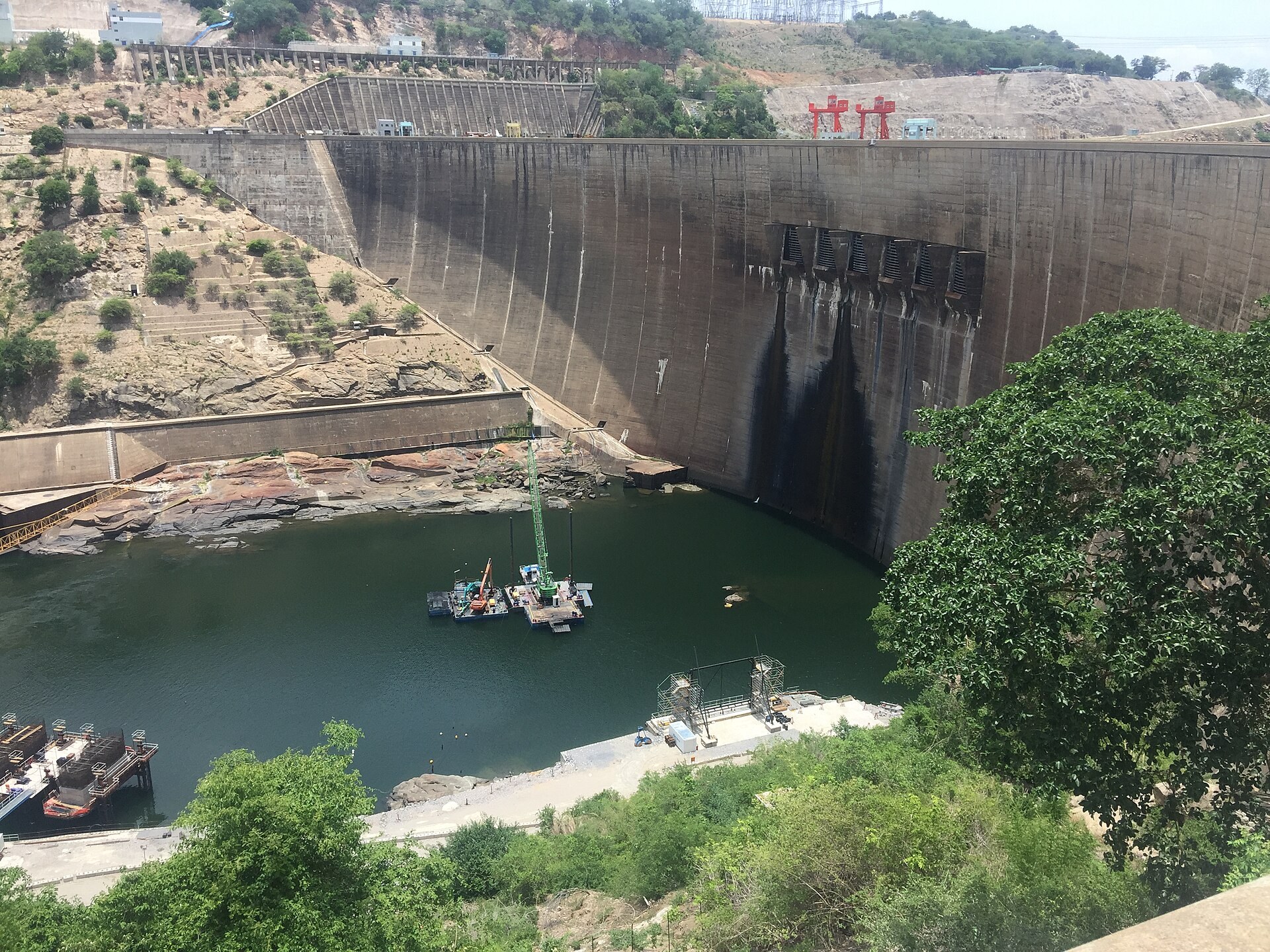
The Kariba Dam rehabilitation is a US$294 million repair of the 128-meter arch dam that anchors power supply for Zambia and Zimbabwe, carried out without taking 2,130 megawatts of hydropower offline. Six decades of spilling had scoured a pit about 80 meters deep into the riverbed at the toe of the wall. Left alone, that erosion threatened to work back toward the foundation.
The Zambezi River Authority, owned jointly by the two governments, launched the program in 2017 with grants and loans from the European Union, the World Bank, the African Development Bank and Sweden. In May 2026 the authority put overall progress at 94 percent and was targeting completion by the end of the year.
Project Scope
The work came in two packages. France’s Razel-Bec reshaped the plunge pool. Its crews built a cofferdam downstream of the wall so the pool could be worked in the dry, then excavated roughly 300,000 cubic meters of rock to give it a stable profile along the weak fault zones. That package was completed and commissioned in September 2024. Gruner Stucky of Switzerland served as the supervising engineer.
The spillway package covers all six sluice gates near the crest. A consortium of GE Hydro France and Freyssinet International has been on site since 2019 rehabilitating the upstream control system. Its scope takes in hydrodemolition, concrete repairs and new built-in parts, along with an emergency gate and a gantry crane. That phase stood at 99 percent in May. A second phase, awarded to a joint venture of Morris Material Handling and STUB Engineers, replaces the hoisting systems on every gate. Fabrication finished in 2025 and site work started that December. The authority expected to wrap up in September 2026.
Why It Matters
Lake Kariba holds about 180 cubic kilometers of water, which makes it the largest man-made reservoir on earth by volume. The EU’s project file estimates that a failure would put close to 3 million people downstream at risk and cause more than US$20 billion in damage. Against that, US$294 million is cheap.
The harder lesson is about timing. The plunge pool problem was understood years before financing closed, and the finish date has slipped more than once since. Arch dams built in the 1950s and 1960s are aging on every continent, and most don’t have four development lenders ready to split the bill. Kariba got its repair because the consequences were too large to ignore. Plenty of smaller dams with the same defect won’t draw that kind of attention, and their owners shouldn’t wait for it.
Project Team & Details
| Owner / Client | Zambezi River Authority |
|---|
| Consultants | Gruner Stucky (Supervising engineer) |
|---|
| General Contractor | Razel-Bec (plunge pool); GE Hydro France / Freyssinet International (spillway) |
|---|
| Major Subcontractors | Morris Material Handling / STUB Engineers JV (Spillway gate hoisting systems, Phase 2)
Sinohydro Bureau 8 (Stop logs)
APC Presmet (Needle cofferdam) |
|---|
| Status | Under Construction |
|---|
| Funding Source | Mixed |
|---|