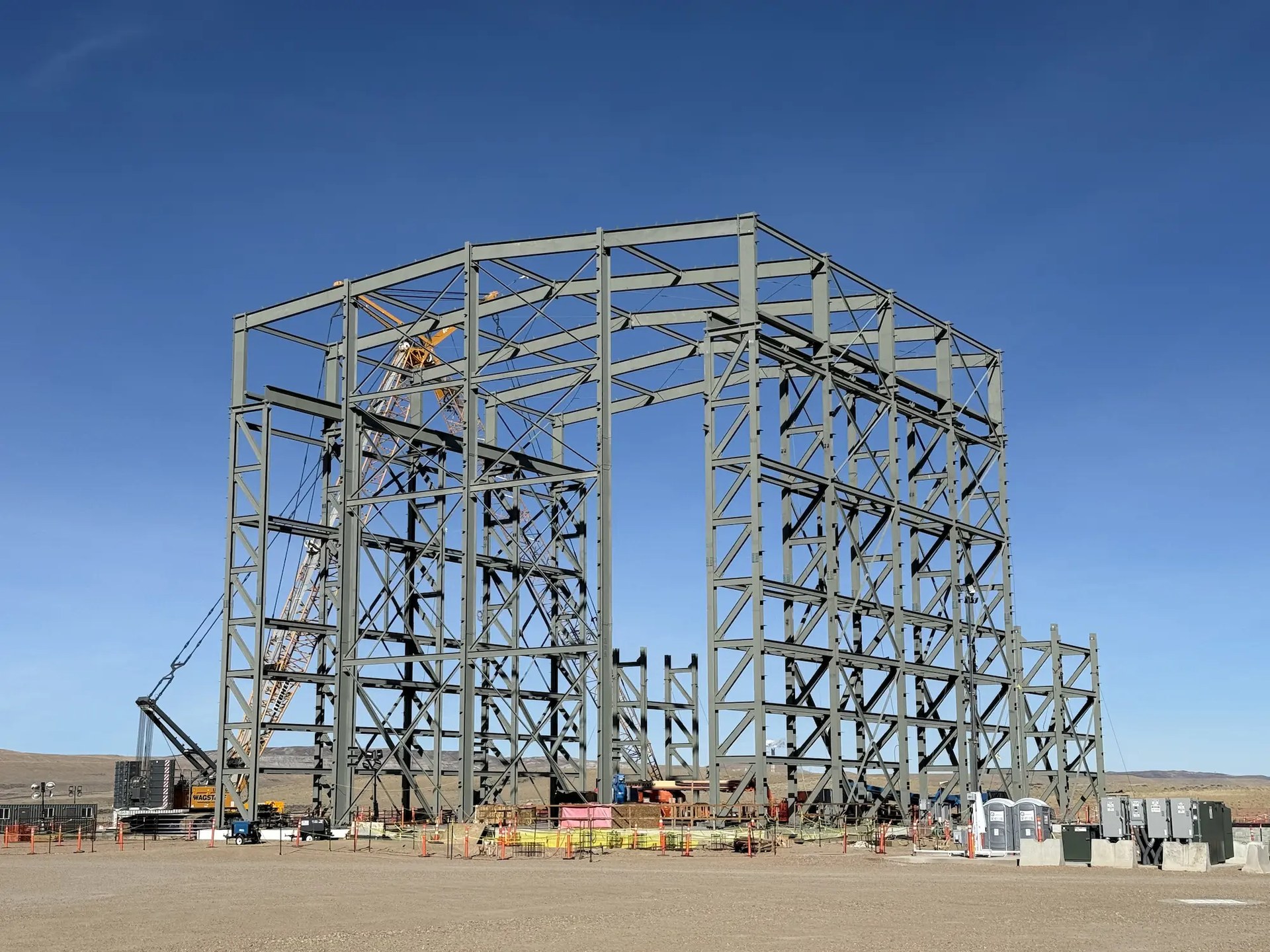
The nuclear island broke ground in April 2026. The conventional power block started two years earlier.
That sequencing is the whole point of TerraPower’s Natrium design, and it’s why Kemmerer Unit 1 should interest anyone who builds power plants. TerraPower split the facility into an Energy Island and a Nuclear Island, licensed them separately, and put conventional crews to work on the non-nuclear side in June 2024 while the NRC was still reviewing the reactor. The commission authorized the construction permit on March 4, 2026, the first ever issued for a non-light-water commercial power reactor in the United States.
The plant occupies 1,120 acres next to PacifiCorp’s retiring Naughton coal unit in southwest Wyoming, reusing the existing transmission interconnection and a good share of the coal-region workforce.
Project Scope
Unit 1 is a sodium-cooled fast reactor rated 840 MWt and 345 MWe baseload. An integrated molten-salt thermal storage loop lets it peak at 500 MWe for more than five and a half hours, which is the commercial argument for the whole design: a nuclear unit that follows load without throttling the reactor. Total project cost runs about $4 billion, split roughly evenly between a DOE Advanced Reactor Demonstration Program award and private capital.
Peak construction employment is about 1,600. Permanent operations staffing is around 250.
The emergency planning zone is roughly a quarter mile, the smallest of any major U.S. power reactor and a direct consequence of running the primary loop at atmospheric pressure.
Fuel is HALEU, and the supply chain for it is being built alongside the plant. Centrus Energy handles enrichment at Piketon, Ohio, Framatome does metallization at Richland, Washington, and Global Nuclear Fuel-Americas fabricates in Wilmington, North Carolina. Large forgings come from Doosan Enerbility, HD Hyundai and ENSA.
Bechtel is finishing the Sodium Test and Fill Facility, a first-of-a-kind sodium handling plant, before the EPC contract goes back out to bid. TerraPower said in September 2026 that it will rebid the work after the two firms failed to agree terms for the next phase, and that the Kemmerer schedule is unchanged. No replacement contractor has been named.
Why It Matters
This is the first utility-scale advanced reactor in the country to move off paper and onto a jobsite, which makes it the live test of whether Gen IV cost and schedule claims survive contact with field conditions.
The decoupled island approach is a real construction innovation. It let the power block start two years before the nuclear permit landed, and other developers are watching whether the parallel-licensing logic holds up through commissioning and startup testing.
The EPC rebid is the other thread to track. How that contract gets rewritten, and what risk the next contractor agrees to carry on a first-of-a-kind sodium plant, will tell the market more about advanced nuclear economics than any vendor cost curve.
Project Team & Details
| Developer | TerraPower, LLC |
|---|
| Owner / Client | PacifiCorp / Rocky Mountain Power (utility partner and eventual owner-operator) |
|---|
| Consultants | GE Vernova Hitachi Nuclear Energy (reactor technology partner) |
|---|
| General Contractor | Bechtel (EPC through the Sodium Test and Fill Facility; contract being rebid) |
|---|
| Major Subcontractors | Centrus Energy (HALEU enrichment, Piketon, Ohio)
Global Nuclear Fuel-Americas (fuel fabrication, Wilmington, North Carolina)
Framatome (metallization, Richland, Washington)
Doosan Enerbility, HD Hyundai, ENSA (large forgings and components) |
|---|
| Status | Under Construction |
|---|
| Delivery Method | Design-Build |
|---|
| Funding Source | Mixed |
|---|