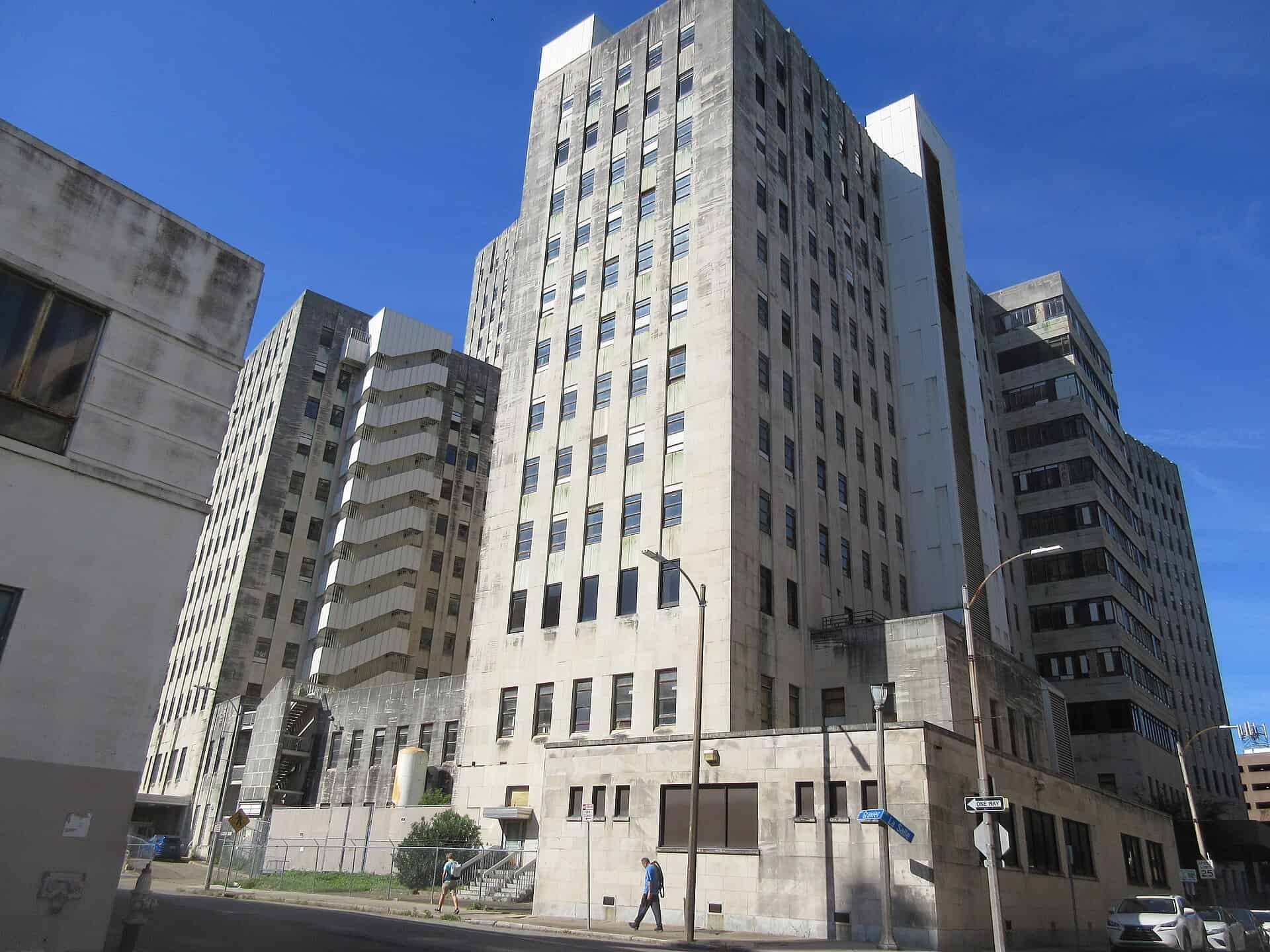
Roughly a million square feet of Art Deco limestone has stood empty in downtown New Orleans for two decades. Charity Hospital opened in 1939 as one of the largest hospitals in the United States, carried a national reputation in trauma care, and closed after the 2005 levee failures during Hurricane Katrina. In June 2026 Tulane University signed a purchase and sale agreement with the original developer, 1532 Tulane Holdco, moving from anchor tenant to owner and lead developer of the $500 million redevelopment.
More than 650,000 square feet goes to the Celia Scott Weatherhead School of Public Health and Tropical Medicine, the Tulane University Innovation Institute and parts of the School of Medicine, with interdisciplinary labs for about 700 new researchers.
Project Scope
About 1,000,000 square feet in total. Academic, research and innovation space across more than 650,000 square feet, plus residential, a food hall, retail and community space, and conversion of the underused basement to parking. Tulane projects a $1.2 billion state economic impact and roughly 7,300 one-time construction jobs.
The historic exterior, including the Enrique Alferez sculptural program, is being restored in cooperation with the Louisiana Department of Culture, Recreation and Tourism and the National Park Service. Funding is mixed: Tulane, a lead gift from the Goldring Family Foundation, the State of Louisiana, the City of New Orleans, BioDistrict New Orleans, and opportunity-zone equity. Financial closing was expected in fall 2026 with groundbreaking to follow and completion in 2029. An architect of record and general contractor haven’t been named publicly.
Why It Matters
Every serious plan for Charity in twenty years failed at the same point, and the point was ownership. A developer holding an anchor-tenant letter couldn’t close. The anchor tenant buying the building could.
For adaptive reuse at this scale the number that matters isn’t the $500 million. It’s the 650,000 square feet of committed institutional program, which is what turns a derelict landmark into a financeable project.
Project Team & Details
| Developer | Tulane University |
|---|
| Owner / Client | Tulane University |
|---|
| Consultants | The Magnolia Group (Development Advisor to 1532 Tulane Holdco)
BioDistrict New Orleans (District Partner)
National Park Service (Historic Rehabilitation Review) |
|---|
| Status | Planned |
|---|
| Funding Source | Mixed |
|---|