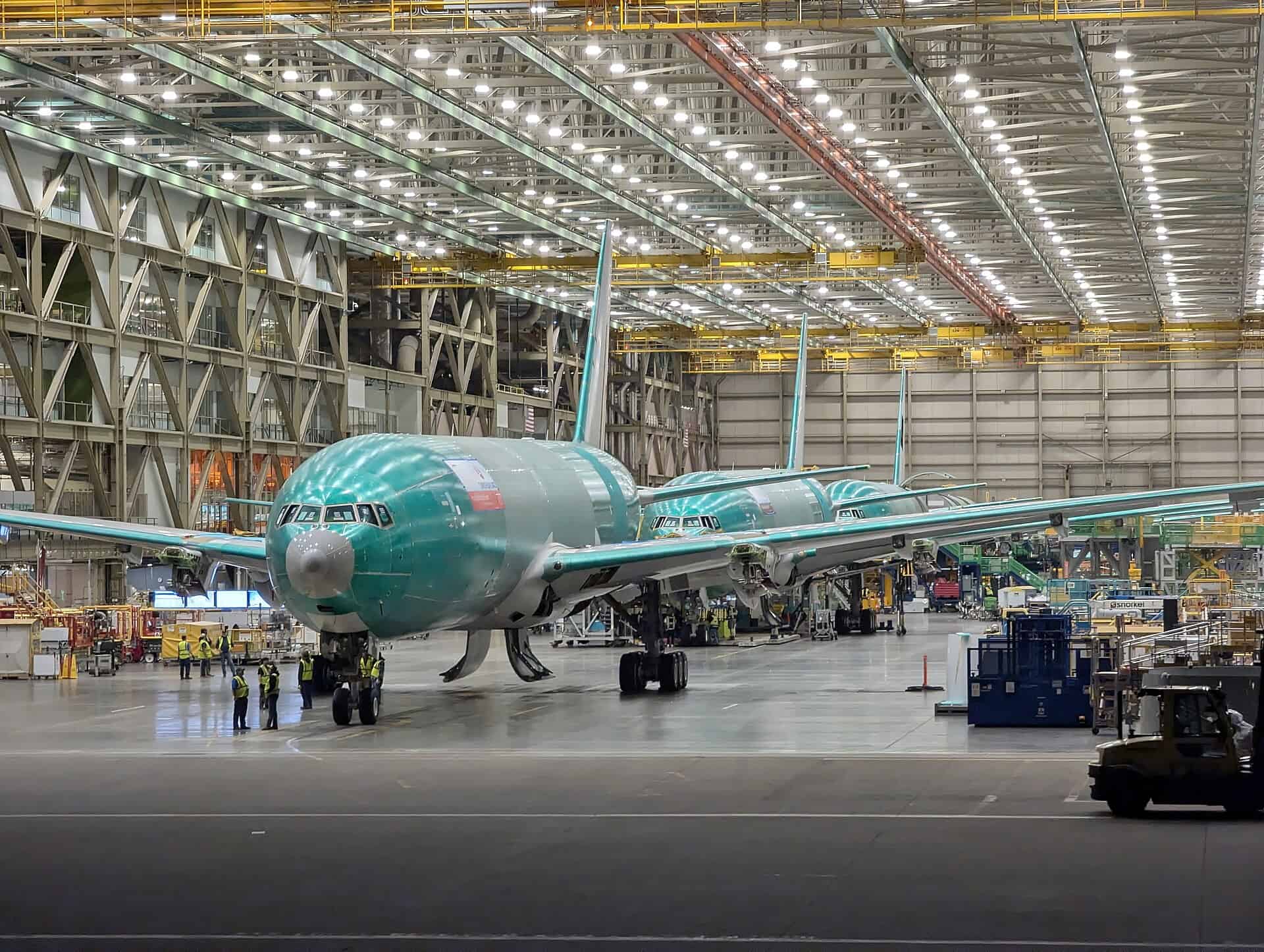
Boeing activated a fourth 737 MAX final assembly line on July 6, 2026, and it didn’t build a factory to do it. It converted widebody bays inside the Everett plant, the building put up for the 747 in 1967 and still the largest building in the world by volume at roughly 472 million cubic feet.
Project Scope
The conversion, known internally as the North Line, repurposes assembly bays that emptied out as 747 and 777 demand fell away. Company reporting puts the investment at about $1 billion. The build process replicates Renton’s with one real departure: a new 737 Wing Transport Tool ferries partially completed wings from Renton up to Everett for mating in final assembly, and that’s the piece that made the conversion viable at all. Boeing is running low-rate initial production on the new line now, moving from 42 aircraft a month to 47, and targets 52 a month by early 2027.
Why It Matters
This is adaptive reuse at industrial scale, and the economics are the whole point. Boeing needed narrowbody rate and had widebody floor space it already owned, already powered, and already staffed within commuting distance. A greenfield final assembly building would have carried a multi-year permitting and construction schedule plus a workforce recruited from scratch. Converting bays inside Everett collapsed that to a fit-out.
The wing logistics are the constraint most people underestimate. Renton builds 737 wings; Everett now mates them. That means a physical transport tool, a route, and a takt time that has to hold across two plants roughly 30 miles apart. Rate targets live or die on that link, not on the assembly bays.
For anyone reading this as a template, the reason it worked is that the building’s bay heights, crane capacity and floor loading were all specified in 1967 for aircraft substantially larger than a 737.
Project Team & Details
| Owner / Client | The Boeing Company |
|---|
| Status | Completed |
|---|
| Funding Source | Private |
|---|