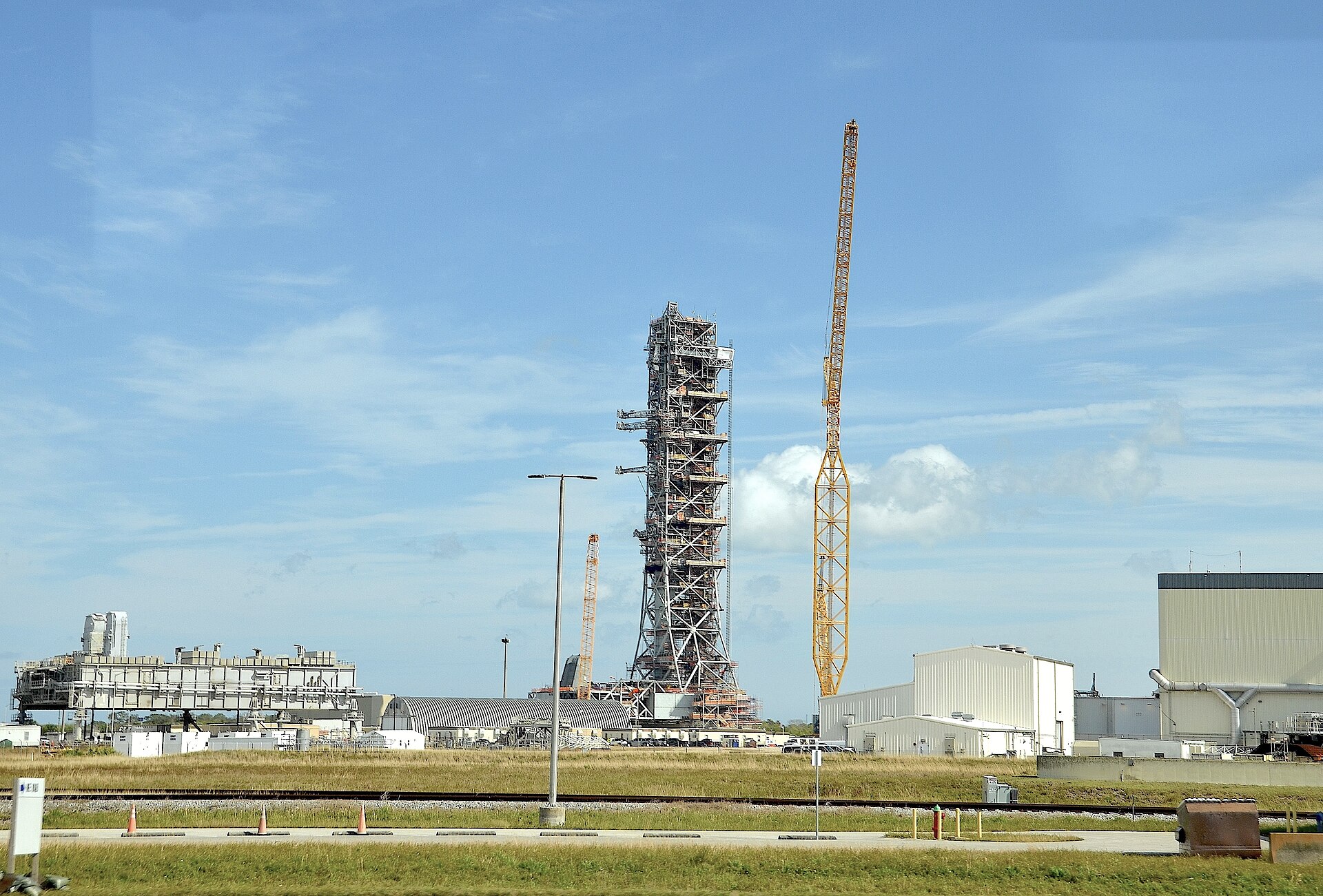
Mobile Launcher 2 stacked its tenth and final module on July 2, 2025, which put 377 feet of steel on a crawler base at Kennedy Space Center and ended a growth spurt that added 270 feet in about six months. Bechtel National builds it in modules on the ground and lifts them into place, which is the only practical way to assemble a structure like this on a site that also has to keep operating.
The design loads are the interesting part. ML-2 has to survive a launch environment above 2,200°F, blast pressures over 130 psi and more than 8.9 million pounds of thrust from the Block 1B configuration of the Space Launch System, which is taller than the rocket the existing mobile launcher was built for. It serves Launch Complex 39B from Artemis IV onward.
Project Scope
A 377-foot steel launch tower and base, assembled from ten prefabricated modules and outfitted with umbilicals, crew access, propellant lines and blast protection. Structure topped out July 2025; outfitting continues toward a first launch slated for fall 2028. NASA Exploration Ground Systems owns it; Bechtel National holds the construction contract.
Why It Matters
ML-2 is also a cost-growth case study, and NASA’s Inspector General and GAO have both said so at length. The original 2019 award was a $383 million cost-plus contract. Current estimates run to roughly $1.5 billion. Some of that is genuine scope discovery on a first-of-a-kind structure, and some of it is what happens when a cost-plus contract meets a design that isn’t finished. Either way, the steel is up, which is more than the schedule critics predicted two years ago.
Related coverage & projects
Project Team & Details
| Owner / Client | NASA Exploration Ground Systems |
|---|
| General Contractor | Bechtel National, Inc. |
|---|
| Status | Topped Out |
|---|
| Delivery Method | Design-Bid-Build |
|---|
| Funding Source | Public (Federal) |
|---|