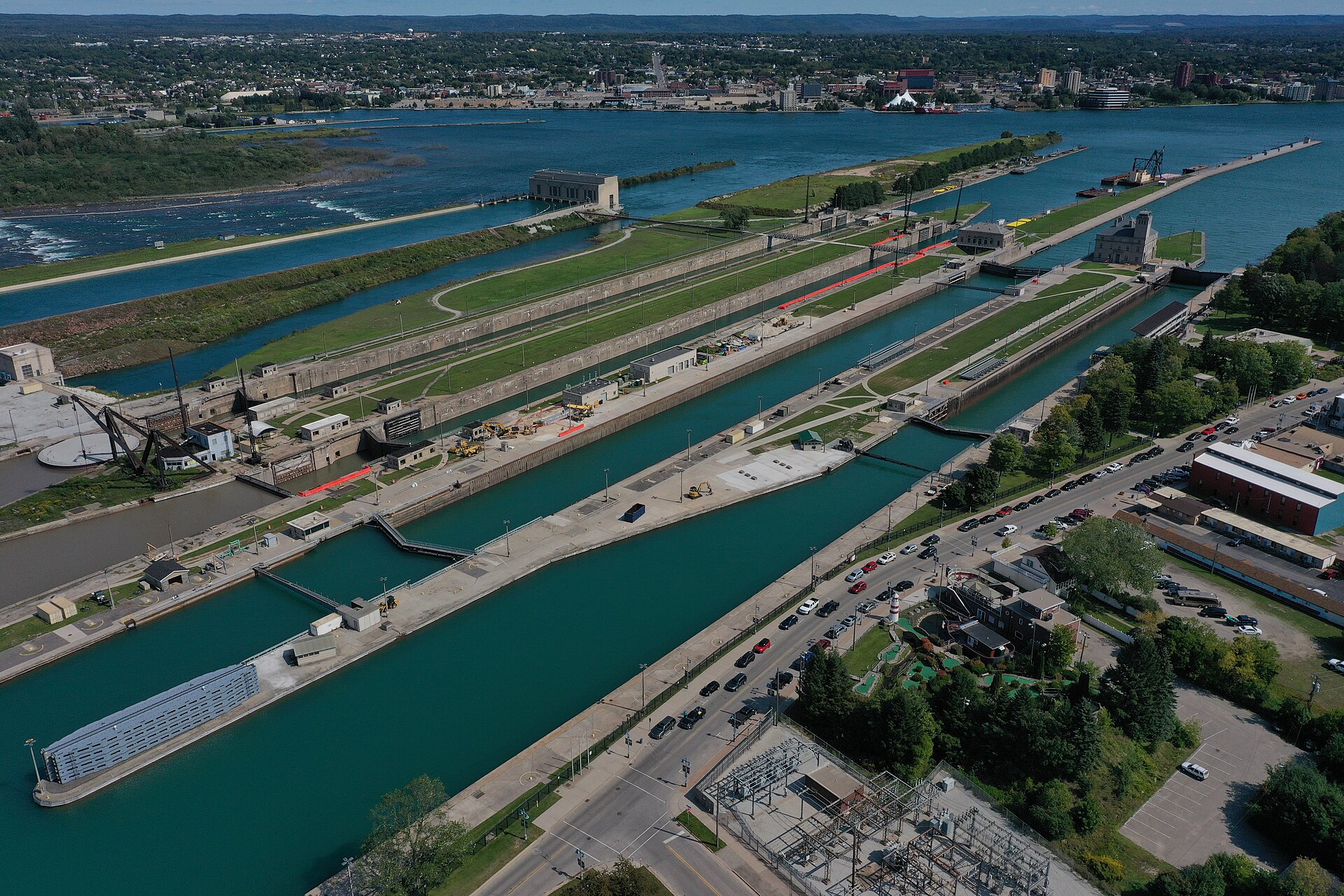
Almost every ton of iron ore that ends up as American steel passes through a single lock chamber. Of the four locks at Sault Ste. Marie, only the Poe can take the 1,000-ft lake freighters that carry that ore, which makes one 1968 structure a single point of failure for the domestic steel supply chain. The New Lock at the Soo exists to remove that risk.
Project Scope
The U.S. Army Corps of Engineers, Detroit District is building a second Poe-class chamber measuring 1,200 ft long, 110 ft wide and 32 ft deep, placed inside the footprint of the decommissioned Sabin Lock. The adjacent Davis Lock is being infilled. Phase 1 deepened the upstream channel to 30 ft and wrapped in 2022. Phase 2 delivered new upstream approach walls and was substantially complete in September 2024. Phase 3, the largest package, runs through 2030.
That final phase covers underwater bedrock excavation, demolition of the Sabin Lock, a new pump well, rehabilitation of the downstream approach walls, upstream and downstream cofferdams built from 90-ft-diameter steel sheet-pile cells, and a 2,000-linear-foot grout curtain. The lock walls comprise 42 concrete monoliths, 21 per side, placed in 5-ft lifts. Total concrete runs to roughly 350,000 cubic yards.
Kokosing Alberici Traylor, the joint venture holding Phase 3, is self-performing fabrication and installation of the upstream and downstream miter gates. Each gate weighs more than 200 tons. Scope also includes a hands-free mooring system, a blasted utility shaft, and a new vehicular bridge connecting the lock to a mid-river hydropower plant.
Why It Matters
The Soo handles more than 4,500 vessel transits a year moving roughly 80 million tons of commodities. Nearly all of the advanced high-strength steel used in U.S. cars and appliances starts as ore that moved through the Poe. A long unplanned Poe outage would idle mills within weeks, and there’s no redundant route.
The cost story is unusual for a federal civil works job of this size. USACE approved a revised fully funded estimate of $2.619 billion, about 13 percent below the $3.22 billion Congress had authorized. The Corps awarded KAT $222.7 million for the lock floor and mechanical and electrical installation in September 2024, then the three remaining Phase 3 options worth $95.3 million in June 2025. By August 2025 the design center had reviewed more than 2,600 technical submittals. For a project that spent decades stuck in the authorization queue, the execution phase has been comparatively quiet.
Related coverage & projects
Project Team & Details
| Owner / Client | U.S. Army Corps of Engineers, Detroit District |
|---|
| Consultants | USACE Inland Navigation Design Center (Design and Technical Review) |
|---|
| General Contractor | Kokosing Alberici Traylor LLC (Kokosing / Alberici / Traylor Bros. JV) |
|---|
| Status | Under Construction |
|---|
| Delivery Method | Design-Bid-Build |
|---|
| Funding Source | Public (Federal) |
|---|