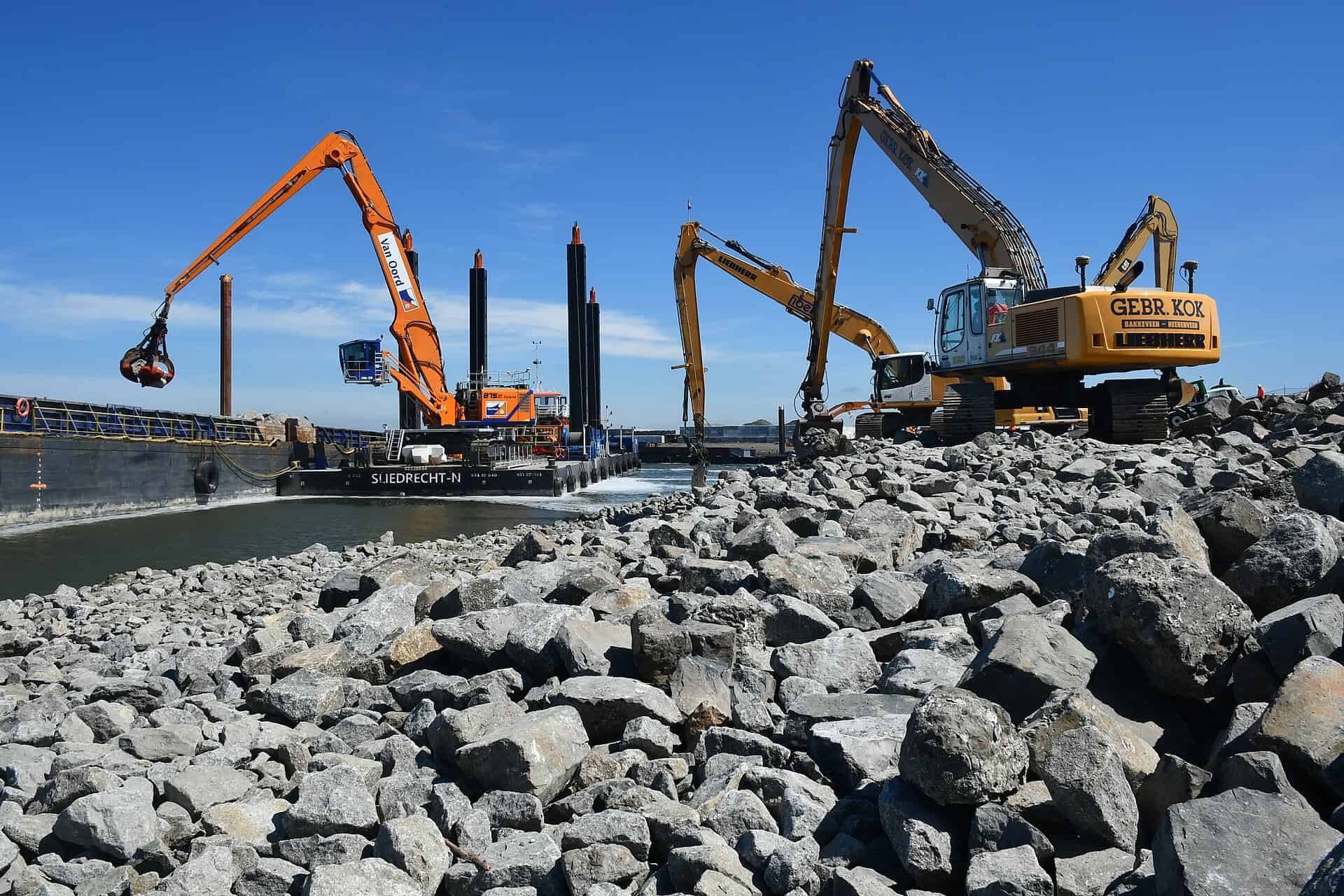
The Afsluitdijk reinforcement is finished, years later than the contract promised. The Dutch government commissioned the new pumping station and discharge sluices at Den Oever on Oct. 1, 2026, the first day of the country’s storm season.
The 32-kilometer dam is now designed for a storm with a 1-in-10,000 chance of occurring in any year.
Project Scope
The Afsluitdijk has separated the Wadden Sea from the IJsselmeer since 1932. A 2006 inspection found it needed an overhaul. Rijkswaterstaat awarded a design-build-finance-maintain contract in 2018 to Levvel, a consortium of Van Oord, BAM and Rebel, at a reported 550 million euros with 25 years of maintenance attached. Witteveen+Bos, which had run the planning study since 2012, joined Levvel’s design team.
The crest went up about 2 meters. The seaward face is armored with roughly 75,000 concrete blocks of about 6.5 tonnes each, cast at a plant in Harlingen at a rate of at least 100 a day. Van Oord says the block, an application of the XblocPlus unit, used 35 percent less concrete than the alternatives.
Water going out matters as much as water kept out. Two additional sets of sluices and six pumps at Den Oever, rated at a combined 275 cubic meters per second, raise discharge capacity to the Wadden Sea by 45 percent. The sluices drain by gravity when the sea is low enough. When it isn’t, the pumps take over, and Baird Maritime’s report on the opening points out that rising sea level keeps shortening the gravity window. New flood barriers went in at the lock complexes at Den Oever and Kornwerderzand. A 4-kilometer fish migration river is still under construction at Kornwerderzand, with the first fish expected in early 2027.
Why It Matters
The delay came from data, not from construction. Dutch News reported in November 2020 that a fault in the sluice design, found that summer, would push completion from 2022 to 2025 and add what the minister called hundreds of millions of euros. ENR reported a year later that water level and wave data behind the design had been underestimated, that about $140 million had been allocated for redesign, and that the contractor had triggered the disputes procedure. Rijkswaterstaat’s completion notice gives no final cost.
A DBFM contract is supposed to move design risk to the builder. It can’t move the risk that the owner’s boundary conditions are wrong.
The work isn’t entirely done, either. Bridge replacements at both lock complexes, renovation of the dam’s monument and life-extension maintenance on the original 1932 sluices all sit outside this milestone.
And Rijkswaterstaat already says the dam will need more discharge capacity after 2045.
Project Team & Details
| Developer | Levvel (Van Oord, BAM, Rebel) |
|---|
| Owner / Client | Rijkswaterstaat |
|---|
| Consultants | Witteveen+Bos (Planning Study and Design Team Engineer)
Strootman Landscape Architects (Fish Migration Design) |
|---|
| General Contractor | Levvel (BAM Infra and Van Oord joint venture) |
|---|
| Status | Completed |
|---|
| Delivery Method | Public-Private Partnership (P3) |
|---|
| Funding Source | Public-Private Partnership (P3) |
|---|