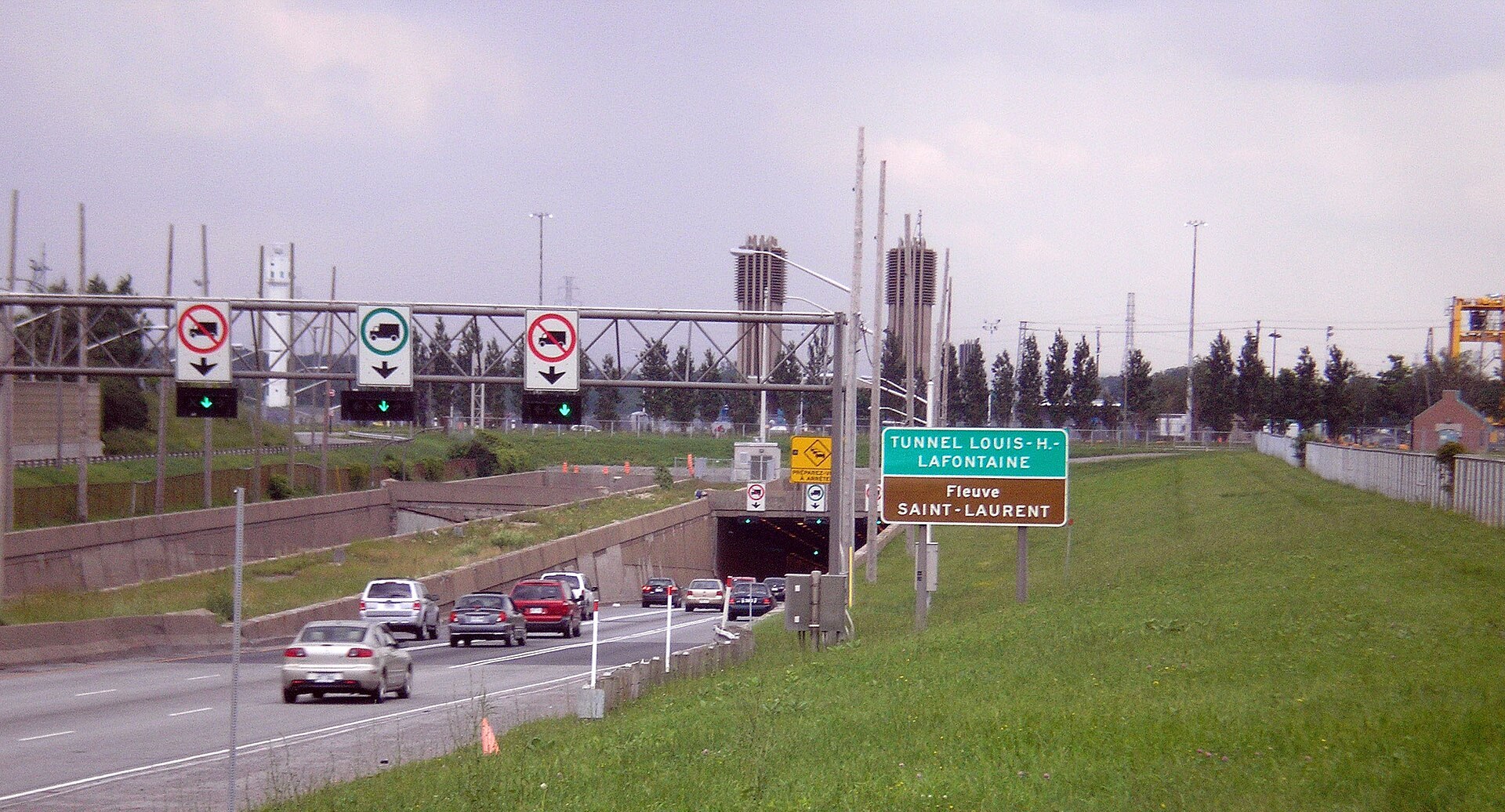
The Louis-Hippolyte-La Fontaine Tunnel rehabilitation is the first full overhaul of Canada’s longest underwater highway tunnel since it opened in 1967, and it’s being done with traffic still running through it. About 120,000 vehicles a day used the crossing between Montreal and Longueuil before work began, 13 percent of them trucks. Closing it was never an option.
Quebec’s transport ministry handed the job to Renouveau La Fontaine, a consortium of Pomerleau, Eurovia and Dodin Campenon Bernard, under a design-build-finance contract that reached financial close in July 2020. The budget hasn’t held. Ottawa’s 2020 funding announcement put the project at about C$1 billion. The ministry’s current figure is C$2.796 billion.
Project Scope
The tunnel is an immersed tube: seven precast sections, each 110 meters long and 32,000 tons, sunk into a trench in the St. Lawrence. Crews are repairing the concrete walls, vault and roadway slab, with hydrodemolition water fully recovered on site. Fire protection is being upgraded along the tubes. The lighting and electrical systems are being replaced along with ventilation and monitoring equipment. The ventilation towers are getting structural repairs plus new cladding and exhaust fans.
Work has moved one tube at a time. The first tube closed in late 2022 and reopened in spring 2025 after crews of up to 350 worked inside it 22 hours a day, seven days a week. The second tube followed. The ministry expects both open in late fall 2026, with approach work and landscaping running through 2027. Outside the portals, the contract rebuilds 13 kilometers of concrete pavement on Highway 25 between Sherbrooke Street and Charron Island. It also covers repairs to the Souligny interchange and a reserved lane for buses and carpools.
The schedule slipped a year in 2024. Quebec said damage in the ventilation towers was worse than expected and that 128 mobile panels still had to be designed and installed. Labor shortages and a mold problem in the service corridor didn’t help.
Why It Matters
Immersed tube tunnels from the 1960s are coming due across North America and Europe, and few of them have a spare crossing to divert into. La Fontaine shows what the alternative costs: three lanes instead of six for about four years, and a budget that more than doubled once crews opened up the concrete.
It’s also a caution on risk transfer. A design-build-finance deal puts schedule pressure on the contractor, but hidden deterioration in a 60-year-old structure still landed on the owner’s ledger. The ministry is aiming for 40 more years of service without another major intervention. That target is the real test of whether the price was worth it.
Project Team & Details
| Owner / Client | Ministere des Transports et de la Mobilite durable du Quebec |
|---|
| General Contractor | Renouveau La Fontaine (Pomerleau, Eurovia, Dodin Campenon Bernard) |
|---|
| Status | Under Construction |
|---|
| Delivery Method | Public-Private Partnership (P3) |
|---|
| Funding Source | Public (State) |
|---|