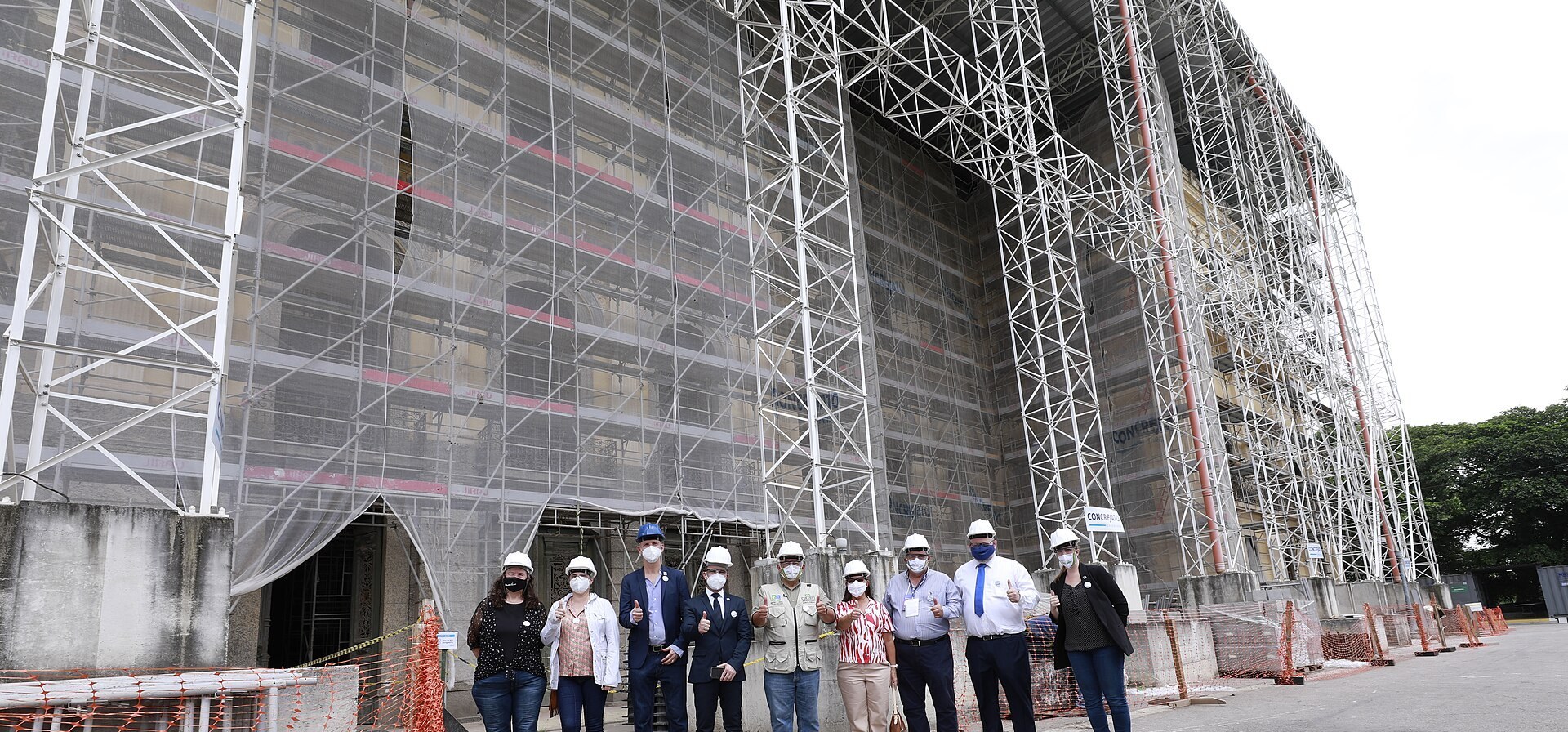
The Bendegó meteorite came through the fire. Most of the building around it didn’t. On the night of September 2, 2018, flames gutted the Paço de São Cristóvão, the former imperial palace in Rio de Janeiro’s Quinta da Boa Vista that housed Brazil’s Museu Nacional. The Museu Nacional reconstruction is now in its longest stretch: turning a restored shell back into a building that can hold a museum, with full reopening targeted for 2029.
Project Scope
The work runs in stages under the Museu Nacional Vive program with the Federal University of Rio de Janeiro (UFRJ), which operates the museum. The main block’s restored facade was unveiled on September 2, 2022, four years to the day after the fire. From February 2024 to October 2025, Construtora Biapó, picked through competitive bidding, restored facades and roofs on the palace’s lateral wings, built new internal slabs, reinforced structural masonry and installed a skylight over the courtyard of the monumental staircase, according to the program.
The interior design comes from a consortium of H+F Arquitetos and Atelier de Arquitetura e Desenho Urbano, winners of the architecture and restoration competition for the palace. Their approach treats the building as part of the collection. Surviving stone floors, chapel remnants, stencil paintings and an old cistern are being worked into visitor routes, and accessible paths become the main circulation instead of an add-on. Fire protection runs through the entire structure.
Before the fire, only about a third of the palace was given over to exhibitions. The new plan puts galleries and visitor space through nearly all of it.
Why It Matters
Money has set the pace. An earlier estimate put the rebuild at R$378.9 million. It’s now about R$520 million, and as of June 2026 roughly R$170 million was still unfunded, Exame reported. BNDES, Vale and Bradesco are among the backers, alongside federal money.
The museum didn’t wait for the finish line. It opened part of the palace on July 2, 2025, with the meteorite and a whale skeleton on show while restoration continued around visitors. That’s a sound model for any heritage rebuild measured in decades: let people watch the work.
The 2029 date is the one to track. It follows earlier public targets of 2025, 2027 and 2028.
Project Team & Details
| Developer | Projeto Museu Nacional Vive |
|---|
| Owner / Client | Universidade Federal do Rio de Janeiro (UFRJ) |
|---|
| Architect | H+F Arquitetos + Atelier de Arquitetura e Desenho Urbano |
|---|
| General Contractor | Construtora Biapó (lateral wings phase) |
|---|
| Status | Under Construction |
|---|
| Funding Source | Mixed |
|---|