Roughly half of cement’s carbon dioxide comes out of the limestone, not the fuel. No amount of fuel switching touches it. That is the problem Padeswood is built to solve.
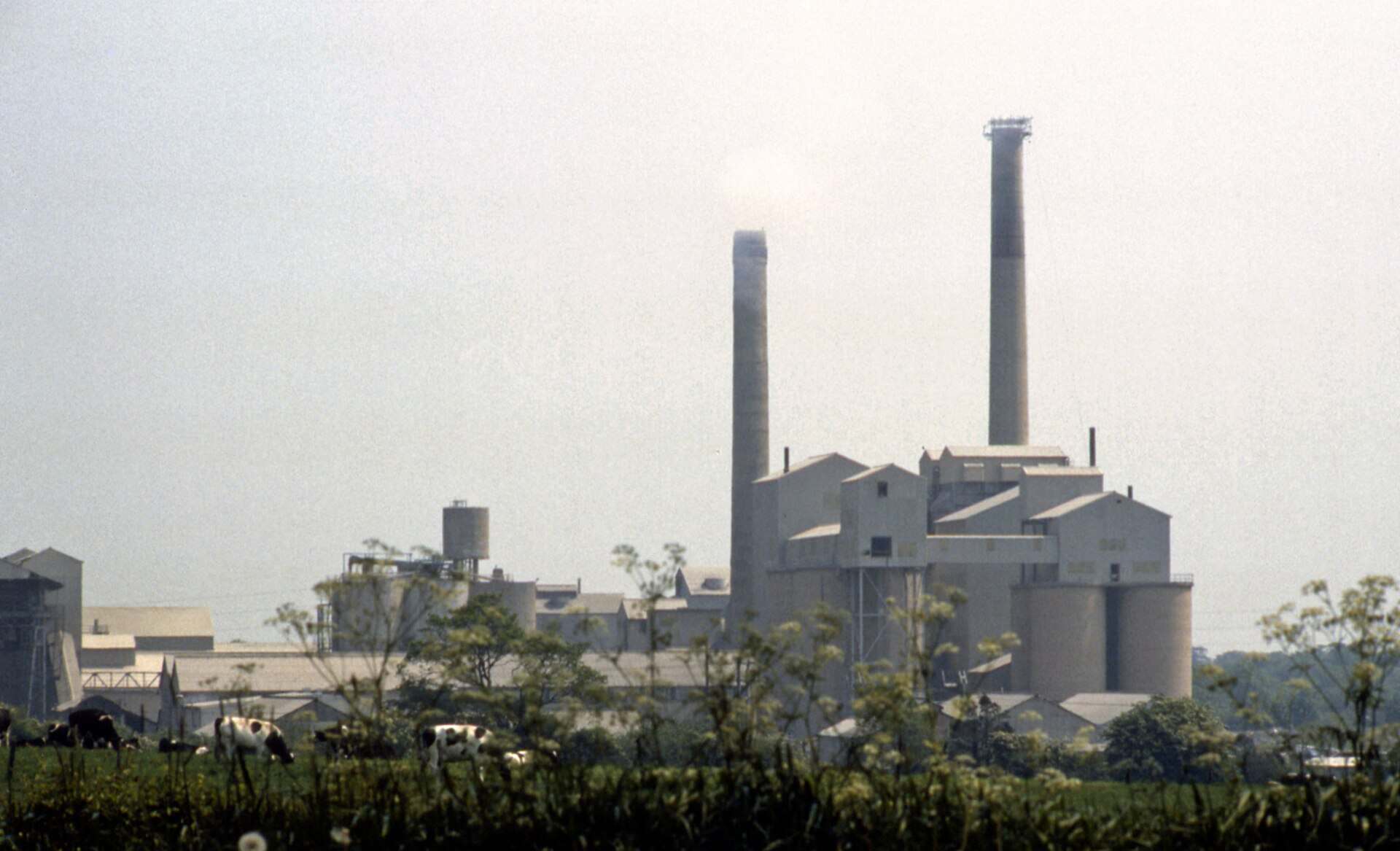
The works near Buckley has made clinker since December 1949, starting with two FLS wet-process kilns, adding a long dry kiln in 1966, and retiring all three in 2005 for the current single air-separate precalciner kiln A4: 65 m by 4.75 m, about 2,650 tonnes a day, fired on coal, petcoke and waste-derived fuels. Heidelberg Materials UK is retrofitting a full-scale post-combustion capture and compression plant plus a new CHP plant onto that operating line.
Project Scope
The capture island uses Mitsubishi Heavy Industries’ Advanced KM CDR Process with KS-21 solvent, the first deployment of that process on cement in Europe. Design capture is about 800,000 tonnes of CO2 a year, roughly 95 percent of the works’ emissions from kiln and CHP together. Because a share of the fuel is waste-derived and therefore biogenic, the plant carries net-sink potential. Output is evoZero near-zero cement at commercial scale.
Physically it is large: a capture plant around 250 m by 100 m by 25 m, an absorber tower up to 100 m, and a CHP plant of about 50 m by 20 m by 40 m generating at least 12 MW of electricity and 83 MW of heat, plus SCR, CO2 compression, limestone store, wet sand mill, raw meal silo and control building. Captured CO2 is compressed on site and exported through a new spur pipeline to the HyNet North West CO2 pipeline at Northop Hall, then to Point of Ayr and offshore storage in depleted Liverpool Bay gas fields operated by Eni.
Worley holds the EPCM contract and balance of plant, announced December 2025; MHI and MHI-EMEA cover engineering and procurement for the capture island. RSK led environment, consents and permitting. As of 31 July 2026 the site had over 600 concrete piles, roughly 5,000 cubic metres of concrete in a retaining wall, more than 60,000 tonnes of aggregate placed and 25,000 tonnes of topsoil stripped, with about 80 construction workers a day expected to roughly double by year end.
The GBP 400 million-plus figure is Heidelberg’s total capital investment, not a let contract sum. The multi-billion figures that circulate alongside it are programme-wide UK CCUS envelopes and should not be attributed to this site.
Why It Matters
If it works, Padeswood becomes the first cement plant anywhere with a fully decarbonised production process. If it doesn’t, the UK sector has no second plan for process emissions.
Either way the construction lesson lands first: fitting a 100 m tower and a 250 m capture hall into a 1940s works that has to keep producing is a sequencing problem before it is a chemistry problem, and every other UK cement plant will have to solve the same one.
Project Team & Details
| Developer | Heidelberg Materials UK |
|---|
| Owner / Client | Heidelberg Materials UK |
|---|
| Consultants | RSK Environment (Environment, Consents and Permitting) |
|---|
| General Contractor | Worley (EPCM) |
|---|
| Major Subcontractors | Mitsubishi Heavy Industries (Capture Technology and CO2 Compression)
Eni / Liverpool Bay CCS (CO2 Transport and Storage) |
|---|
| Status | Under Construction |
|---|
| Delivery Method | Design-Build |
|---|
| Funding Source | Mixed |
|---|