
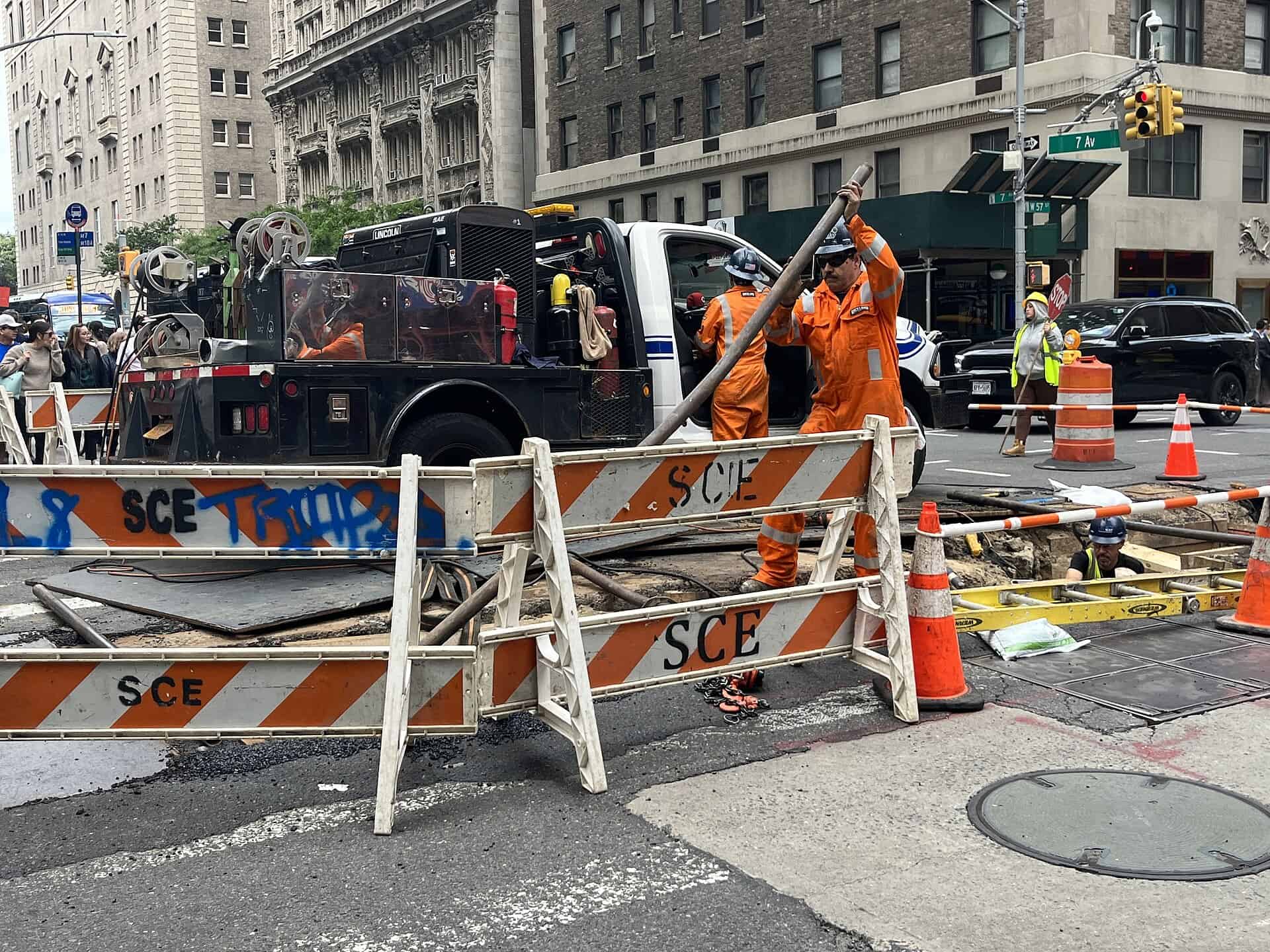
The New York City Dept. of Buildings inspected 180 jobsites in the first phase of its safety sweep following the July 7 partial collapse at 235 East 42nd St., and found nothing posing imminent danger to the public. It did write 65 violations.
What the 180-jobsite DOB sweep turned up
Every site in phase one was tied to the former Pfizer headquarters project through one of four entities: Metroloft, Domani, Barone Steel or Northeast Specialist Group. Of the 180 sites, 24 were office-to-residential conversions.
At those 24 conversion jobs, DOB issued three OATH violations and one stop-work order. At the other 156 sites, 62 OATH violations and 18 stop-work orders. None of the 65 total violations, spread across 38 unique work sites, involved immediately hazardous structural conditions. Most covered site safety issues putting workers at risk, failures to follow approved design plans, or administrative problems.
The conversion question the agency answered directly
After structural columns failed at 235 East 42nd St. in July, forcing evacuations and street closures in Midtown, the obvious question was whether office-to-residential conversion carries a structural risk profile the code hasn’t caught up to. DOB’s answer, at least for now: no evidence the July 7 incident “is in any way inherent to office-to-residential conversion projects.”
That matters commercially. Conversion pipelines in New York and elsewhere are underwritten on the assumption that cutting new shafts and removing slab through an existing frame is a solved engineering problem. A finding the other way would have repriced a lot of deals. The investigation at East 42nd Street is still open, so the answer isn’t final.
Read the violation count for what it is
Sixty-five violations across 180 sites is not an indictment. Joe DiPompeo of Structural Workshop told Construction Dive the surge resembles past responses to construction failures, when DOB “sent a wave of inspectors, writing violations left and right for anything and everything.” The sweep functions partly as public communication: the agency showing it is paying attention.
What contractors should take from it is narrower and more useful. Two-thirds of the violations were paperwork and site-safety housekeeping on jobs that had no structural problem at all. Those are the findings an inspector writes when they arrive unannounced and start looking. DOB says the next phase widens to sites connected to other entities attached to the East 42nd Street building.
More inspectors are coming. The stop-work orders were real.