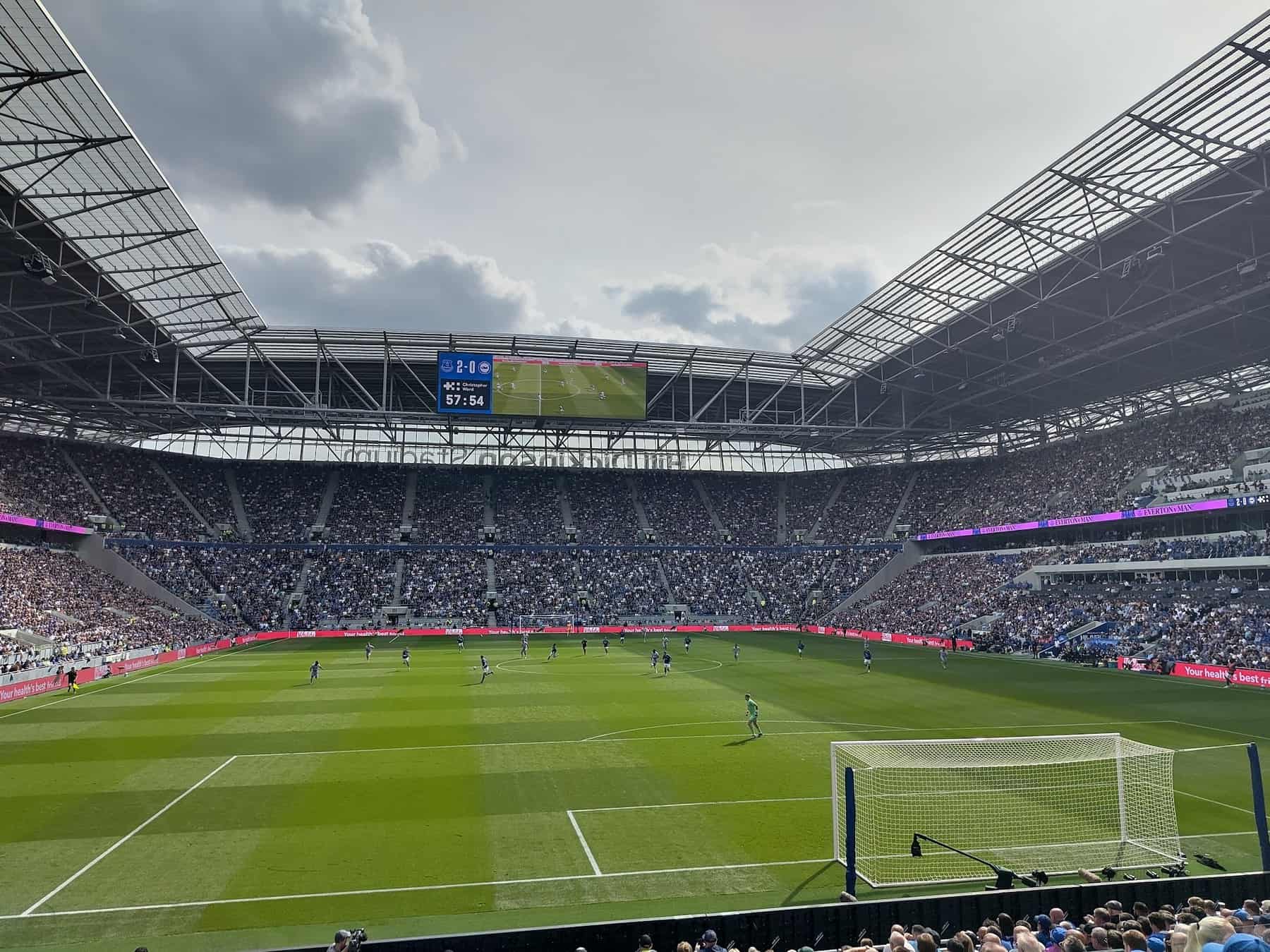
Everton spent 132 years at Goodison Park and then moved 1.6 miles north onto a dock that had been sitting there since 1848. Bramley-Moore was a Jesse Hartley design, a working basin with a granite river wall, and the first job on the site was to fill it in with sand dredged out of the Mersey. That took from August to December 2021. Everything since has been a stadium built on reclaimed ground inside a listed dock estate on a UNESCO-contested waterfront.
Project Scope
Laing O’Rourke delivered a 52,769-seat four-stand bowl using its own off-site DfMA approach: precast terracing units and steel frame assemblies fabricated away from site and lifted into place, which is the only sensible way to build at that volume on a constrained dock with one land-side access route. The South Stand is a single tier of 13,000, modelled openly on Dortmund’s Westfalenstadion. The final terracing panel went in during February 2024 and Laing O’Rourke handed the building over on 23 December 2024.
Capacity came in 119 seats below the design figure after a pre-opening segregation and media review, which is a rounding error on a job this size but worth noting because published capacities and licensed capacities are rarely the same number. The pitch is a standard 105 by 68 metres. Financing shifted mid-project: the Liverpool City Council loan model was dropped in March 2022 and replaced with private debt from JP Morgan and MUFG.
The building opened in stages. A 10,000-capacity test event on 17 February 2025 (Everton U18 against Wigan U18) came first, then a 50,837 certification fixture against AS Roma on 9 August, then the first competitive match on 24 August 2025. Record attendance so far is 52,590, against Sunderland on 20 May 2026.
Why It Matters
This is the reference job for large-scale DfMA in UK stadium work, and the delivery record backs the method: structural completion inside 25 months of the dock being filled. It is also a reminder of what sits underneath a headline programme. Site worker Michael Jones died in an accident in August 2023 and work stopped; a permanent memorial was unveiled a year later. Facade subcontractor Alucraft Systems entered administration in March 2024 owing suppliers GBP 7.7 million, mid-package, on a job that still finished on its handover date.
The ground hosts five UEFA Euro 2028 matches including a Round of 16 tie, and took its first non-football event, the 2025 Rugby League Ashes second Test, in front of 52,106.
Project Team & Details
| Developer | Everton Football Club (The Friedkin Group) |
|---|
| Owner / Client | Everton Football Club |
|---|
| Architect | BDP Pattern (stadium architect); MEIS Architects (concept design) |
|---|
| Consultants | Buro Happold (Structural) |
|---|
| General Contractor | Laing O'Rourke |
|---|
| Major Subcontractors | Alucraft Systems (Facade / Cladding) |
|---|
| Status | Completed |
|---|
| Funding Source | Private |
|---|