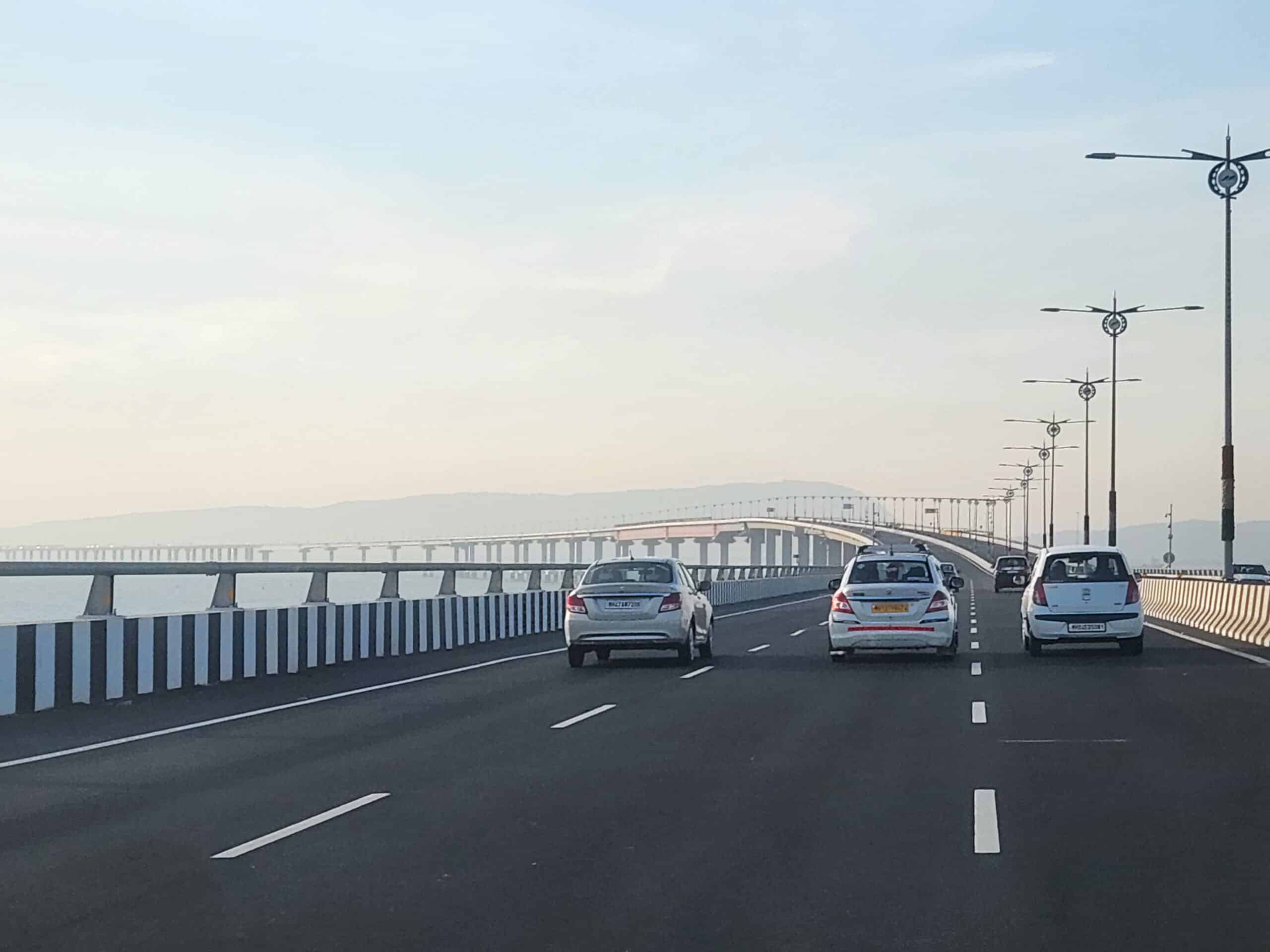
It took 17 kilometres of open water to cut an hour-long drive down to 20 minutes. Atal Setu, formally the Mumbai Trans Harbour Link, is India’s longest sea bridge at 21.8 km, and since opening it has rewired how people move between Mumbai and the mainland to the east.
Project Scope
The link runs from Sewri on the Mumbai side to Chirle near Navi Mumbai, with about 16.5 km of it carried on a viaduct over Thane Creek and the rest on land. It carries six lanes, three in each direction, plus emergency lanes, and it was built to handle heavy commuter and freight traffic feeding the new Navi Mumbai International Airport and the port at Jawaharlal Nehru.
The engineering had to work around the bay’s wildlife as much as its water. A cable-stayed design was ruled out because the towers would have crossed the flight path of the area’s flamingos, so for the longer spans the team used orthotropic steel deck technology instead. The Mumbai Metropolitan Region Development Authority split the work across packages: an L&T and IHI consortium took the Sewri side, a Daewoo and Tata Projects consortium built the Navi Mumbai section, and L&T handled the land portion toward Chirle. The price tag ran past Rs 17,840 crore, roughly $2.2 billion, financed largely through a Japanese development loan.
Prime Minister Narendra Modi opened the bridge to traffic on 12 January 2024, capping a build that started in 2018.
Why It Matters
Atal Setu is the kind of project that changes a region’s geography, not just its commute. By connecting Mumbai directly to the growth corridor on the eastern shore, it unlocks land for the housing, logistics and industrial development that a crowded island city can’t absorb on its own. The new airport and the freight links on the far side suddenly sit inside a reasonable drive of the financial district.
It also stands as a marker for marine bridge engineering in monsoon conditions. Building 16-plus kilometres of viaduct over a tidal creek, on soft marine soil, while protecting a flamingo habitat, is a hard problem solved at scale. For a country building out infrastructure at a furious pace, it’s a reference project. Exchange covers major crossings worldwide, including the Chenab Rail Bridge and Padma Bridge.
Project Team & Details
| Developer | Mumbai Metropolitan Region Development Authority (MMRDA) |
|---|
| Owner / Client | Mumbai Metropolitan Region Development Authority (MMRDA) |
|---|
| Consultants | AECOM (General Consultant) |
|---|
| General Contractor | L&T / IHI; Daewoo E&C / Tata Projects (by package) |
|---|
| Status | Completed |
|---|
| Delivery Method | Design-Bid-Build |
|---|
| Funding Source | Mixed |
|---|