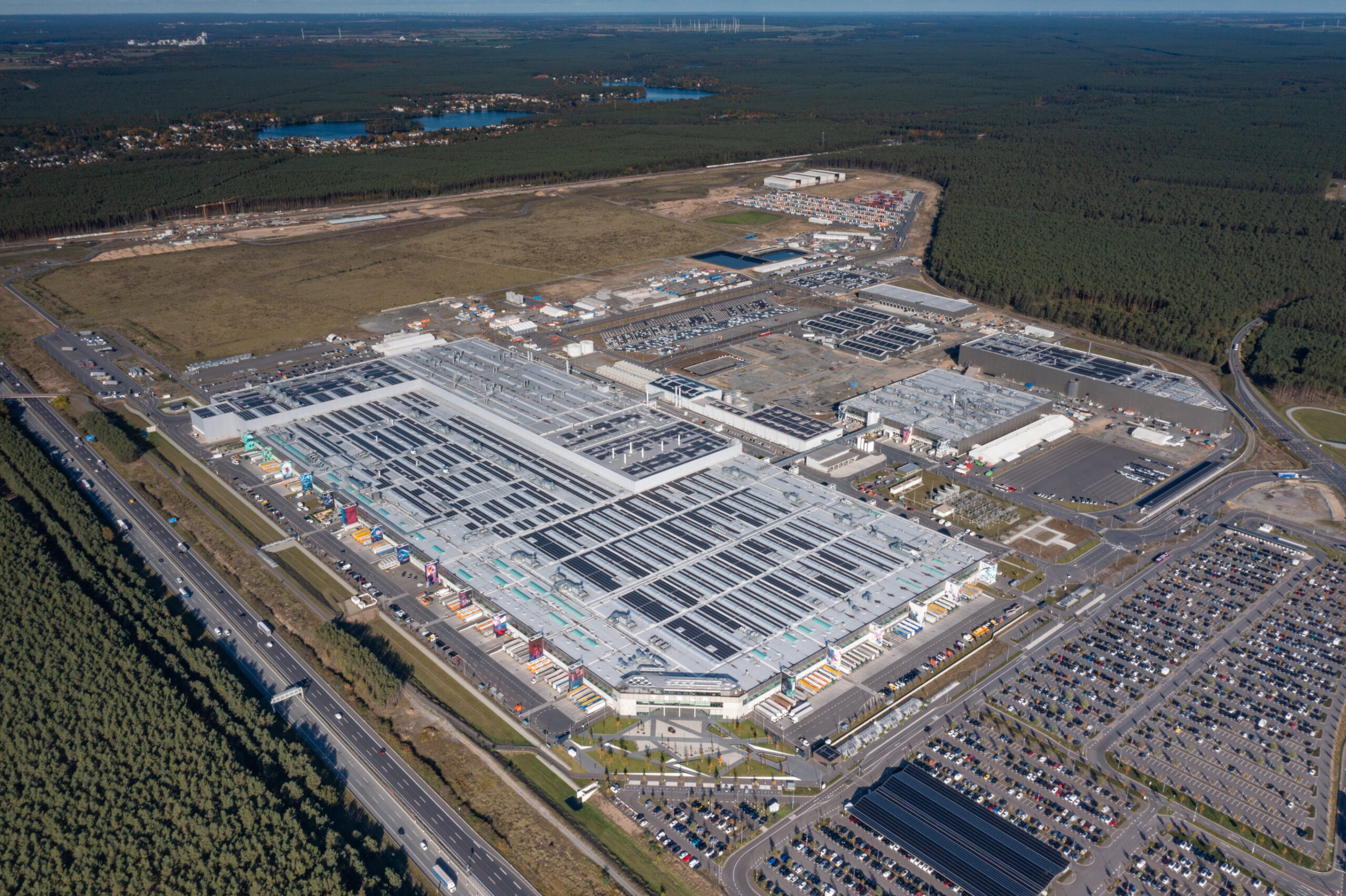
About 35 kilometres southeast of central Berlin, in the municipality of Gruenheide, Tesla put up its first vehicle plant in Europe, and it built it fast. Gigafactory Berlin-Brandenburg opened on March 22, 2022, roughly two years after Tesla signed for the 300-hectare site. The plant assembles the Model Y and produces batteries, packs and powertrains, and it’s become the centre of gravity for Tesla’s European supply chain.
Project Scope
The factory sits on a 300-hectare forested parcel that Tesla acquired in early 2020, and construction ran in parallel with permitting in a way that drew both attention and friction. The company lists the plant’s annual production capacity at more than 375,000 vehicles, and Giga Berlin has now built over 700,000 Model Y units since startup. The site combines stamping, casting, paint, general assembly and battery work under one campus, the vertically integrated layout Tesla uses to compress its build-to-ship cycle.
Employment has climbed past 11,500 workers, with a planned expansion pushing the headcount and output higher. The campus runs on the same megacasting and integrated-line approach Tesla pioneered in Nevada and Texas, scaled to European demand.
Why It Matters
Giga Berlin is the clearest example of how an EV maker compresses a heavy-industrial build that would normally take half a decade. The speed came with controversy over forest clearance and groundwater, and the plant has stayed a lightning rod for debates about how fast green-tech manufacturing should be allowed to move. For the trade, it’s a working case study in vertically integrated factory delivery at continental scale. Compare it with North American EV builds like the Hyundai Metaplant America.
Project Team & Details
| Developer | Tesla, Inc. |
|---|
| Owner / Client | Tesla, Inc. |
|---|
| Architect | Tesla (in-house design) |
|---|
| General Contractor | Tesla, Inc. |
|---|
| Status | Completed |
|---|
| Delivery Method | Design-Build |
|---|
| Funding Source | Private |
|---|