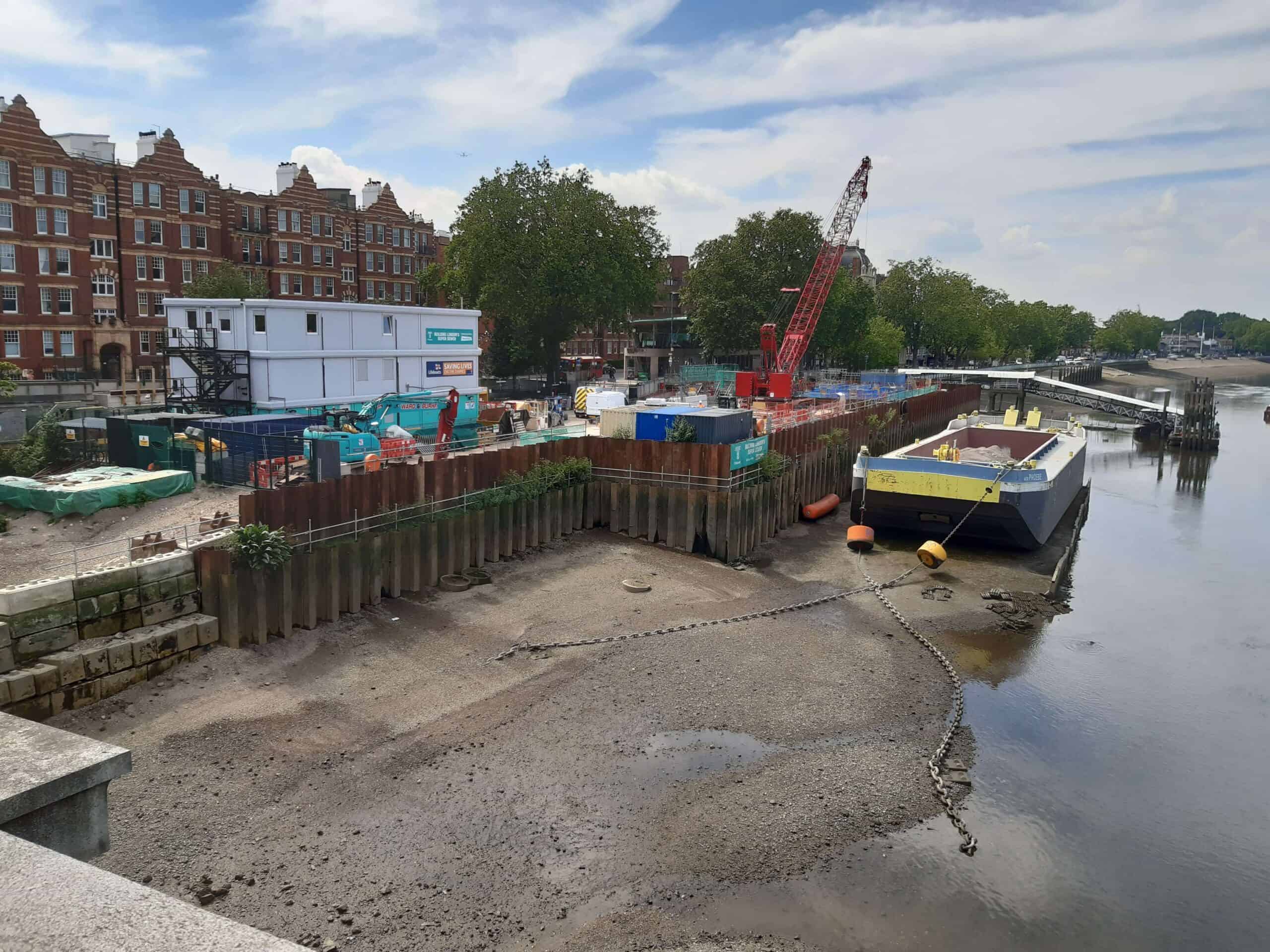
London’s Victorian sewers were built for four million people. The city now holds more than double that, and on a heavy rain the old network simply overflows into the Thames. The Tideway Tunnel is the fix, a 25-kilometer pipe driven deep under the river to catch what the 1860s system can’t.
Project Scope
The tunnel runs from Acton in the west to Abbey Mills in the east, where it ties into the Lee Tunnel and on to Beckton sewage works. It sits up to 65 meters down with an internal diameter around 7.2 meters, intercepting 34 combined sewer overflows along the tidal Thames. Three regional joint ventures built it: a western team of BAM Nuttall, Morgan Sindall and Balfour Beatty; a central team of Ferrovial and Laing O’Rourke; and an eastern team of Costain, VINCI and Bachy Soletanche. Bazalgette Tunnel Limited, named for the engineer of the original sewers, financed and owns the asset.
Why It Matters
The tunnel was structurally completed in 2024 and switched into service across 2024 and 2025, and it should cut sewage spills into the tidal Thames by tens of millions of tons a year. The financing model is the quieter story. Rather than load the cost onto government, Tideway was built by a privately funded, independently regulated company that recovers its money through a small charge on London water bills. It’s a template other countries are watching for big civil works that don’t fit a normal utility, the same long-horizon logic behind base-tunnel megaprojects like the Brenner Base Tunnel.
Project Team & Details
| Developer | Bazalgette Tunnel Limited (Tideway) |
|---|
| Owner / Client | Bazalgette Tunnel Limited |
|---|
| General Contractor | Three regional JVs (BAM Nuttall / Morgan Sindall / Balfour Beatty; Ferrovial / Laing O'Rourke; Costain / VINCI / Bachy Soletanche) |
|---|
| Status | Completed |
|---|
| Delivery Method | Design-Build |
|---|
| Funding Source | Private |
|---|