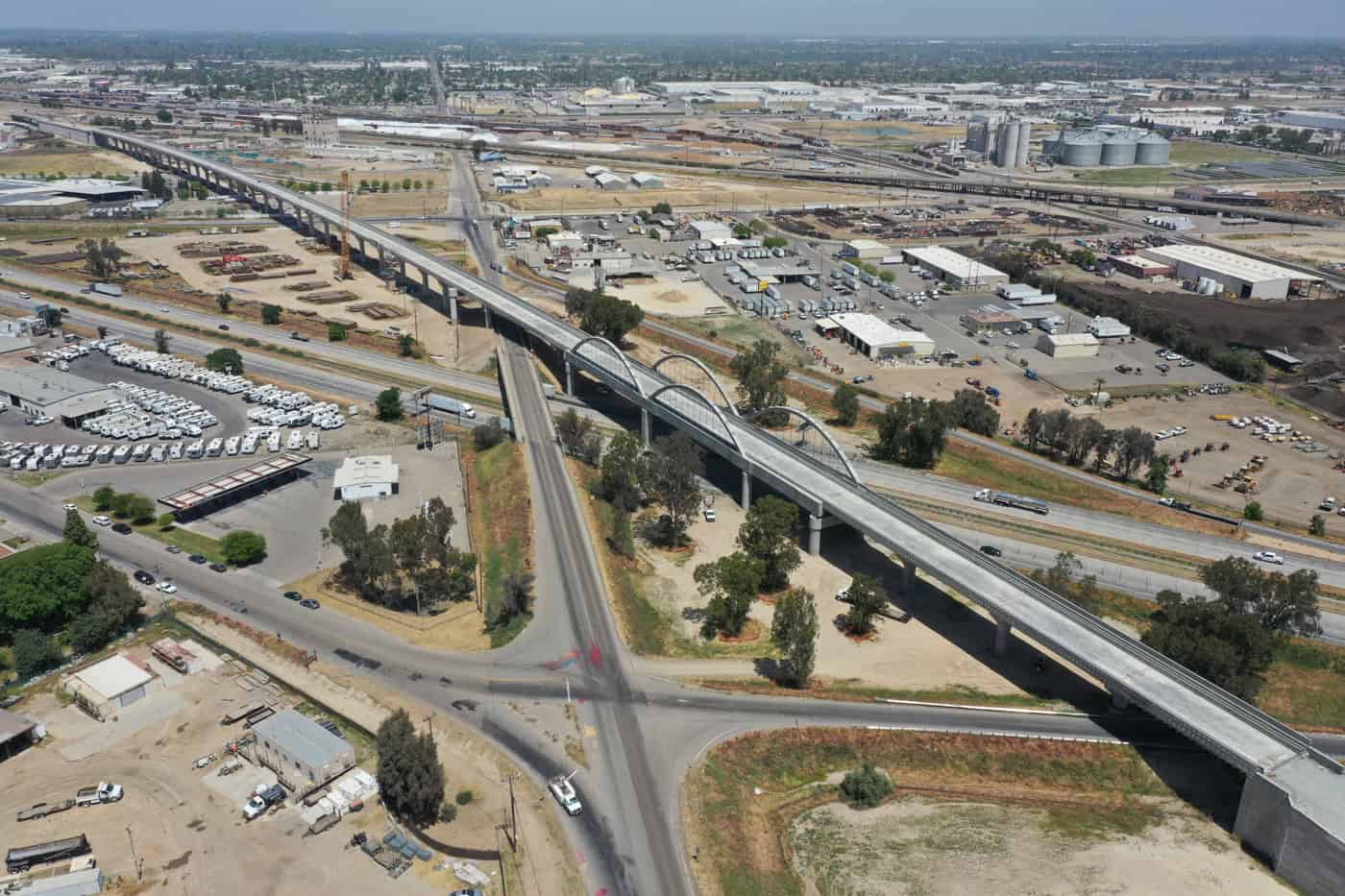
California High-Speed Rail — Merced to Bakersfield Initial Operating Segment
A Fresno Based Infrastructure Construction Project.

default
Business Details
Key information about the business.
Project Details
Website
Social Media
A Bit About California High-Speed Rail — Merced to Bakersfield Initial Operating Segment
A decade in, the U.S.’s only true high-speed rail program has 60 completed major structures, 80-plus miles of finished guideway, and the first track-laying contracts moving toward award. The 171-mile Merced-to-Bakersfield Initial Operating Segment of California High-Speed Rail is the first build phase of an eventual 800-mile network linking San Francisco and Los Angeles, and it’s the largest civil construction program currently active in the United States.
May 2026 closed with the completion of the Road 26 grade separation in Madera County, the 60th major structure on the line. The Authority’s draft 2026 business plan targets completion of all 119 miles of civil construction in the active segment by the end of 2026, with track and systems work running through 2030 and revenue service starting in 2033 on diesel-electric or hybrid trainsets while the full electrified line is completed.
Project Scope
The Merced-Bakersfield segment is split into four construction packages spanning Madera, Fresno, Kings, Tulare, and Kern counties. Tutor Perini / Zachry / Parsons holds Construction Package 1 (Madera to north Fresno). Dragados / Flatiron / Shimmick holds CP2-3 (north Fresno to the Tulare-Kern county line) and the recently re-awarded CP4 (Tulare-Kern to north Bakersfield). A separate Kiewit / Skanska / Granite joint venture is in procurement for the Track and Systems package.
The civil work includes 36 grade separations, 39 viaducts, multiple river crossings, and the relocation of nearly 200 miles of utility infrastructure. The Tuolumne Street Viaduct in Fresno spans the BNSF mainline and downtown Fresno’s street grid in a single 1,600-foot structure. The Hanford and Wasco viaducts cross the BNSF and Union Pacific freight corridors with cast-in-place segmental box girders. The Authority is using a mix of precast and cast-in-place construction depending on right-of-way conditions, with about 60% of the line on at-grade dedicated alignment and the balance on viaduct.
The Southern Railhead Facility in Wasco, completed in February 2026, will be the staging yard for incoming rail and ballast. Procurement for the running rail itself was approved by the Authority Board in late 2025. Track installation is scheduled to begin in 2026 once the first track-and-systems contract closes.
The Authority’s program management is led by WSP USA. HNTB serves as program-wide engineering consultant. Arup is leading station design for the four Central Valley stops at Merced, Madera, Fresno, and Bakersfield. The Hanford and Kings/Tulare stations were dropped in the most recent business plan to manage program cost.
Why It Matters
California High-Speed Rail is the closest thing the U.S. has to a benchmark project for how, and whether, a developed economy with strong land-use protections can deliver true HSR. The project has absorbed roughly $14 billion in funding to date against a forecasted Phase 1 (San Francisco–Anaheim) total in the $135 billion range, and its political durability across three governors and an active opposition coalition has been the program’s most underrated achievement.
The Initial Operating Segment is the part that has to work for the rest of the line to be financeable. It will demonstrate train performance, real construction productivity rates for tunneled mountain crossings (San Jose to Bakersfield includes 36 miles of tunnel through the Tehachapi and Pacheco passes), and the operating economics of running 220-mph service through an agricultural valley. Federal funding for the next segments will depend on what those metrics look like in service.
For the construction industry, CAHSR is the only sustained pipeline of true heavy civil rail work in the western U.S. The contracts that started in 2014 with TPZP’s CP1 award now amount to a 12-year program of design-build civil work that has trained a generation of estimators, structural engineers, and superintendents in viaduct and electrification work. Whether the line is ever extended to Sacramento and San Diego, the workforce and supply chain it built will be the foundation for the next U.S. rail program of similar scale.
Project Team & Details
| Developer | California High-Speed Rail Authority |
|---|---|
| Owner / Client | State of California |
| Architect | HNTB (Lead Design — Program) |
| Consultants | WSP USA (Program Management) HNTB (Engineering Consulting) Arup (Stations) AECOM (Environmental) |
| General Contractor | Tutor Perini / Zachry / Parsons JV (CP1)Dragados / Flatiron / Shimmick JV (CP2-3, CP4)Kiewit / Skanska / Granite JV (Track and Systems) |
| Major Subcontractors | California Rail Builders (Track Materials) Progress Rail (Rail and Turnouts) |
| Status | Under Construction |
| Delivery Method | Design-Build |
| Sustainability Certification | Envision Platinum (targeted) |
| Funding Source | Mixed |
Sorry, no records were found. Please adjust your search criteria and try again.
Sorry, unable to load the Maps API.
California High-Speed Rail — Merced to Bakersfield Initial Operating Segment
A Fresno Based Infrastructure Construction Project.

default
Project Details
Key information about the construction project.
Project Type
Project Value
Project Schedule
Location
Website
Social Media
A Bit About California High-Speed Rail — Merced to Bakersfield Initial Operating Segment
A decade in, the U.S.’s only true high-speed rail program has 60 completed major structures, 80-plus miles of finished guideway, and the first track-laying contracts moving toward award. The 171-mile Merced-to-Bakersfield Initial Operating Segment of California High-Speed Rail is the first build phase of an eventual 800-mile network linking San Francisco and Los Angeles, and it’s the largest civil construction program currently active in the United States.
May 2026 closed with the completion of the Road 26 grade separation in Madera County, the 60th major structure on the line. The Authority’s draft 2026 business plan targets completion of all 119 miles of civil construction in the active segment by the end of 2026, with track and systems work running through 2030 and revenue service starting in 2033 on diesel-electric or hybrid trainsets while the full electrified line is completed.
Project Scope
The Merced-Bakersfield segment is split into four construction packages spanning Madera, Fresno, Kings, Tulare, and Kern counties. Tutor Perini / Zachry / Parsons holds Construction Package 1 (Madera to north Fresno). Dragados / Flatiron / Shimmick holds CP2-3 (north Fresno to the Tulare-Kern county line) and the recently re-awarded CP4 (Tulare-Kern to north Bakersfield). A separate Kiewit / Skanska / Granite joint venture is in procurement for the Track and Systems package.
The civil work includes 36 grade separations, 39 viaducts, multiple river crossings, and the relocation of nearly 200 miles of utility infrastructure. The Tuolumne Street Viaduct in Fresno spans the BNSF mainline and downtown Fresno’s street grid in a single 1,600-foot structure. The Hanford and Wasco viaducts cross the BNSF and Union Pacific freight corridors with cast-in-place segmental box girders. The Authority is using a mix of precast and cast-in-place construction depending on right-of-way conditions, with about 60% of the line on at-grade dedicated alignment and the balance on viaduct.
The Southern Railhead Facility in Wasco, completed in February 2026, will be the staging yard for incoming rail and ballast. Procurement for the running rail itself was approved by the Authority Board in late 2025. Track installation is scheduled to begin in 2026 once the first track-and-systems contract closes.
The Authority’s program management is led by WSP USA. HNTB serves as program-wide engineering consultant. Arup is leading station design for the four Central Valley stops at Merced, Madera, Fresno, and Bakersfield. The Hanford and Kings/Tulare stations were dropped in the most recent business plan to manage program cost.
Why It Matters
California High-Speed Rail is the closest thing the U.S. has to a benchmark project for how, and whether, a developed economy with strong land-use protections can deliver true HSR. The project has absorbed roughly $14 billion in funding to date against a forecasted Phase 1 (San Francisco–Anaheim) total in the $135 billion range, and its political durability across three governors and an active opposition coalition has been the program’s most underrated achievement.
The Initial Operating Segment is the part that has to work for the rest of the line to be financeable. It will demonstrate train performance, real construction productivity rates for tunneled mountain crossings (San Jose to Bakersfield includes 36 miles of tunnel through the Tehachapi and Pacheco passes), and the operating economics of running 220-mph service through an agricultural valley. Federal funding for the next segments will depend on what those metrics look like in service.
For the construction industry, CAHSR is the only sustained pipeline of true heavy civil rail work in the western U.S. The contracts that started in 2014 with TPZP’s CP1 award now amount to a 12-year program of design-build civil work that has trained a generation of estimators, structural engineers, and superintendents in viaduct and electrification work. Whether the line is ever extended to Sacramento and San Diego, the workforce and supply chain it built will be the foundation for the next U.S. rail program of similar scale.
Project Team & Details
| Developer | California High-Speed Rail Authority |
|---|---|
| Owner / Client | State of California |
| Architect | HNTB (Lead Design — Program) |
| Consultants | WSP USA (Program Management) HNTB (Engineering Consulting) Arup (Stations) AECOM (Environmental) |
| General Contractor | Tutor Perini / Zachry / Parsons JV (CP1)Dragados / Flatiron / Shimmick JV (CP2-3, CP4)Kiewit / Skanska / Granite JV (Track and Systems) |
| Major Subcontractors | California Rail Builders (Track Materials) Progress Rail (Rail and Turnouts) |
| Status | Under Construction |
| Delivery Method | Design-Build |
| Sustainability Certification | Envision Platinum (targeted) |
| Funding Source | Mixed |
Sorry, no records were found. Please adjust your search criteria and try again.
Sorry, unable to load the Maps API.
Project Team & Details
| Developer | California High-Speed Rail Authority |
|---|---|
| Owner / Client | State of California |
| Architect | HNTB (Lead Design — Program) |
| Consultants | WSP USA (Program Management) HNTB (Engineering Consulting) Arup (Stations) AECOM (Environmental) |
| General Contractor | Tutor Perini / Zachry / Parsons JV (CP1)Dragados / Flatiron / Shimmick JV (CP2-3, CP4)Kiewit / Skanska / Granite JV (Track and Systems) |
| Major Subcontractors | California Rail Builders (Track Materials) Progress Rail (Rail and Turnouts) |
| Status | Under Construction |
| Delivery Method | Design-Build |
| Sustainability Certification | Envision Platinum (targeted) |
| Funding Source | Mixed |