Danjiang Bridge
A New Taipei City Based Infrastructure Construction Project.

danjiang-bridge-tamsui-river
Business Details
Key information about the business.
Location
Website
Social Media
A Bit About Danjiang Bridge
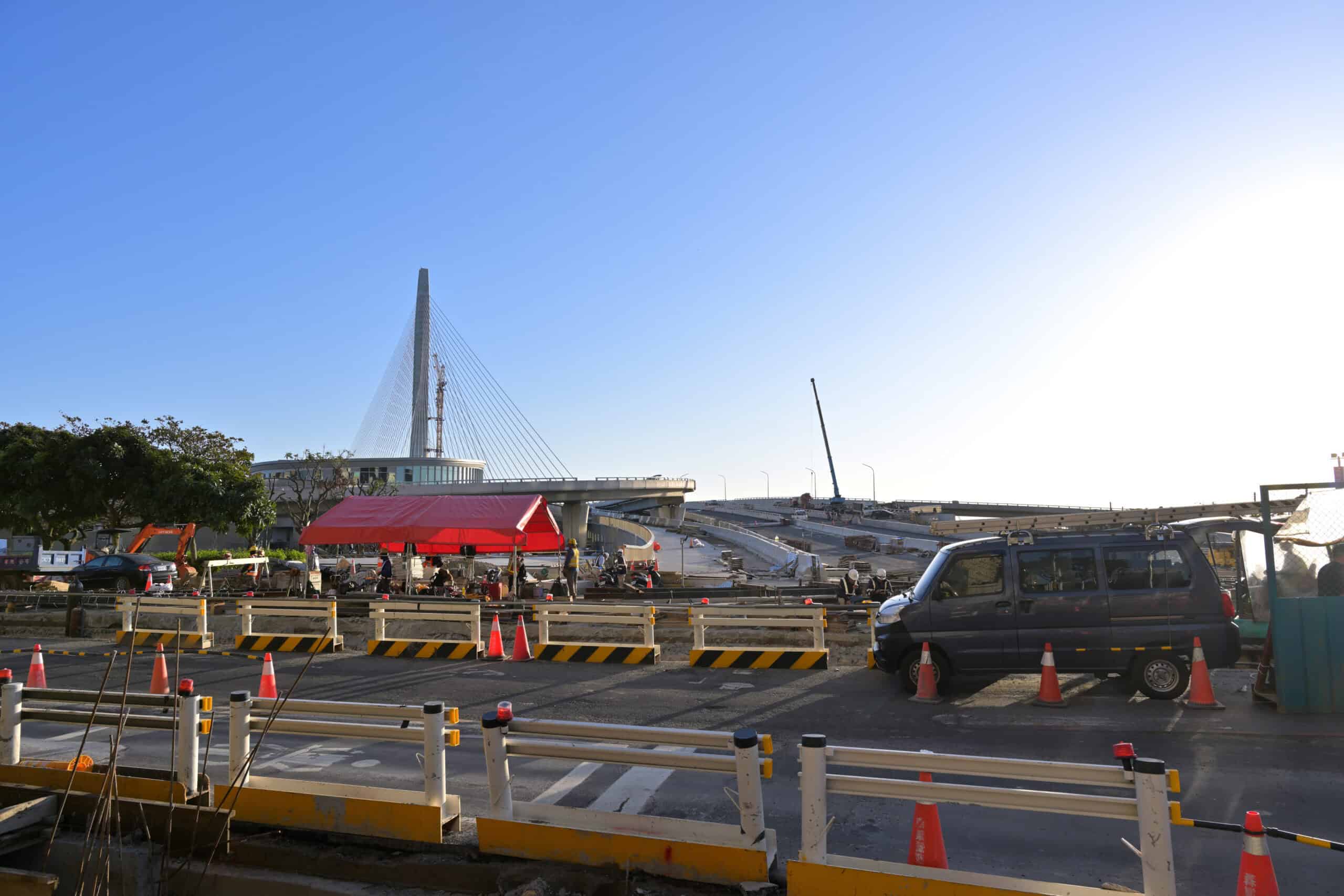
The bridge connects Tamsui and Bali across the Tamsui River estuary in northern Taiwan, and on May 12, 2026 it became the world’s longest single-pylon asymmetric cable-stayed bridge. The 920-meter deck is suspended from a single 200-meter pylon angled toward the east bank, with no second tower to counterbalance it. The geometry is unusual enough that Taiwan’s Directorate General of Highways spent more than five years just on the structural verification before construction started in 2019.
Project Scope
The bridge carries a combined road, light-rail and pedestrian deck across the Tamsui River mouth, linking Highway 2 on the east bank to Highway 15, the West Coast Expressway and the Bali-Xindian Expressway on the west side. The 920-meter main span is supported by 48 stay cables fanning out from a single pylon, with the deck twisting subtly along its length to align rail clearances on one side with road profiles on the other.
Zaha Hadid Architects designed the bridge in 2015 in collaboration with German bridge engineer Leonhardt, Andrä und Partner. Local firm Sinotech Engineering Consultants handled the constructability and code-compliance review. Kung Sing Engineering Corporation, a Taiwanese contractor with prior experience on the Taipei Mass Rapid Transit network, won the construction bid. Total project cost came in at NT$12.49 billion, roughly USD $405 million, on a 68-month construction schedule.
Why It Matters
The bridge’s primary purpose is functional. The Tamsui River estuary previously forced all north-south traffic between Tamsui’s dense neighborhoods and Bali’s port-and-industrial district onto narrow local roads, with peak-hour delays that ran 45 to 60 minutes. Danjiang gives that traffic a four-minute alternative, and it integrates a future Taipei MRT light-rail extension that will run on a dedicated deck level.
Structurally, the project is the highest-profile asymmetric cable-stayed bridge in service. Asymmetric stay geometry is engineering-expensive, and most owners pick a symmetrical layout for cost reasons. The Taiwan Highway authority absorbed the premium here in exchange for a clear sightline up the river toward Yangmingshan and for a bridge silhouette that has already become the visual identifier for the Tamsui waterfront. It is also one of the last major commissions Zaha Hadid completed in person before her death in 2016, with her studio shepherding construction documentation and site oversight through to opening day.
Project Team & Details
| Developer | Directorate General of Highways (MOTC) |
|---|---|
| Owner / Client | Government of Taiwan |
| Architect | Zaha Hadid Architects |
| Consultants | Leonhardt, Andrä und Partner (Bridge Engineering) Sinotech Engineering Consultants (Local Engineering) |
| General Contractor | Kung Sing Engineering Corporation |
| Status | Completed |
| Delivery Method | Design-Bid-Build |
| Funding Source | Public (Federal) |
Sorry, no records were found. Please adjust your search criteria and try again.
Sorry, unable to load the Maps API.
Danjiang Bridge
A New Taipei City Based Infrastructure Construction Project.

danjiang-bridge-tamsui-river
Project Details
Key information about the construction project.
Project Type
Project Value
Project Schedule
Location
Website
Social Media
A Bit About Danjiang Bridge
The bridge connects Tamsui and Bali across the Tamsui River estuary in northern Taiwan, and on May 12, 2026 it became the world’s longest single-pylon asymmetric cable-stayed bridge. The 920-meter deck is suspended from a single 200-meter pylon angled toward the east bank, with no second tower to counterbalance it. The geometry is unusual enough that Taiwan’s Directorate General of Highways spent more than five years just on the structural verification before construction started in 2019.
Project Scope
The bridge carries a combined road, light-rail and pedestrian deck across the Tamsui River mouth, linking Highway 2 on the east bank to Highway 15, the West Coast Expressway and the Bali-Xindian Expressway on the west side. The 920-meter main span is supported by 48 stay cables fanning out from a single pylon, with the deck twisting subtly along its length to align rail clearances on one side with road profiles on the other.
Zaha Hadid Architects designed the bridge in 2015 in collaboration with German bridge engineer Leonhardt, Andrä und Partner. Local firm Sinotech Engineering Consultants handled the constructability and code-compliance review. Kung Sing Engineering Corporation, a Taiwanese contractor with prior experience on the Taipei Mass Rapid Transit network, won the construction bid. Total project cost came in at NT$12.49 billion, roughly USD $405 million, on a 68-month construction schedule.
Why It Matters
The bridge’s primary purpose is functional. The Tamsui River estuary previously forced all north-south traffic between Tamsui’s dense neighborhoods and Bali’s port-and-industrial district onto narrow local roads, with peak-hour delays that ran 45 to 60 minutes. Danjiang gives that traffic a four-minute alternative, and it integrates a future Taipei MRT light-rail extension that will run on a dedicated deck level.
Structurally, the project is the highest-profile asymmetric cable-stayed bridge in service. Asymmetric stay geometry is engineering-expensive, and most owners pick a symmetrical layout for cost reasons. The Taiwan Highway authority absorbed the premium here in exchange for a clear sightline up the river toward Yangmingshan and for a bridge silhouette that has already become the visual identifier for the Tamsui waterfront. It is also one of the last major commissions Zaha Hadid completed in person before her death in 2016, with her studio shepherding construction documentation and site oversight through to opening day.
Project Team & Details
| Developer | Directorate General of Highways (MOTC) |
|---|---|
| Owner / Client | Government of Taiwan |
| Architect | Zaha Hadid Architects |
| Consultants | Leonhardt, Andrä und Partner (Bridge Engineering) Sinotech Engineering Consultants (Local Engineering) |
| General Contractor | Kung Sing Engineering Corporation |
| Status | Completed |
| Delivery Method | Design-Bid-Build |
| Funding Source | Public (Federal) |
Sorry, no records were found. Please adjust your search criteria and try again.
Sorry, unable to load the Maps API.
Project Team & Details
| Developer | Directorate General of Highways (MOTC) |
|---|---|
| Owner / Client | Government of Taiwan |
| Architect | Zaha Hadid Architects |
| Consultants | Leonhardt, Andrä und Partner (Bridge Engineering) Sinotech Engineering Consultants (Local Engineering) |
| General Contractor | Kung Sing Engineering Corporation |
| Status | Completed |
| Delivery Method | Design-Bid-Build |
| Funding Source | Public (Federal) |